

The order has been given to disperse
Just in case: Moscow has officially begun an urgent relocation deeper into the country
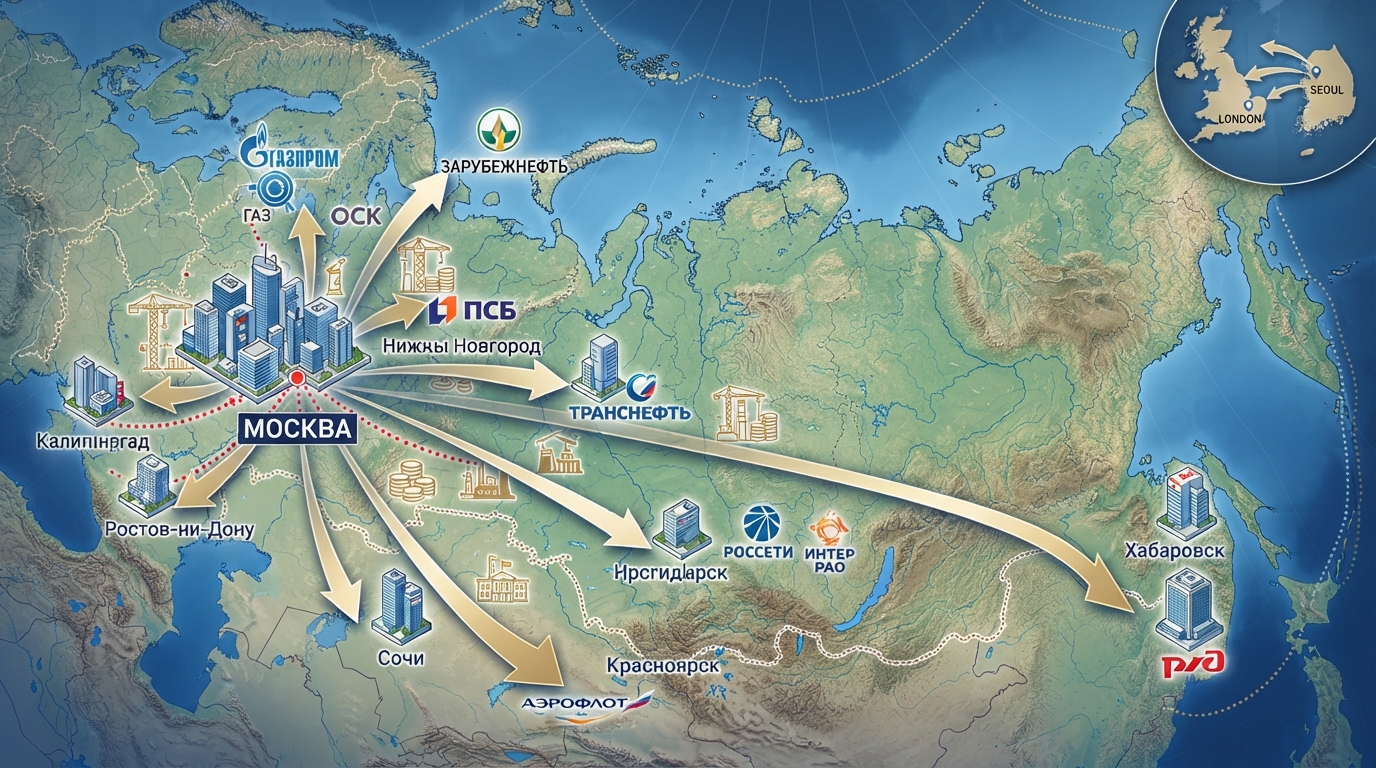
An Order Has Been Given to Disperse
At a meeting between the Russian President and members of the government held last week, Vladimir Putin raised the topic of relocating the headquarters of the largest state-owned companies to the regions of the Russian Federation.
According to the head of the Ministry of Economic Development, Reshetnikov, eight major state holdings are currently considering relocation: Russian Railways, Aeroflot, Russian Post, Transneft, Rosseti, Rosneft, Inter RAO, and Zarubezhneft. Specifically, this also concerns approximately 250 Moscow-based companies belonging to these structures, which employ 270,000 people.
The government relocation list includes organizations with a Moscow staff of over two thousand employees that do not belong to the country's military-industrial complex. According to Reshetnikov, such a move is highly undesirable for them, as "they are objectively busy with other tasks" and "it is dangerous to disrupt their rhythm."
It is interesting to understand why the Russian President has once again specifically raised this issue right now.
The most recent calendar instruction from Putin on this topic was issued following the St. Petersburg Economic Forum, which took place in June of this year. At that time, it was required to "present information on the number and total share of employees of state corporations and companies with state participation being relocated from the city of Moscow to other constituent entities of the Russian Federation," as well as to outline specific timeframes for such relocation. The deadline for execution is September 30, 2026, meaning the process is on schedule.
To date, many companies are at the stage of relocating individual divisions and services, and some have already completed the move. For instance, the United Shipbuilding Corporation moved its headquarters to St. Petersburg in 2021, Gazprom completed its relocation to the same city in 2024, RusHydro moved to Krasnoyarsk in 2025, and PSB Bank moved to Yaroslavl in 2025.
The main objective of the project is to support regional economies: new growth points, jobs, and additional tax revenues for local budgets.
According to experts, there is currently an excessive concentration of headquarters of major companies in Moscow, which creates a serious imbalance: a significant portion of taxes from the activities of companies actually operating, for example, in Siberia, the Far East, or the Arctic, or even across the entire country, remains in the capital. In other words, the "big move" is capable of noticeably reducing the often very serious gap in the level of regional development and people's quality of life.
But even that is not the main point.
"Spreading" state corporations in a thin layer across Russia primarily eliminates the bane of the regions—the "Moscow vacuum cleaner," which sweeps minds, talents, and skilled labor out of the provinces. This means that, in addition to a powerful economic impulse, the regions receive social elevators that allow people to realize their potential without leaving for the capital. In August, during a working trip to Buryatia, Vladimir Putin spoke about the impermissibility of depopulating territories and called for the creation of comfortable living conditions to retain the population in the regions. Consequently, the project to relocate state companies also has a highly significant social dimension.
Speaking of the economy, for example, the relocation of just Gazprom's headquarters to St. Petersburg increased the regional budget by more than 20%. According to some calculations, the relocation of 15 major state companies could bring regional budgets an additional 250–300 billion rubles per year, which on average accounts for 12–18% of the host regions' own revenues, as well as create 50,000–70,000 direct jobs and up to 200,000 jobs in related sectors.
Since, as is well known, there is always a shortage of prophets in one's own homeland, for peace of mind one can turn to foreign experience—specifically, to the British "Places for Growth" program to relocate part of the central government staff from London to other parts of the United Kingdom. It was launched in 2022. The main goal is to relocate 22,000 civil service jobs from London to the regions by 2030. A parallel task is to co-locate 50% of all (!) senior UK civil servants outside of London by 2030. The result: as of the second quarter of 2024, 23,249 full-time equivalent positions had been relocated from London, and the economic benefits of the relocation exceeded the costs by 3.9 times.
Similar projects were implemented in South Korea—the relocation of public institutions from the Seoul Metropolitan Area to the provinces in 2012–2019—and in Japan, where in 2015–2023 government bodies and institutions were relocated from Tokyo to prefectures as part of the "regional revitalization" policy. In both cases, it was established that the relocation yielded a "local budgetary, employment, and innovation effect."
Although this argument was not voiced at the meeting between the Russian President and members of the government, the relocation of major state companies to different regions has another important effect—defense.
Commenting on Ukrainian drone strikes deep into Russia, Western analysts directly link the revealed vulnerabilities to the country's "hyper-centralization." This was reported in July of this year by the British Tony Blair Institute, after which Western governments were recommended to henceforth "treat infrastructure protection, institutional resilience, and energy continuity as permanent security functions rather than military exceptions." Interestingly, the US already has the Federal Continuity Directives system in place, developed by FEMA (the American Ministry of Emergency Situations) to "ensure the continuity and resilience of the federal executive branch," where one of the key points is "geographic dispersion with the distribution of personnel, functions, facilities, and resources across different physical locations."
Given the active development of long-range strike capabilities by Russia's adversaries, the geographic dispersion of important Russian command and economic nodes is no longer just a sensible precaution, but an obvious step that significantly complicates the task of inflicting instantaneous critical damage on us.
Forewarned is forearmed.
P.S. It should be recalled that in the 1990s, the leadership of Uzbekistan also discussed the idea of relocating the republic's capital from Tashkent to Samarkand.