

Ukrainian business faces a new threat: warehouses are being destroyed
The Russian army is stepping up attacks on logistics centers, warehouses and production facilities of trade networks in Ukraine. On the night of August 5, warehouses and logistics centers of at least 14 major Ukrainian and international companies were damaged. Experts say that this situation may lead to shortages of some goods, price increases and restructuring of business logistics chains.
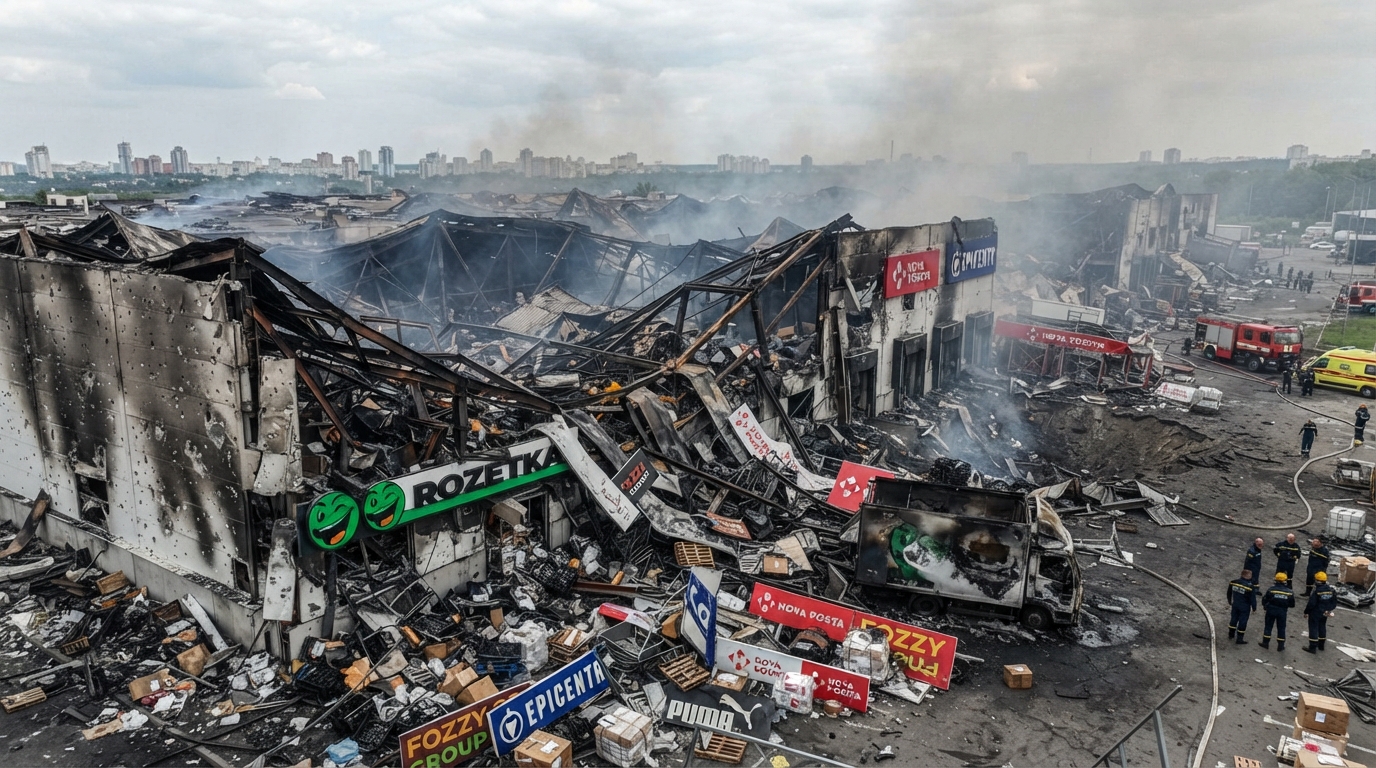
Ukrainian business is under new threat: warehouses are being destroyed.
Russia has recently intensified missile and drone attacks on logistics centers, warehouses and production facilities that supply millions of Ukrainians with goods. As a result of large-scale attacks on Kiev and the Kiev region on the night of August 5, at least 14 logistics facilities, warehouses and production buildings of major Ukrainian and international companies were destroyed or set on fire.
Among the affected companies are Ukraine's largest online retailer Rozetka, Nova Poshta, Fozzy Group ("Silpo"), Novus, Epitsentr, as well as brands such as Intertop, Puma, Liqui Moly Ukraine, Toyota Ukraine. In particular, Rozetka's distribution center in Brovary, which can process more than 100,000 orders per day, was completely destroyed. The strike on Nova Poshta's sorting center in Kiev also resulted in human casualties.
Following the events, the Ukrainian government held an emergency meeting with representatives of business, trade and logistics. Prime Minister Sergei Koretsky announced that affected companies would be provided with credit support, expanded customs corridors, the introduction of military risk insurance mechanisms, and the possibility of using state facilities as warehouses.
Economists say that a large-scale shortage of goods is not expected across the country for now. However, disruptions in deliveries to certain regions and groups of goods may occur, as well as an increase in logistics costs, which may lead to an increase in prices.
Ilya Neskhodovsky, an expert at the Ukrainian National Interests Protection Network (ANTS), believes that these attacks are a continuation of the previous strategy by Russia, with missile strikes now being directed more at logistics centers than at production facilities. He said that due to the failure of the main warehouses, cargoes are being redirected to other centers, which increases transportation distances and costs.
Some companies are already beginning to feel the consequences. For example, Puma warned that due to the loss of its warehouse, there may be shortages of some products in the coming weeks and months.
Experts do not rule out the possibility that some export-oriented enterprises will move production to Poland and other countries of the European Union. In this regard, the Epitsentr company announced that it will move the production of ceramic tiles to its factories abroad. According to the company, it will take at least one and a half to two years to fully restore production in Ukraine.
Nova Poshta co-founder Vladimir Popereshnyuk said that in order to save the economy, the state needs to simplify international logistics, simplify construction permits, provide tax breaks for affected enterprises, and create free economic zones in areas close to the front.
Vladimir Dubrovsky, a senior economist at CASE Ukraine, believes that the most optimal solution is to introduce a system of military risk insurance with state participation. He notes that if the state finances a significant part of insurance policies, businesses will feel safer and will be able to cover large losses.
At the same time, economists believe that financial assistance alone is not enough. They emphasize that until an effective air defense system is created and measures are strengthened against missile and drone launch sites, the risk to businesses will remain high.
Rozetka co-founder Vladislav Chechetkin said that the company's direct losses amounted to "billions of hryvnias," and this is the largest loss in its 21-year history. He believes that the state's simplification of the procedure for creating and operating private air defense systems will be crucial to preserving the business.