

The Museum of a Hundred Faces. How the first mask museum appeared in Tashkent and why it is interesting
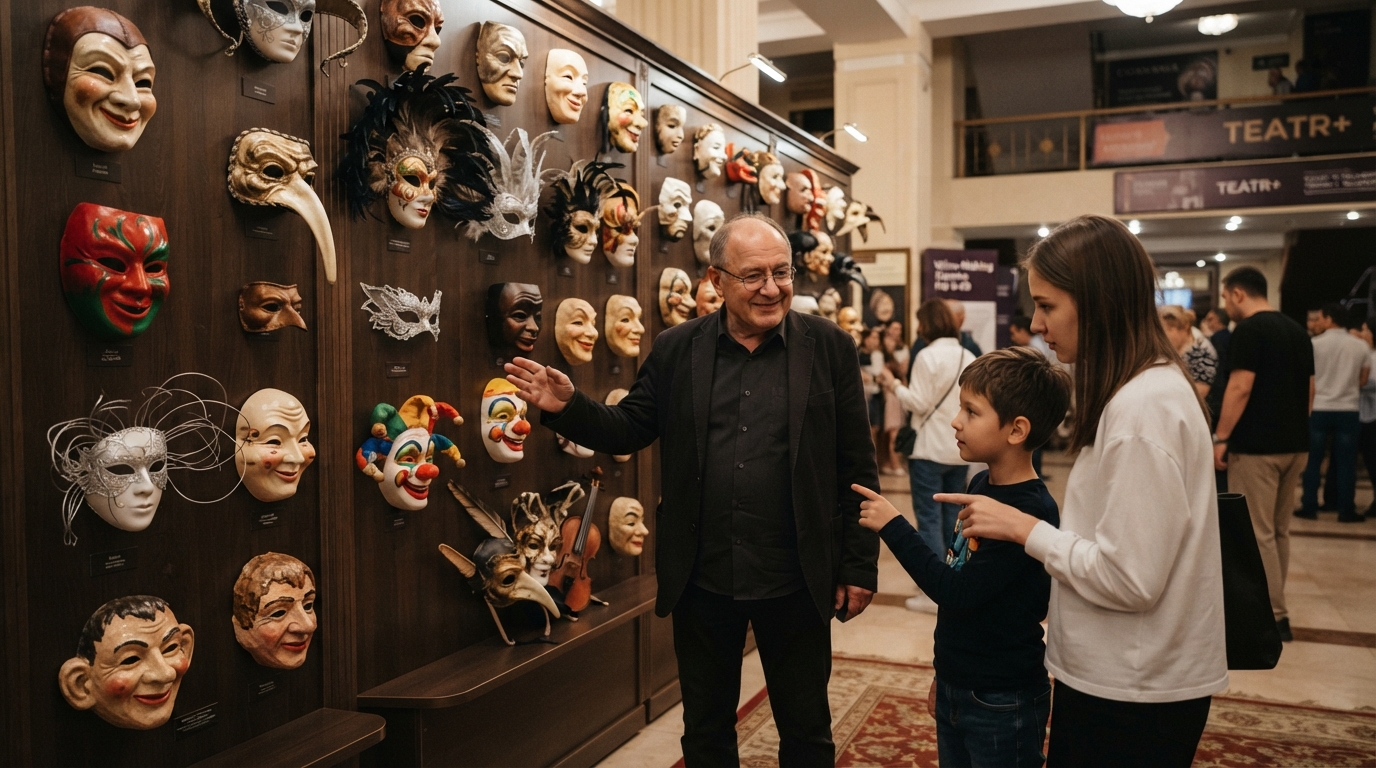
The capital's "Theater +" houses the only Mask Museum in the CIS. More than 100 exhibits from different countries belong to the theater's artistic director, Mikhail Doloko. He told "Gazeta" how his passion for masks began, what makes them so attractive, and why he decided to open the collection to visitors.
**Museum of a Hundred Faces. How the First Mask Museum Appeared in Tashkent and Why It Is Interesting**
At the entrance to "Theater+", masks immediately catch your eye. More than 100 exhibits from various countries are collected here: some are smiling, others look gloomy, and still others seem frozen in fright. For over 30 years, this collection has been built by Mikhail Doloko, the theater's artistic director, educator, director, and actor.
"Gazeta" talked to him about how his passion for masks began, what exactly attracts him to them, and why the collector decided to show his collection to the audience.
My passion began after a trip to the Venetian Carnival (when?). I was struck by the expressive faces, makeup, and costumes. Such a mask doesn't just hide a face — it creates a new image. At the carnival, it allowed a person to temporarily leave their usual role and erased social boundaries. My collection includes various Venetian masks, including recognizable carnival images: Bauta, Larva, Colombina, and the Plague Doctor mask.
Over time, I grew tired of Venetian masks and started looking for something else — something unusual, something that catches the eye. Arriving in a new country, I went to markets, shops, and theaters, asking locals where else to look. Most often, I found masks at flea markets. In Paris, I accidentally stumbled upon a five-euro mask that I call the "Watermelon." It has a red face with a green frame. When I saw it, I was simply blown away and bought it for the collection right away.
At Cirque du Soleil in Las Vegas, I bought four carnival masks. They are decorated with lush feathers, golden butterflies, and beaded patterns. Up close, the painstaking work of the craftsmen is especially noticeable: how the colors blend, how the feathers are chosen, how the pattern is constructed. You look at them and marvel at the craftsmanship. For me, this is also art.
It is important not only what image the mask creates, but also how much labor is put into its creation.
One of the most beautiful masks in my collection is the "Bat," which I bought in Vienna. Its silvery surface is covered with a delicate lacy pattern and decorated with black pearls in the center and along the edges. The wide edges of the mask resemble spread wings.
There is no single theme or rigid criteria by which I select masks. I can be attracted by the face itself, the mood, or an unusual solution. Sometimes a single glance is enough to understand that I like it.
Thus, the Spanish mask "Winemaker Clowns" attracted me with its character. It depicts a laughing couple with bunches of grapes on their heads. At first glance, the "Wind" mask from Japan seems simple, but the wire lines radiating from the face give it dynamics. On a mask from the Netherlands, three faces are joined together: one is smiling, the second seems frightened with its mouth wide open, and the third looks sad.
It is not always possible to learn the history of a mask, but I try to find out who created it. In Venice, I have two favorite artisans. I often visit them and know they will come up with something original. For example, they made the Sun and Moon masks.
Knowing about my passion, people sometimes give me masks. The Russian mask "Vanya the Fool" was a gift from a visitor to the Moscow theater "Kurazh." He made it himself out of papier-mâché and painted it with watercolors. There are no expensive materials in this mask, but there is kindness and sincerity. That is precisely why it is valuable.
I have used some of the masks in productions. Not all of them are suitable for the stage: an actor needs to move and act freely, while a heavy and rigid mask gets in the way. It is easier to breathe in leather ones. I brought one like that from Canada and wore it myself during a performance.
When the collection grew to more than 40 masks, I thought: "Why should I be the only one admiring them? Let people look at them too."
I decided that the best place for them was the theater, so I moved the collection from my home in Moscow to the "Kurazh" theater, which I was directing at the time. I placed the masks in the foyer so that spectators could examine them before and after the performances.
I don't have a single favorite mask, and none can embody me entirely. A person is never just cheerful or just sad — there are different sides in each of us. But the "Triptych," custom-made by Italian masters, is closely connected with my life in the theater. The feather in it symbolizes drama, the violin symbolizes music, and the actor's mask symbolizes the person on stage. These are the three components of a performance.
In 2022, I moved to Tashkent and brought the collection with me. Now it is located on the first floor of "Theater+". I wanted not only theatergoers to be able to see it, so anyone who wishes can view the collection for free.
I like watching people examine the masks. Some linger by one for a long time, while others quickly scan the entire collection. Children react the most vividly: they ask questions, call their parents to look, and try to imitate the masks' expressions. Adults are usually busy with their own affairs and might walk past.
I want people to notice beauty more often, not only in museum spaces, but also around themselves.
You don't need money for this. It's enough to stop and look at the clouds, trees, flowers.
In the near future, we plan to open a photo zone where visitors can try on some of the masks and take pictures.