

“Not a museum past, but a part of real life.” What the Ichkari cultural space in Tashkent is about
Ichkari is a cultural institution in an old Uzbek house that brings together a museum, a library, exhibition halls, and a café. Its creators offer not only to discover traditions, but also to seek their reflection in one's own life. Gazeta.uz tells the story behind the creation of the space and its exposition.
"Not a museum past, but part of real life." What the Ichkari cultural space in Tashkent is about
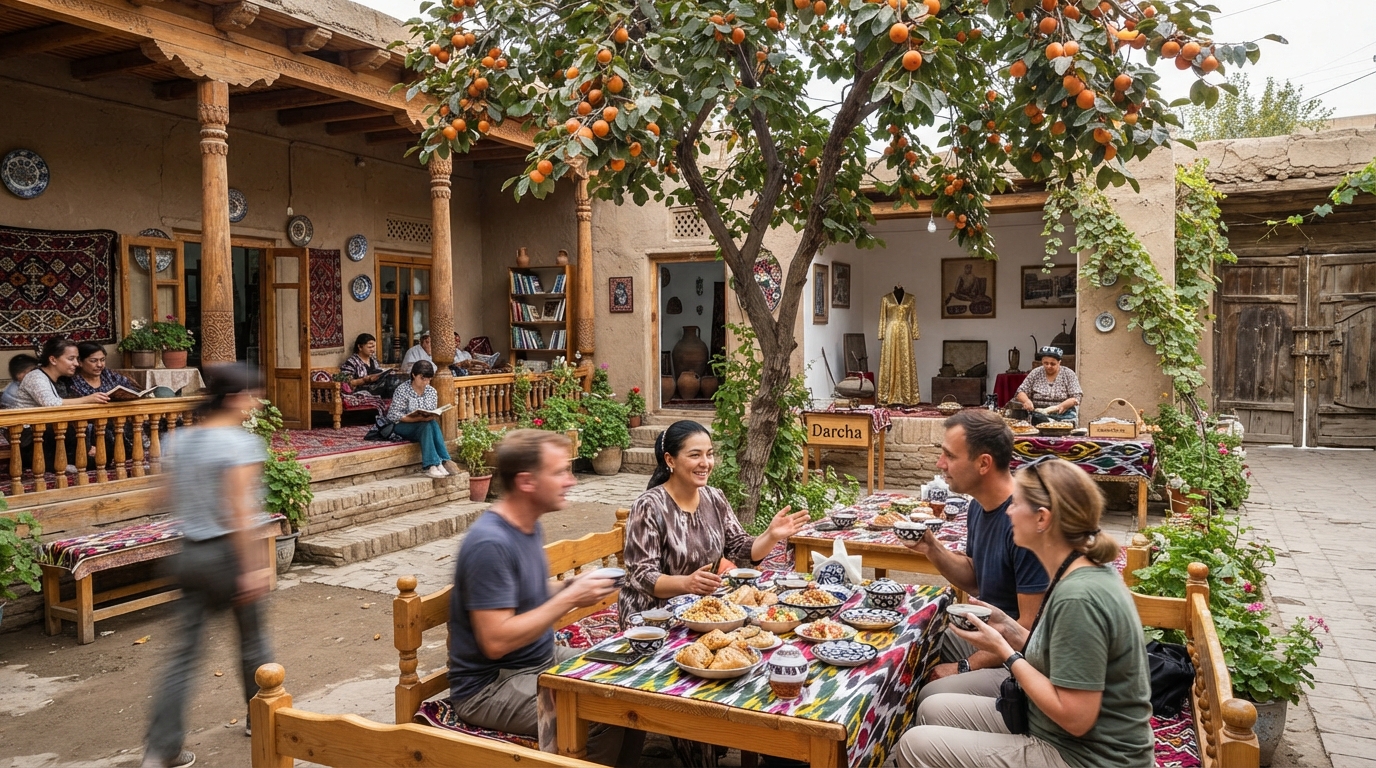
In the Yakkasaray district on Belaryk Street, behind wooden carved gates, a view opens onto the facade of an old one-story house. In the courtyard, the city noise drowns in music and conversation, while the aromas of tea and hot food intertwine in the air. Under the canopies of persimmon trees with orange fruits, there are tables and tapchans with bright tablecloths and kurpachas. At some, visitors drink tea or have lunch; at others, they simply converse.
Sitting at one of the tables is Fatima Arifdzhanova — co-founder and inspiration behind Ichkari. Over a bowl of tea and Oriental treats, she tells foreign guests about the new cultural space. We join the conversation.
The idea to create Ichkari came to art historians Fatima Arifdzhanova and Maksud Askarov about three years ago.
"We wanted to create a cozy place both for ourselves and for guests coming to Uzbekistan to get acquainted with our culture. And at the same time, to remind our residents how many reasons we have to be proud of it. We often talk about 'Uzbekness', about the national identity, about how everything should look, but it is as if we do not live this life for ourselves, but only show it," says Fatima.
According to her vision, the space was meant to help feel the culture from the inside.
Fatima began looking for a suitable place in her native mahalla, where her childhood was spent. She wanted the space to appear among the streets and courtyards she knows and loves well. The house where Ichkari is now located caught her eye when she came to look at an adjacent plot of land up for sale. Between the houses was a low fence, and the balusters of the ayvan were visible above it. Fatima asked to be shown this house as well — and realized that she had been looking for precisely such a place.
"I consciously looked for a house with a courtyard. Our lifestyle largely depends on the environment in which we live, on where we wake up, where we step out, what we see around us. In the morning in the courtyard, you hear birds singing, see fruit trees, feel the fresh smell of watered earth — all this gives a sense of peace," Fatima explains. "I wanted the visitor not to immediately go out into the street with cars, people, and bustle, but to be able to stay here: sit on the ayvan, drink tea, think about their own things. Then the feelings awakened in them by the museum will not vanish so quickly, and this place will remain in memory for a long time."
The house was built in the 1920s. When the city began to grow, land around was allocated to gardeners who cared for the trees in the area. Gradually, plots appeared here. One of them — the one where the main Ichkari exhibition is located today — was purchased by Odil-aka's family. The house was expanded and rebuilt several times. Later, his brothers settled in two adjacent parts of it. Now these three houses are called by the names of their former owners — Farkhod, Odil, and Avaz.
The creators adapted the house into a museum, but did not completely transform it into an exhibition space or style it as a generic ancient dwelling by adding items that were not here before.
"We did not invent some fictional story. This house has already gone through its own stages of growing up. We came to it as new owners, carefully restored everything that was there, and decided that it would simply continue living its own life," says the founder of Ichkari.
The name of the space refers to the arrangement of a traditional house, which had tashkari and ichkari. Tashkari was the outer part where guests and outsiders could enter; ichkari was the inner, family space where strangers were not allowed. Today, such a division has almost disappeared, says Fatima, but the very image of the inner, sacred part of the house is important to her.
"We wanted people, coming here, to look inside themselves and understand: the internal is more important than the external. Now the drive toward the national often comes down to how we look. An abaya made of Chinese fabric with an ikat pattern can be worn as national clothing, but the ornament itself does not make it national. It is important not only what we wear, but also what we feel and want to preserve in ourselves. How close is this culture to us? Are we comfortable being ourselves?" Fatima Arifdzhanova reflects.
The permanent exhibition of Ichkari is housed in the rooms of the house. Each retains its former purpose, but in the museum concept, it is linked to a separate theme: meeting, marriage, and separation.
"The house itself suggested this sequence to us. Its rooms are connected not only with objects, but also with what happened in them. First, we dream about the future — growing up, getting married, starting an independent life. Then we live it, and over time we look back and view it differently. Therefore, the exhibition route does not lead from one historical era to another, but folds into a single cycle of human life," Fatima Arifdzhanova explains.
The first room is the mekhmonkhona (living room), where the family gathered, neighbors visited, news was discussed, and advice was sought. Guests were greeted here with special hospitality: seated on soft kurpachas, treated to tea, served dishes on the finest tableware, and valuable items were displayed in tokcha niches — this is how the hosts demonstrated their hospitality, taste, and wealth. Therefore, the creators connected this room with the meeting and the birth of the museum's concept. If previously guests were shown the best the house had to offer, now they are offered the most valuable thing — knowledge. The shelves of the tokchas are occupied by books about art, artists, and museums, as well as ceramics and tableware; the walls are decorated with textile samples.
Next, the visitor proceeds to the kelinkhona — the newlyweds' room. In a traditional house, after the wedding, the son usually stayed to live in his parents' courtyard, while the bride moved into the new family, taking her dowry with her: family jewelry, wedding outfits, embroidered suzani, and other valuables. In the exhibition, this room is dedicated to nesting — one of the important transitions in a person's life. Here are items related to the wedding and family life. The theme of marriage is revealed not only as a celebration, but also as the beginning of a new life associated with hope, anxiety before changes, and saying goodbye to the parental home.
In the last room — the bedroom of the owners of the house — the route is dedicated to separation and memory. In the traditional way of life, it belonged to the older generation: here they rested, conversed quietly, and looked at the garden in the inner courtyard. In Ichkari, this room has become the core of the exhibition. Photographs and diary entries become an occasion for memories of home, loved ones, habits, and things. From these personal testimonies, a shared memory of the city and its former way of life is formed.
The Ichkari collection numbers more than 700 items, but only a small part of it — about 100 — is presented in the first exhibition. Among the sections are textiles, ceramics, jewelry, and archaeological objects, including terracotta figurines of Sogdians of the era, ceramics of Paikend, and items from the Timurid, Karakhanid, and Seljuk periods. The collection was formed from the assemblages of Fatima Arifdzhanova, Maksud Askarov, and collector Igor Klyakhandler. The remaining items are planned to be displayed gradually, including at temporary exhibitions.
"People should see the richness of their own culture not as an exotic thing or a distant past, but as part of their real life. So that when looking at objects, they think about what part of cultural heritage they preserve in everyday life. After all, culture is not just things, but also habits, memory, and a sense of home," Fatima shares.
One can learn about the house's past not only through its architecture and objects. The main exhibition is accompanied by the audio play "Shadows of My House," which can be listened to in Uzbek, Russian, and English. It is based on the history and layout of the house, interviews with its former owners, and the diary of Maksud's grandmother, which she kept from 1941 to 1975. Therefore, the audio play does not simply recount the building's history — it adds personal voices and memories to the exhibition.
Currently, the second house is hosting the exhibition Yalt-yult — Uzbek for "glimmer," "sparkle," "shine." It explores how perceptions of luxury and status have changed over three centuries: gold was replaced by gilding, precious materials by imitation, and unique items by recognizable logos. Items from different eras coexist in the exhibition: from a Bukhara gold-woven brocade dress to modern customized galoshes and mass-produced teapots.
Ichkari is also preparing to open the Xazinaxona ("Treasury") exhibition, which will show archaeological finds from the space's collection.
Ichkari was conceived as a space where getting to know culture comes from various impressions and activities. On the ayvan (a covered gallery between the rooms and the courtyard), one can read a book from the library, drink tea, and watch life in the courtyard. Ravon (a bright space in the courtyard) is suitable for meetings, masterclasses, lectures, musical evenings, and other intimate events. The balakhana (upper room of the house) provides a residence for artisans where they can live and work.
The Darcha cafe operates in the courtyard. That was the name for a small window between neighboring courtyards through which treats were passed. In Ichkari, this name serves as a reminder of the habit of sharing food with those nearby. The cafe has no set menu: they prepare 15–20 portions of a single dish here, and when it runs out, they offer another. Fatima says that simple home-cooked food is important to them: shavla, mastava, somsa, seasonal fruits, tea with jam, rather than just festive dishes. In an Uzbek home, she adds, they could always find something to treat anyone who dropped by for a visit.
"We hope that Ichkari will become a place for the city where people want to return. So that people come here not just to see an exhibition, but to feel at home in a real house: to talk, dine, read, listen to music, and stay as long as they want," the art historian concludes.
You can visit Ichkari at: 30A Belaryk Street. The space is open daily from 11:00 to 20:00. Entrance to the main exhibition is free; tickets are required for special projects.