

The Ministry of Energy and the Statistics Committee diverged on electricity generation figures. What's the matter?
The Ministry of Energy and the Statistics Committee presented different figures for electricity generation. What is the reason?
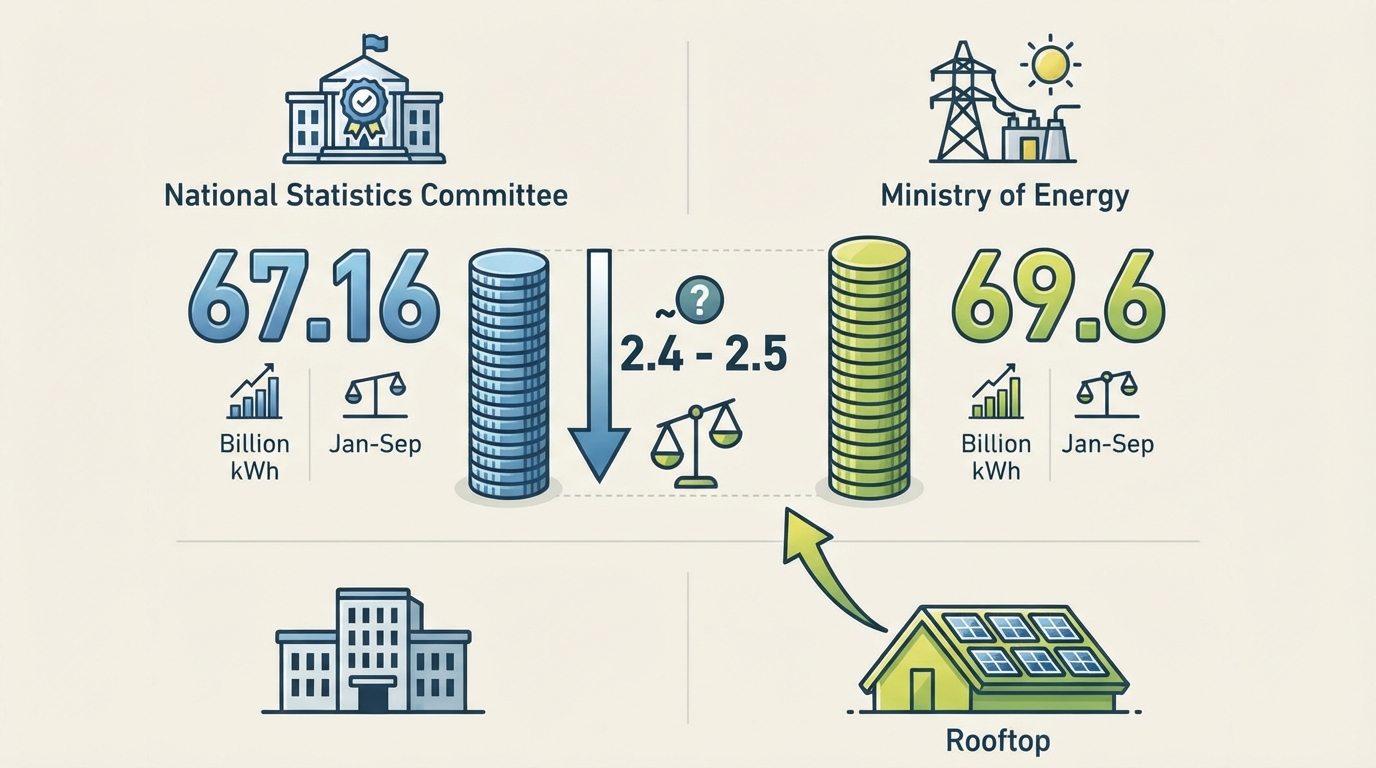
The National Committee on Statistics and the Ministry of Energy of Uzbekistan published varying data on electricity production for the nine months of 2026. The gap between the indicators is approximately 2.4 billion kilowatt-hours. Attention to this was drawn by economist Otabek Bakirov, who believes that the agencies should explain the discrepancy. A Podrobno.uz correspondent requested a comment from the Ministry of Energy and found out the possible reason for the difference in numbers.
According to the National Committee on Statistics, 67.16 billion kilowatt-hours of electricity were produced in the country in January–September. At the same time, the Ministry of Energy reported generation of 69.6 billion kilowatt-hours for the same period. As a result, the difference is about 2.44 billion kilowatt-hours.
It was previously assumed that the agencies' data might include different categories of producers. In particular, the Ministry of Energy separately publishes information on the generation of small solar installations and captive power plants.
In response to a request from Podrobno.uz, the press service of the Ministry of Energy stated that the Statistics Committee might not have taken into account the electricity produced by small "Rooftop" solar stations installed on building roofs. According to the ministry, they generated 2.5 billion kilowatt-hours of electricity in January–September.
This same figure was announced at a Ministry of Energy briefing on October 20 dedicated to the results of electricity generation and supply for the nine months. At that time, the ministry reported that low-power solar panels produced 2.5 billion kilowatt-hours compared to two billion for the entire year of 2025.
Thus, the volume of generation by small solar stations almost coincides with the difference between the data of the two agencies. At the same time, the Ministry of Energy stressed that this is only a possible explanation for the discrepancy.