

The minister who became a fruit and "gravel"-tasting sugar: Sanskrit secrets in our language
The Minister Who Became a Fruit and "Gravel"-Flavored Sugar: Sanskrit Secrets in Our Language
"While the powerful raja played shatranj and ate a mandarin as sweet as sugar, the bakhshi sang of courage." Would you believe that almost half of this sentence consists of Sanskrit words? Sanskrit, one of the oldest languages in the world which has gifted words to many of the world's languages, is no stranger to Uzbek either.
Twins from the Indian Soil
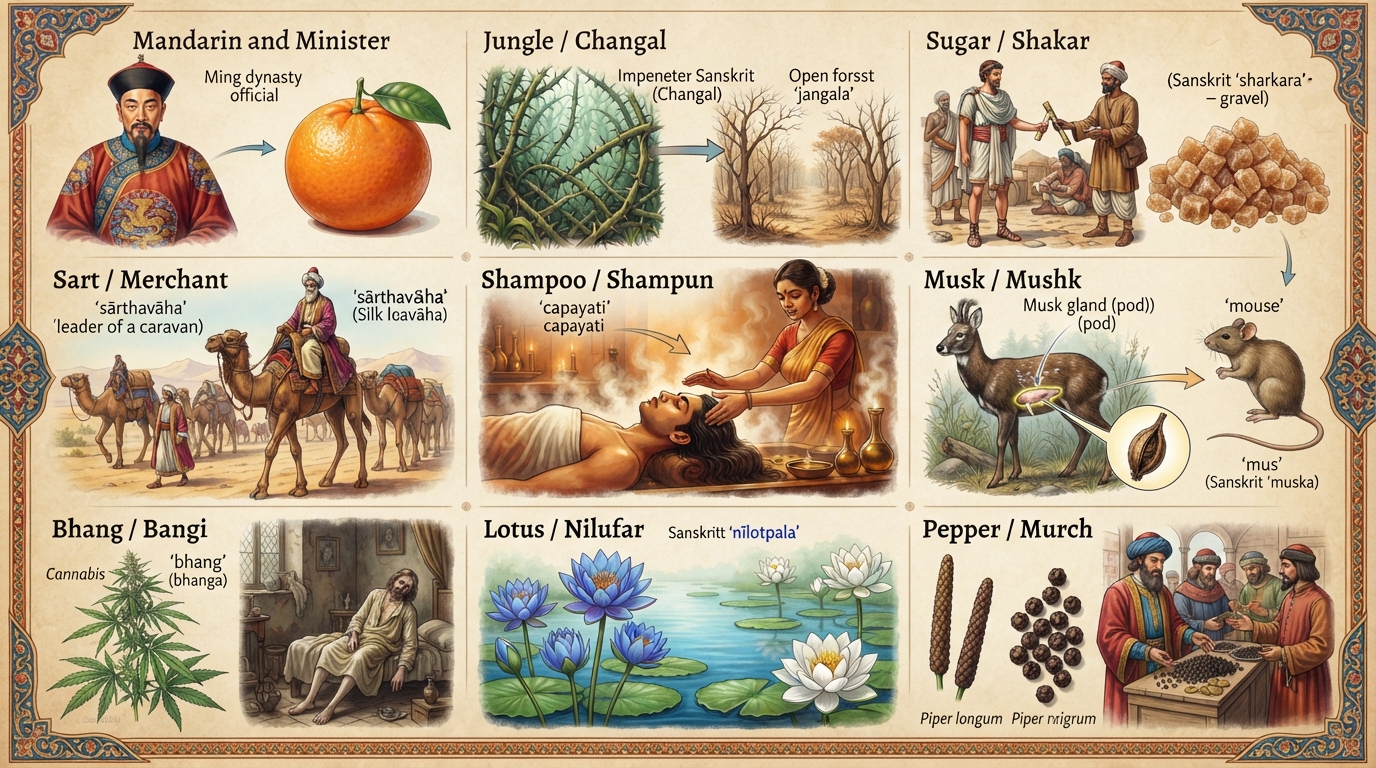
We call impassable thorny thickets and dense groves *changal* or *changalzor*. Interestingly, in its origin, this word did not mean a dense forest, but on the contrary, dry land with sparse trees. Its root goes back to the ancient Sanskrit term *jangala* – arid, sparsely brushed, uncultivated land. This word was adopted into our language through Persian. In spoken language, we also use it in the forms *jingil* and *jangal*.
The word *jungle*, well known from foreign movies, is a sibling to *changal*. The British, who went to India in the 18th century, adopted this word. Over time, in English, it came to mean a place covered with dense, wild vegetation.
To describe an environment dominated by violence and lawlessness, we use the phrase "the laws of the jungle." This phrase became popular with Rudyard Kipling's "The Jungle Book," published in 1894. Its transformation into a symbol of lawlessness is associated with the American writer Upton Sinclair's novel "The Jungle," published in 1906. Through this title, the author exposed the brutal order of the society of that time.
Was there no word with this meaning in Uzbek? What did our ancestors call such dense thickets and groves a thousand years ago? In Mahmud Kashgari's dictionary, the word *buk* is recorded with the meaning of an impassable dense grove. However, centuries later, this Turkic word was forgotten, and loanwords took its place.
Do We Call Our Child "Gravel" as an Endearment?
Sugar is one of the oldest sweets. Alexander the Great and his companions described it as honey without bees. Pliny the Elder, a Roman writer who lived in the 1st century AD, wrote: "Sugar is also made in Arabia, but Indian sugar is better. It is a type of honey found in reeds. Sugar is as white as resin and crunches between the teeth. Sold in pieces the size of a hazelnut, sugar is used only for medical purposes." These words of Pliny may seem surprising to us. The reason is that this product was delivered to the Roman Empire where he lived from India via Egypt, and because it was extremely expensive, it was often consumed only as medicine. Later, after Muslims established sugarcane cultivation in Sicily and Spain, it entered the tables of the common people.
*Shakar* (sugar) originates from the Sanskrit *sharkara* – gravel, sand, ground sugar, and was adopted into Uzbek through Hindi and Persian. This word is found in "Qutadgu Bilig," and "Diwan Lughat al-Turk" provides information about dishes cooked with sugar. In the works of Alisher Navoiy, we encounter words such as *shakkar*, *shakkarafshon*, *shakkarbor*, *shakarguftorligʻ*, *shakarlab*, *shakkariston*, *shakarxanda*, *shakarshikan*.
Over time, the term conquered the languages of the world. While it spread to Europe through Medieval Latin via Persian and Arabic, many other languages adopted it directly from Arabic or Greek. For example, it migrated into Old East Slavic from the Greek word *sakcharon* in the form *sakhar*.
In daily life, we often use expressions like *shakar qizim* (my sweet girl), *shakarim* (my sweet), *shakarday shirin* (sweet as sugar) in the sense of endearment and praise. Interestingly, this form of address also exists in English. The use of the word *sugar* as a term of endearment in English became fashionable in the 1930s.
Seeing that its meaning in Sanskrit is gravel and that the pronunciation of both words is similar, it is natural to hypothesize whether the term *shagʻal* (gravel) in our language also originates from this same root. However, there is no scientific evidence to prove this; it is just a coincidence. Some people also try to link the words *shakar* (sugar) and *sahro* (desert) to the same root because of their connection to sand. But there is no relationship between these words.
The Peeled "Official"
A person peeling a fragrant mandarin and eating it with appetite probably never imagines that this word actually refers to a serious government official. In 16th-century Portuguese written sources, Chinese officials are recorded under the name *mandarins*. Later, in the West, the language of the officials of the Ming and Qing empires also took this name. Over time, the term *mandarin* also began to be used as the name of the Chinese language spoken by Chinese officials and educated people.
The Portuguese took this word from the Malay language. The Portuguese living in the Malacca Sultanate addressed Chinese officials as *mandarin* when they met them. This was the Portuguese-adapted pronunciation of the Malay word *menteri*. The Malay term *menteri* was a modified form of the ancient Sanskrit word *mantrin* – counselor, minister.
You might ask, how did a state title turn into a simple fruit? The use of *mandarin* as a fruit name was also connected with China. Various reasons are given for this. According to one hypothesis, the similarity in color between the citrus fruit and the robes of Chinese officials prompted *mandarin* to become the name of the fruit. According to another interpretation, because this citrus was mainly served on the tables of high-ranking officials, it took their title as its name. Gradually, in the popular language, *mandarin* came to mean not an official, but the sweet fruit we all love.
The Term That Displeased the Jadids: What Does "Sart" Actually Mean?
In our history, many debates have arisen around the term *sart*. This was because the term acquired different meanings in different periods. For example, while Mahmud Kashgari explains this word with the meaning of a merchant, Yusuf Khas Hajib also uses it in this sense. Alisher Navoiy and Zahiriddin Muhammad Babur used this term in relation to Persian speakers. In particular, Navoiy describes his contemporary Sayyid Hasan Ardasher, saying: "I have not seen a more complete person than him among this poor Turk and Sort." Here, *sort* referred to the Persian-speaking population.
With the passage of time, the term *sart* also began to be used to describe the settled, agricultural population in the oases. By the beginning of the 20th century, sharp debates arose in the press regarding its application to Uzbeks. In particular, Mahmudkhodja Behbudiy, in his article titled "The Word Sart is Not Known" published in the journal "Oina," noted that the origin and usage of this term had not yet been definitively determined.
In authoritative sources, the term *sart* is linked to the Sanskrit word *sārthavāha* – caravan leader, merchant. The alignment of the ancient meaning of this word with the explanation of *sart* as a merchant provided by Kashgari supports this etymological interpretation.
If It Falls into the Pot, It's a Flatbread; What If It Falls on the Head?
The British who went to India adopted a treatment based on head massage and introduced the word *shampoo*, which describes it, into the English language. First recorded in English in 1762, this word was derived from the Hindi *champo* – to press, massage. Its root goes back to the Sanskrit verb *capayati* – to knead, soothe.
For a century, the British used this word mainly in the sense of a massage treatment. The meaning of washing hair with lather was first recorded in 1860.
The tradition of head massage with fragrant oils was popularized in Britain by the Bengali traveler, surgeon, and entrepreneur Sake Dean Mahomed. In 1814, he opened a therapeutic vapor bath in Brighton and achieved unprecedented fame. He was even deemed worthy of the official title of "Shampooing Surgeon" to the British Kings George IV and William IV.
"Mice" That Cats Cannot Catch
Based on its sound composition, one might think that the word *mushk* (musk) was borrowed from Arabic or Persian. Our explanatory dictionary partially confirms this, stating that the word is Persian. But etymological sources show that *mushk* passed into Persian from Sanskrit. Actually, the natural substance musk is obtained from the sac-like gland under the abdomen of the musk deer. Because of the shape and appearance of the small pouch, the ancient Indians called it by the Sanskrit word *mushka* – testicle. This term itself was formed from the ancient Indo-European root *mus* – mouse. Words meaning mouse in European languages, for example, the English *mouse* or the Russian *мышь*, spread from this very root.
The words *mushak* (muscle) and *muskul* (muscle) in our language also go back to this ancient root. The Latin name for muscles, *musculus*, meant "little mouse." Indeed, it is similar: remember an athlete flexing his muscle, the muscle looks like a mouse running back and forth in the arm.
In the ancient Turkic language, musk was called *yipar*. It has been preserved in the modern Uzbek language in the form of *ipor*.
The Color of the "Bangi"
Have you heard the word *bangi* in mutual conversation or in the language of older people? It means a hashish user, a drug addict. While the etymological dictionary of the Uzbek language indicates this word is Persian, the explanatory dictionary states it is Hindi. Actually, there is truth in the explanations of both sources.
The cannabis plant and the intoxicating drink prepared from it were called *bhanga* in the ancient Sanskrit language. In ancient Indian scriptures, *bhanga* is mentioned as one of the sacred plants. Later, this word entered our language in the form of *bangi* through the Persian language.
Today, when hearing the word *bangi*, a person imagines a pale, thin figure with lifeless eyes. Sometimes words speak for themselves, as if the meaning in them is absorbed into the sounds. The same can be said about the term *bangi*, which embodies paleness and lifelessness.
Was Your Robe Blue, Nilufar?
Poetry wafts from the word *Nilufar* (water lily/lotus); there is elegance and melody in it. The name of this aquatic plant with large leaves and beautiful large flowers is a modified form of the Sanskrit word *nīlotpala* – a blue flower growing in water. The water lilies we see on the streets are mostly white. Why does the name of this water flower contain the meaning of the color blue? The answer is related to geography: the blue water lily has been famous and revered since ancient times in India and its surrounding areas.
This elegant word also entered European languages. For example, the French and Spanish adopted it through Eastern languages in the form of *nénuphar*.
The first part of the word, *nil*, is also used separately in our language; the words *nil*, *niliy* convey meanings associated with the color blue. For example, poets may use *niliy gumbazlar* (indigo domes) instead of the phrase *koʻk gumbazlar* (blue domes).
"Money" That Gave Flavor to Dishes
*Murch* (black pepper) is one of the most widely used spices in world cuisines. The word *murch* originates from the Sanskrit term *maricha*.
The history of the Sanskrit word *pippali*, which is related to this term, is also interesting. It was originally the name of the long pepper. This word spread to Europe through Greek and Latin. When black pepper replaced long pepper, this name began to be used mainly for black pepper. As a result, the Latin *piper*, English *pepper*, German *Pfeffer*, and Russian *перец* were born.
In the Middle Ages, black pepper was a very valuable commodity: in some places, it was also used for rent, taxes, and other payments. In some European cities, merchants who grew rich from the spice trade were given nicknames like "pepper sacks." In those times, the word for pepper in Europe became a general name for fragrant spices.
The name of the sweet bun we loved to eat in our childhood – *pryanik* (gingerbread) – also goes back to the history of pepper and spices. The Germans called the honey delicacy bun baked with expensive spices added to its dough *Pfefferkuchen* – pepper cake. In the Old East Slavic language, the name of the sweet – *pryanik* – was formed from the adjective *пряный* – spicy, fragrant. Look at the transformation of the word: bitter pepper traveled across languages and turned into the name of a sweet pastry!
Fashionable with Us, Banned in Europe
Probably many people do not know that *chit* (chintz), which is now one of the cheapest fabrics, once obsessed Europe, and its import and use were even restricted by law.
Chintz fabric is usually decorated with flowers and patterns. Its name also reflects this feature. The word *chit* is derived from the ancient Sanskrit word *chitra* – meaning beautiful, bright, colorful, variegated. Thus, the concept of variety and decoration is embodied in its very name.
This term spread to Eastern and European languages through Hindi. In the 17th century, the British, who traded with India, adopted both this fabric and its name, calling it *chintz*. In English, this word today still means a cotton fabric with large flowers and patterns.
This bright fabric imported from the East rapidly became fashionable in Europe, bringing local silk and wool weaving to the brink of ruin. As a result, France in 1686, and England starting from the 1700s, began to restrict and ban chintz and other printed cotton fabrics. However, despite the bans, interest in chintz did not fade: it remained one of the fabrics associated with fashion and luxury in Europe.