

The "Great Game" continues. How did it begin?
In the 19th century, Central Asia became one of the main arenas of the "Great Game" between the Russian and British empires. The khanates found themselves under pressure from two colossal powers, but the roots of this geopolitical situation began with the shift in the global balance of power. Today, just as two centuries ago, the global balance of power is changing, and the strategic importance of Central Asia has increased even further.
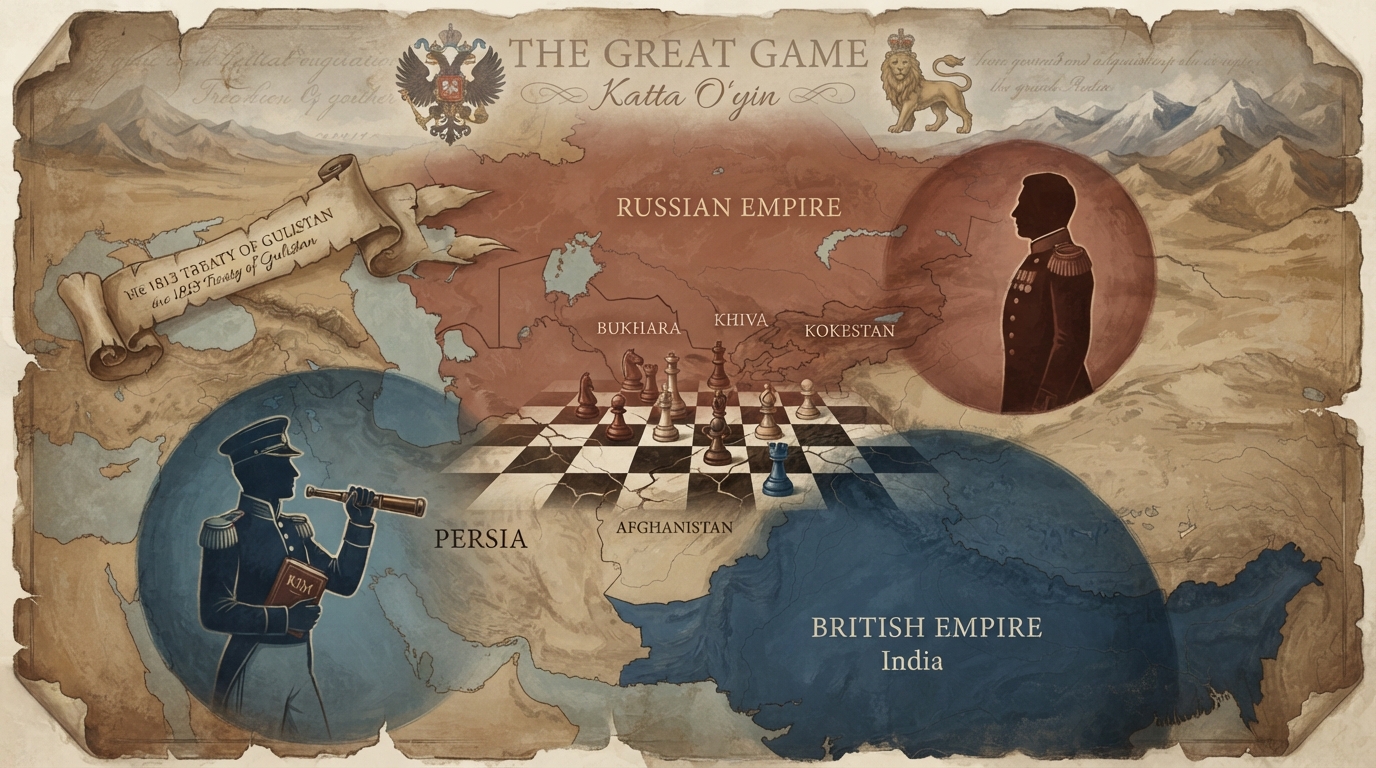
The "Great Game" continues. How did it begin?
- What does the term "Great Game" mean, and when and why did this rivalry begin?
Bahrom Irzayev, historian:
This is a conditional name. The beginning of the "Great Game" is usually associated with the Treaty of Gulistan in 1813. Through the Treaty of Gulistan, the war between Iran's Qajar dynasty and Russia ended, and a large part of the Caucasus came under Russian control. Russia's real penetration into the East was taken very seriously in Europe. The subsequent processes are referred to by historians today as the "Great Game."
The term "Great Game" was first used by the British officer Arthur Conolly. He was a British intelligence officer disguised as a traveler. However, the person who made this term most famous in the world was Rudyard Kipling. He used this term in his novel "Kim," published in 1901. After that, the concept of the "Great Game" became widely popular, mainly representing the rivalry between the British and Russian empires for control and influence over Central Asia and Afghanistan.
However, long after these events ended, they began to be interpreted based on specific ideological and historical views. Today, works on this topic are being translated into the Uzbek language, and Uzbek politicians and historians are also using these interpretations. In my opinion, this issue needs to be looked at a bit differently. This is my personal opinion; I cannot fully accept the concept of the "Great Game" in its current existing interpretation.
Because, on the one hand, I think this is the influence of Eurocentric historical views. That is, the events are being viewed through that ready-made framework, as if Central Asia was a buffer zone formed as a result of the rivalry between Great Britain and Russia, and as if the weakness of the khanates in Turkestan should also be explained from this point of view. As a result, we often repeat the same interpretation as the historians of that period interpreted it. However, in my opinion, we must first deeply study the "Great Game" from beginning to end from our own historical point of view. Only after that should we form our own independent scientific and historical opinion regarding these processes.