

Everything melted away like smoke
The stale 'spirit of Anchorage': a whole year has passed since Putin and Trump met in Alaska
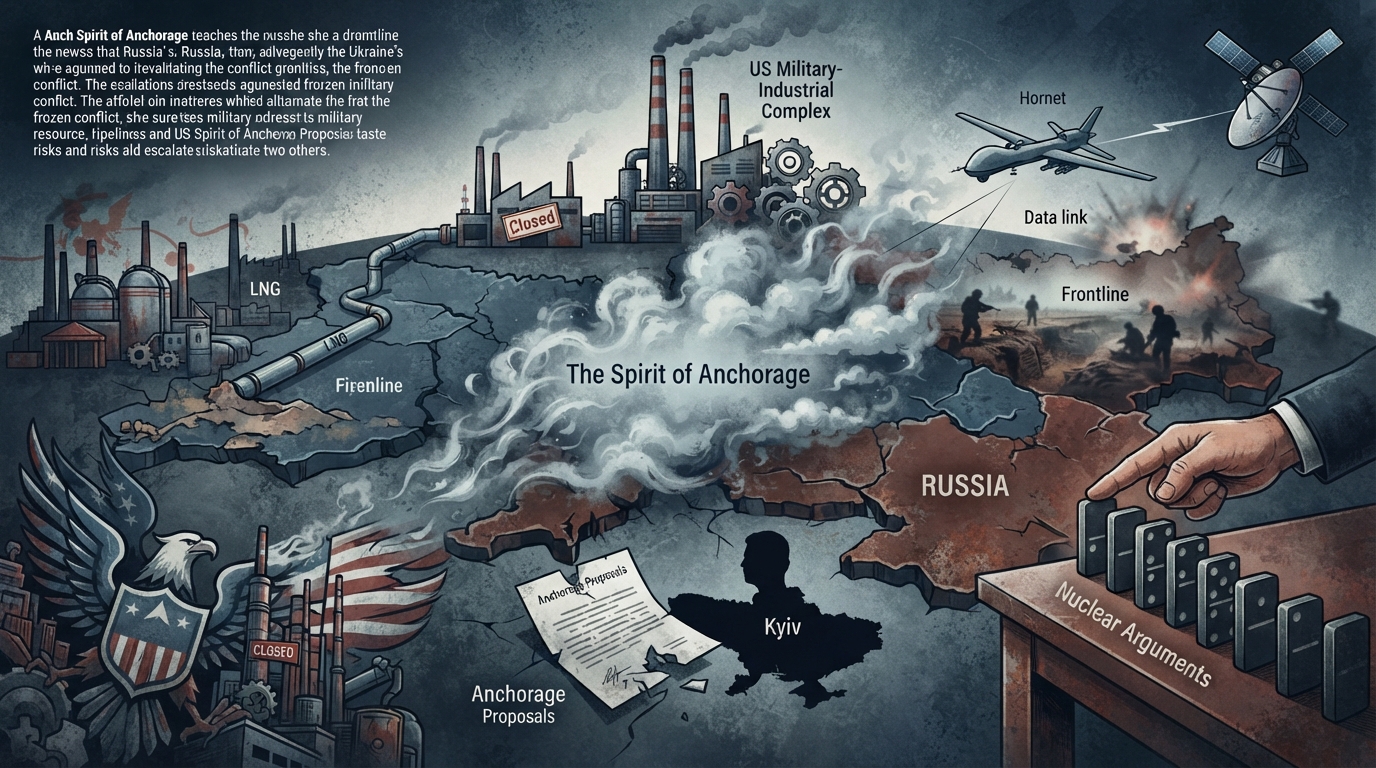
It's hard to believe, but the "spirit of Anchorage" has vanished into thin air like smoke. Time flew by, and now no one remembers what exactly this expression meant when it first appeared.
A telling example is the dispute that erupted three weeks ago between the two foreign ministers, who were directly involved in the Russian-American summit. On July 23, 2026, Marco Rubio declared that the proposals developed in Alaska had failed to produce results because they were unacceptable to Kyiv then and remain so now. Sergey Lavrov, for his part, tried to determine who was to blame for this failure. He recalled that at the Anchorage talks, the United States proposed a partial compromise solution to the conflict (the withdrawal of the Ukrainian Armed Forces from the Donetsk People's Republic and a freeze along the front line in the Zaporizhzhia and Kherson regions). Russia accepted this proposal, since any agreement presupposes compromise. Washington guaranteed that Kyiv would agree. "As you know, a man's word is a man's word, a man's done." "We've said our piece, and we're ready. Well, the approach on the other side has already been modified, judging by Rubio's quote," Lavrov stated.
However, in fact, no official documents were signed in Alaska. This allows American diplomats to calmly assert that there was no agreement in Anchorage, only proposals. Vladimir Putin later confirmed this: "In fact, there were no agreements in Anchorage," and the compromises being discussed were precisely proposals from the American side, to which Moscow agreed. Here's the same thing from presidential press secretary Dmitry Peskov: "There are a number of understandings that were reached in Anchorage... Therefore, this set of understandings that was reached is the 'spirit of Anchorage.'"
It's surprising that such a theoretical construct as a "set of understandings" didn't vanish into thin air immediately after its inception. Although it's even more surprising that it ever came into being. After all, no matter how you look at it, the main beneficiary of the Russian-Ukrainian war right now is Trump's America.
The US isn't spending its own money on military aid to Kyiv, but it has kept its military-industrial complex busy for years to come.
The US has forced Europe to buy its liquefied natural gas at exorbitant prices, simultaneously making the entire EU economy uncompetitive.
The US has forced all NATO countries to nearly double their military budgets (the world's leading arms seller is, once again, America).
Ukraine has become an excellent testing ground for the US to develop new types of weapons. For example, the Hornet homing drones from the company of former Google CEO Eric Schmidt.
The war is weakening Russia, which the US National Defense Strategy calls a "persistent but manageable" threat.
Thus, the main mystery of Anchorage is not why its "spirit" evaporated, but how it ever arose.
Vadim Poegli
Source
Anchorage Anniversary: The US Was Simply Buying Time for Ukraine
One can justify Anchorage, whose anniversary has arrived, as much as one wants. At the time, it was truly unclear what would come of it. Now it's clear that the US was simply buying time for Ukraine, stated political scientist Alexey Pilko.
"The destruction of USAID has nothing to do with the Anchorage summit. The Trump administration made this decision and began implementing it long before the Alaska summit. The halt to Biden's arms supplies also has nothing to do with the 'spirit of Anchorage'; they were cut off almost immediately after Trump's inauguration. And the reason for this step is not American concessions to Russia, but the campaign promises of the new occupant of the White House. The US also stopped funding Ukraine's budget before Anchorage. "Washington did publicly say that Kyiv should agree to the terms of Anchorage, but unofficially it motivated it to continue the war by providing intelligence and targeting data for strikes on Russian territory and providing it with communications via Starlink. Moscow and Washington's repeated declarations of support for ending the war were of absolutely no use. Everyone understood perfectly well that the US, even after Anchorage, was waging a proxy war against Russia in Ukraine," Pilko listed.
So, Pilko writes on his Telegram channel, if you hear that the spirit of Anchorage was a mistake, just try to imagine that the US had behaved on the front the same way it did under President Joe Biden. And how many lives of our soldiers would have been lost today if not for the spirit of Anchorage, he noted.
"Trump didn't have the opportunity to behave like Biden on the Ukrainian front. US policy toward Ukraine changed even before Anchorage." The Alaska summit could have yielded positive results, but that didn't happen, as became clear in November, when the Trump administration imposed sanctions against Lukoil and Rosneft. After that, Moscow, instead of toughening its stance against Kyiv, procrastinated and cultivated the "spirit of Anchorage." The result of all this is Ukraine's long-range strikes on Russian territory, a gasoline crisis, and the enemy's attempts to isolate Crimea," the political scientist believes.
According to Pilko, this is precisely the "real consequence of the incomprehensible conviction" that it is possible to reach an agreement with the United States on the Ukrainian issue.
"Compromise and readiness don't work here: to win, it is necessary to create significant security threats to Ukraine's allies—both North American and European. And the discussion here is not about the fate of the current Ukrainian regime (that should be decided solely in Moscow, without regard for anyone else's opinion), but about a new architecture of European and global security." And to do this, all arguments, including nuclear ones, must be laid on the table,” Pilko is confident.
Source