

The mayor called the election results a "catastrophe"
The elections held in the German federal state of Mecklenburg-Western Pomerania and the city of Berlin ended worse than expected for the Christian Democratic Union led by Chancellor Friedrich Merz. For the first time in history, the CDU failed to enter the parliament of one of the federal states, but Merz stated that he has no intention of resigning.
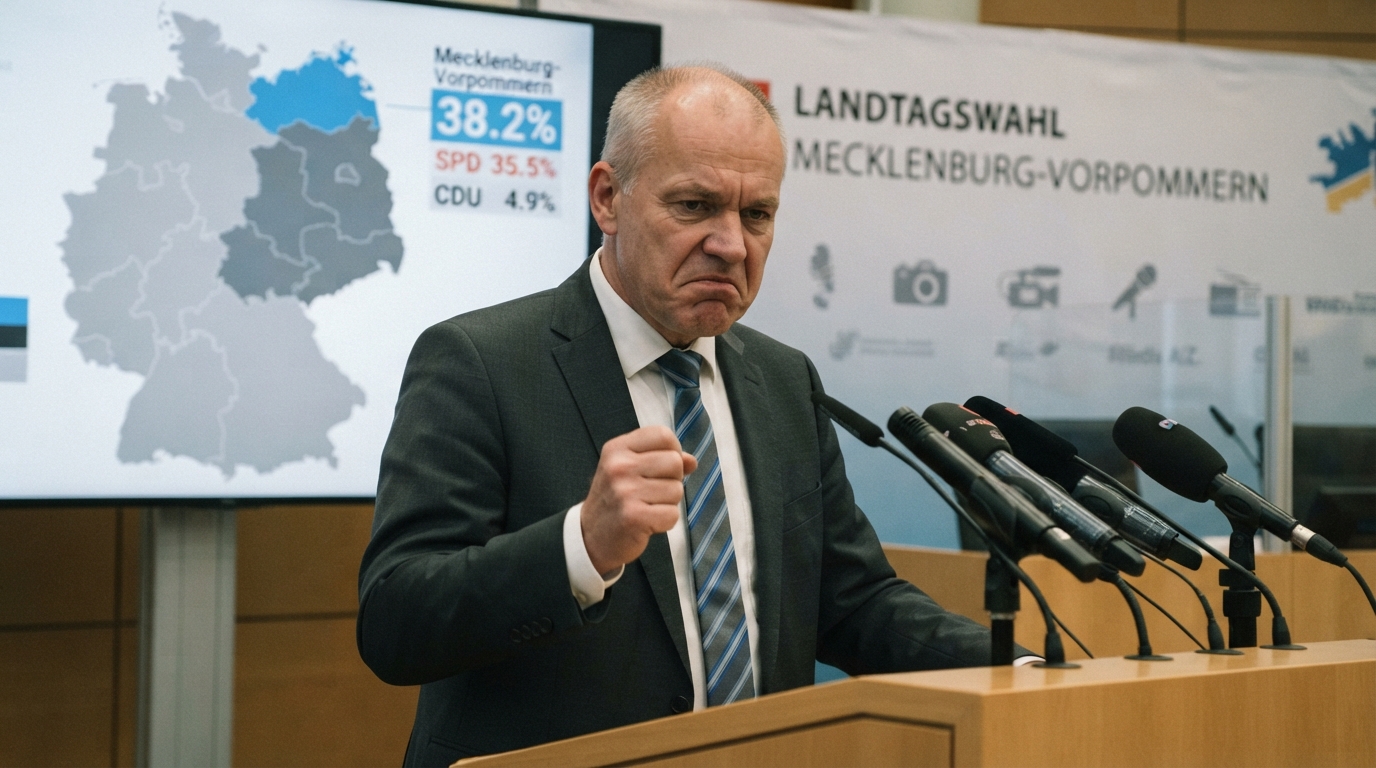
Merz called the election results a "catastrophe"
German Chancellor and leader of the Christian Democratic Union, Friedrich Merz, described the results of the elections held on September 20 in Mecklenburg-Western Pomerania and Berlin as a "catastrophe." He made this statement before it became known that, for the first time in history, the conservatives would not be represented in the parliament of one of the country's federal states.
In Mecklenburg-Western Pomerania, the CDU received only 4.9 percent of the vote. To enter the state parliament — the Landtag — a party needed to gather at least 5 percent of the vote.
The far-right "Alternative for Germany" party won the election with 38.2 percent of the vote. For comparison, in the 2021 election, this party was supported by 16.7 percent of voters.
The Social Democratic Party of Germany took second place with 35.5 percent of the vote. In 2021, its result was 39.6 percent. The Left Party received 6.5 percent, while "Alliance 90/The Greens" got 5.7 percent. The remaining political forces failed to clear the five percent threshold.
Thus, among the parties that also participated in the 2021 election, only "Alternative for Germany" improved its result. However, this victory is mainly of symbolic importance, as other parties do not wish to form a coalition with the far-right.
The head of the federal state government, Social Democrat Manuela Schwesig, conducted her election campaign mainly based on the idea of fighting against "Alternative for Germany." One of her campaign slogans was "The Woman against the Blues." Blue is the symbolic color of the far-right party.
In an interview with the ZDF television channel on election day, Schwesig pointed to two main reasons for the rise in the far-right's popularity. According to her, a large part of the population of Mecklenburg-Western Pomerania is against providing financial and military aid to Ukraine. Additionally, many want to resume Russian gas deliveries through the "Nord Stream" pipeline.
The "Alternative for Germany" party actively used these two issues in its election campaign. Schwesig said that the Social Democrats understood in advance that they do not support these positions and would lose votes as a result.
Nevertheless, Schwesig's strategy worked. In polls at the beginning of the month, the Social Democrats' rating was below 30 percent, and a year ago it had not even reached 20 percent. The final result of 35.5 percent allows the party to form a government together with the Left Party and the Greens.