

The largest "white spot" on Earth: how well has the world ocean been studied?
About 400 kilometers southwest of the island of Guam, the ocean floor drops sharply toward a giant fissure in the Earth's crust. It is so deep that even if Mount Everest were placed entirely here, its peak would not reach the surface of the water. This is the Mariana Trench. And in its southern part lies the deepest point of the planet's oceans - the Challenger Deep.
The largest "blank spot" on Earth: how well is the world ocean explored?
The Mariana Trench is one of the clearest examples showing how little we still know about the world ocean, even though humanity has been conducting oceanographic research for more than 150 years.
At the same time, answering the question "how much of the ocean has been explored?" with a precise number is not easy. Because here, everything depends on what we mean by "explored." Mapping the ocean floor using modern equipment is one thing, but seeing it directly, researching the living organisms and ecosystems there is an entirely different matter.
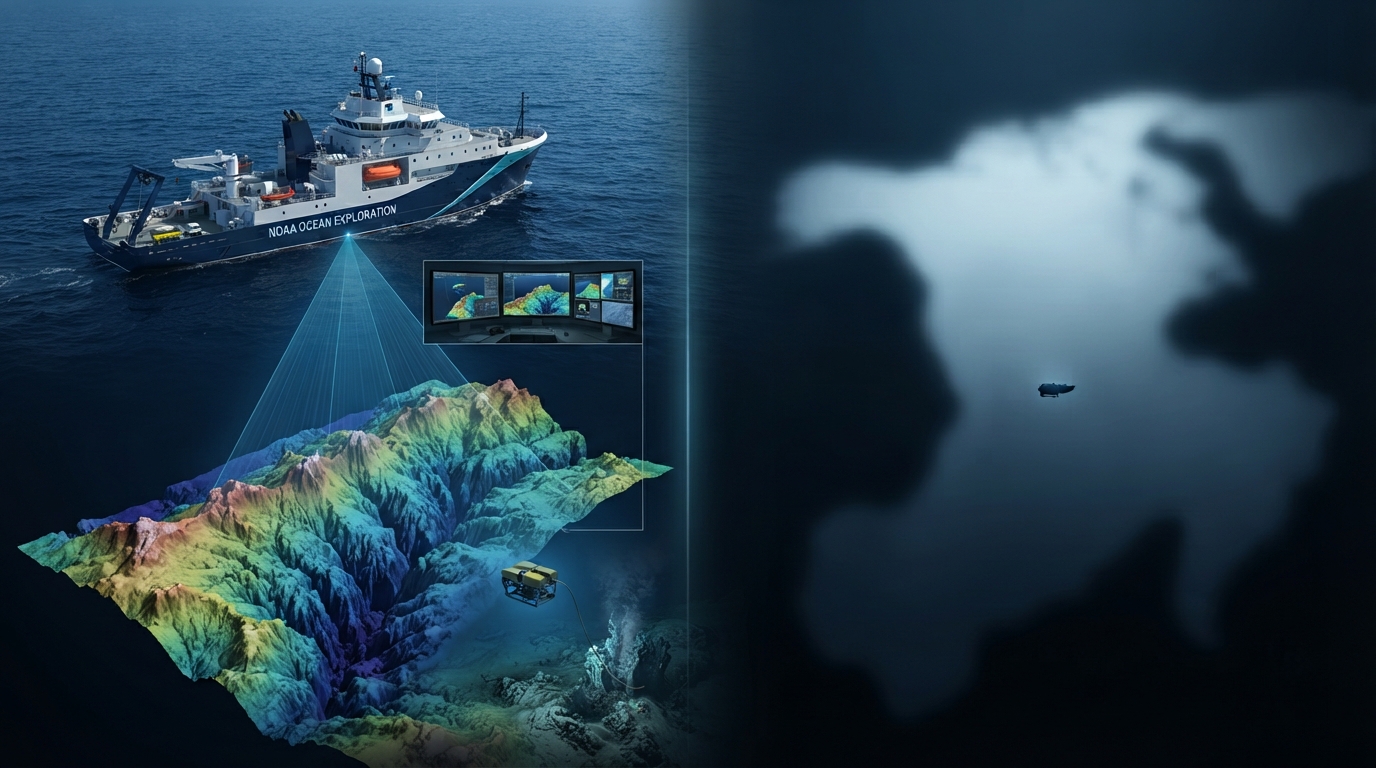
For many years, the figure that more than 80 percent of the world ocean remains unexplored and unmapped was widely circulated. The National Centers for Environmental Information within the US National Oceanic and Atmospheric Administration (NOAA) used exactly this definition. This indicator is linked to the international Nippon Foundation–GEBCO Seabed 2030 project, whose goal is to create a complete map of the planet's ocean floor by the end of the decade.
However, the "unmapped" part of the ocean is not a static number. As research expands, this indicator is also changing.
According to NOAA Ocean Exploration, as of August 2026, 28.7 percent of the world ocean floor has been explored and mapped using modern high-resolution multibeam sonars. A few years ago, this figure was approximately 23 percent.
This means that even now, more than two-thirds of the ocean floor does not have a detailed high-resolution map. At the same time, the area of mapped territories is expanding year by year.
Large "blank spots" in this regard also remain in US waters. As of January 2026, 44 percent of the country's ocean territories, coastal waters, and Great Lakes have not yet been mapped to modern standards. The US aims to completely eliminate this gap by 2040.
However, mapping the ocean floor does not mean fully exploring it.
For example, a ship equipped with sonar can pass through a certain area and determine the topography of the ocean floor, finding underwater mountains or deep trenches. But such data tells us almost nothing about what kind of organisms live there, how they interact with each other, or how the local ecosystem functions.
Therefore, mapping is only the first stage of exploring the ocean. For a full-scale study, humans or special underwater vehicles must descend into the depths, directly observe the area, take samples, and document what is seen. Work in this direction lags far behind the process of mapping the ocean floor. NOAA also notes that only a small part of the ocean has been directly explored in this broader sense.