

The largest tailings dam in the CIS is being built at the AGMK
The CIS Largest Tailings Storage Facility Is Being Built at AGMK
A tailings storage facility for an industrial enterprise is one of the most critical facilities in the mining and metallurgical industry: environmental safety and the safety of people living nearby directly depend on the accuracy of site selection and compliance with construction technology. It is precisely such a facility that is currently being built at the Almalyk MMC—next to copper concentrator No. 3, which is gradually reaching its full design capacity.
Work on the tailings storage facility started simultaneously with the development of the "Yoshlik" quarry: at the same time, the design of the new concentrator, water intake, and the tailings storage facility itself began. Specialists from the O'zGEORANGMETLITI institute were involved in the project, and the structure was designed taking into account international engineering standards.
"Designing the tailings storage facility for MOF-3 required taking into account a whole range of mining, engineering-geological, environmental, and technological factors," says Vladimir Kanonyuk, chief project engineer. "Since the facility is classified as a hydraulic structure and is designed for indefinite existence, the most stringent requirements are imposed on it. We have designed similar facilities before, but the MOF-3 tailings storage facility is unique in its scale. Our project had to guarantee the absolute stability of the dam and reliable protection of the environment, so we studied global experience in detail and exchanged views with leading foreign companies."
According to him, the result was a structure that fully complies with advanced international standards—the only one of its class not only in Uzbekistan but in the entire CIS space. There are only a few such facilities in the world.
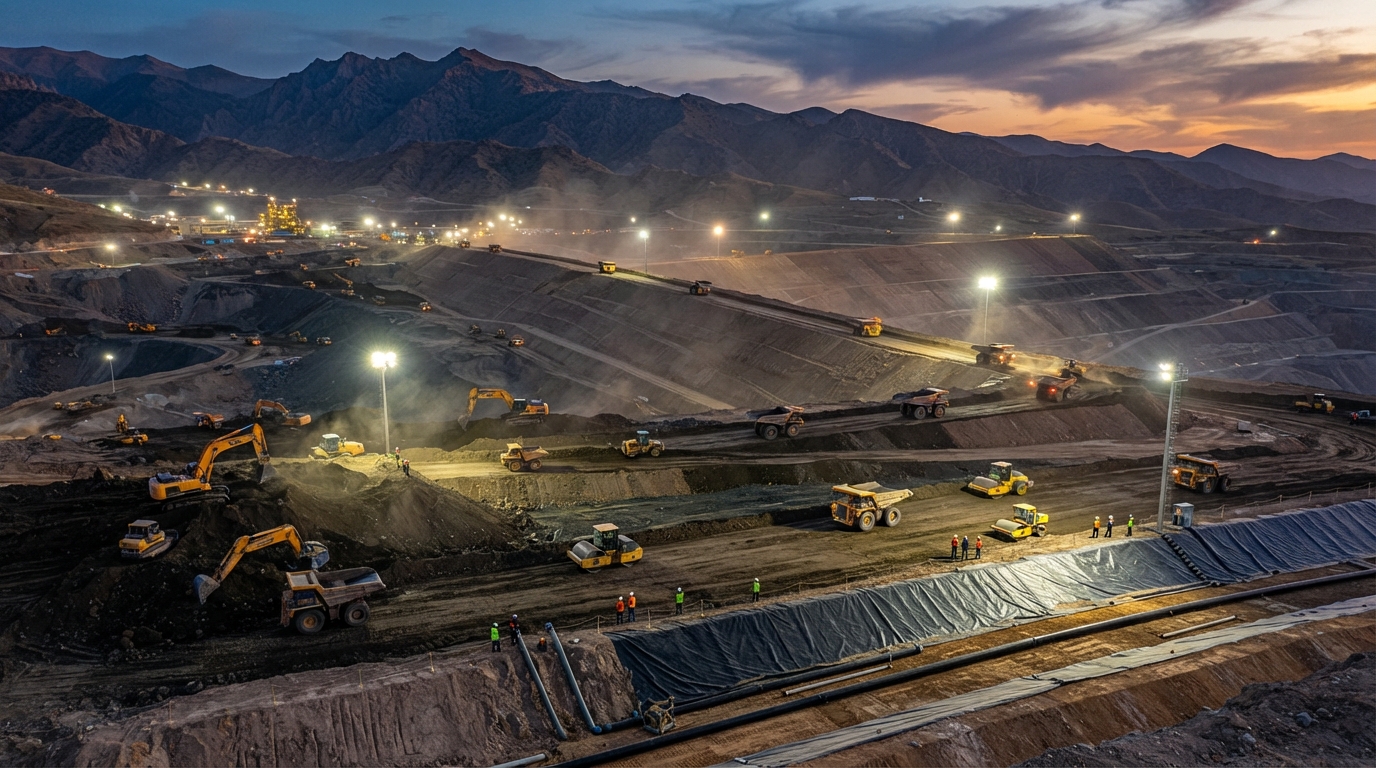
When the sun floods the construction site, a picture opens up before one's eyes that changes the usual perception of a construction project: the huge bowls of future reservoirs cut into the relief, changing the landscape, while dozens of pieces of equipment move in an almost balletic rhythm. Powerful bulldozers and excavators level the base meter by meter, exposing ancient layers of soil, while dump trucks transport tons of earth to build dams.
"Intense work is underway at the facility, involving about 300 units of specialized equipment, including excavators with a bucket capacity of 6 m³, 60-ton dump trucks, 36-ton vibratory rollers, and bulldozers. More than a thousand qualified specialists from various fields support the processes," says Alexander Ten, head of the project's construction site sector.
The main front of work now is the construction of the retaining dam. Its length will be 7 kilometers, and its maximum height will reach 57 meters. A foundation pit is being excavated under the base of the dam over an area of 176 hectares with soil excavation to a depth of 4 meters, followed by layer-by-layer backfilling and compaction—local soil is used for this, which significantly simplifies logistics. Thanks to the powerful fleet of machinery, the average daily volume of earthworks reaches 70–80 thousand m³, and more than 2 million m³ per month.
Construction is carried out under strict quality control: each layer of soil undergoes a geodetic check for compliance with design elevations, and then specialists from the field laboratory take samples and determine their moisture content and density. Such checks are not a formality: they are what guarantee the strength and reliability of the structure for its entire service life.
One of the key elements of the design is the so-called clay lock.
"To ensure the necessary density of the foundation and the body of the dam, clay and water-soil mixtures are used," explains Madir Adylzhanov, general construction works engineer of the project. "The resulting mass is laid in layers, usually in layers of 20–25 centimeters, on the bottom and slopes of the pit, after which it is thoroughly compacted with rollers. Such a layer with a thickness of 0.5 meters or more works as a powerful natural waterproofing: upon contact with water, the clay swells and forms a dense, impermeable layer."
The principle of operation is simple and at the same time reliable: fine clay particles, when saturated with water, almost completely block the pores. In addition, clay works as a natural filter—the montmorillonite it contains is capable of binding heavy metals and other substances from industrial waste. Another advantage of the clay layer is its plasticity: unlike dry soil or concrete, which crack over time under load, the clay mixture is able to adapt to small deformations of the base while maintaining integrity.
The construction utilizes technologies focused on environmental safety and rational use of resources. One of the main solutions is a recycled water supply system: after the flotation process, the clarified water is returned back to the technological process via floating pumping stations. This solution is being used for the first time for the plant, and it significantly reduces the volume of water intake from natural sources.
For additional protection, the base of the tailings storage facility and key areas will be covered with a high-strength geomembrane, which prevents the penetration of process water into the ground and protects groundwater. To monitor seepage water, observation wells will be equipped, and a drainage system will ensure the safe collection and removal of seepage water and gases from the waste.
In parallel, on the second section of the tailings storage facility—located about 7 kilometers from the factory, in the northwestern part of the Kurama Range—existing utility lines are being relocated. The area of the first section is 1,420 hectares, the second is 1,380, so the total area of the facility will reach about 2,800 hectares. Waste after flotation will enter the tailings storage facility through a hydro-transport system—slurry pipelines with a length of about 9 kilometers. The facility is designed to receive up to 300 million m³ of tailings per year, of which more than 59 million tons is the solid component.
All technological processes of the facility will be digitalized: their parameters are controlled by a single management system, and data is analyzed in real time in the central control room. This will allow maintaining process stability, quickly identifying malfunctions, and promptly making decisions.
With the onset of twilight, the construction site does not fall silent—it merely changes its appearance. Powerful searchlights on lighting masts flare up, turning the pit into a futuristic stage: in the darkness, the silhouettes of machinery seem even more monumental, light beams catch the gleam of steel structures, clouds of dust from vehicles, and the silhouettes of people in reflective vests. The roar of engines in the cool night air sounds deeper, and the hum of working rollers resembles the pulse of a huge iron heart. This is a time when engineering thought and human will work to the limit of their capabilities, bringing closer the moment when the facility will become a reliable link in the chain of environmentally friendly production.
This eco-polygon will become another major strategic facility of AGMK, created taking into account modern requirements for industrial and environmental safety.