

The Incomers. Mathematician Waldo Arriagada on Tashkent's contrasts, an obsession with time, and why Mathematics is an art
Waldo Arriagada is a Chilean-Canadian mathematician, watch collector, and rock music enthusiast. He has worked in the Bahamas, the UAE, and China. A year ago, he moved to Tashkent to join New Uzbekistan University. For The Incomers project, Professor Arriagada explained why a mathematician is closer to an artist than a scientist, what surprised him most in the city, and how his love of watches led him to start a YouTube channel.
**The Incomers. Mathematician Waldo Arriagada on Tashkent's contrasts, an obsession with time, and why Mathematics is an art**
The series began from a simple curiosity that naturally comes up when meeting foreigners who have made Uzbekistan their home. Through these talks, we aim to learn why they came and stayed, what they appreciate about the country, what they learn from Uzbekistanis, and what changes they would like to see.
I was born in Santiago, the capital of Chile. I grew up there and attended elementary school in that city. To be honest, after secondary school I had no clear idea what I wanted to do next. I eventually enrolled in a medical technology program at the University of Chile's School of Medicine. I studied there for a year and a half, but it was quite painful because I had no interest in medical sciences at all.
Then, during a calculus class, the lecturer discussed the concept of limit. I was fascinated.
Something suddenly made sense in my head, and I knew mathematics was exactly what I wanted to do.
That was when I decided to leave and quit the medical program. In the next admission cycle, I entered the Civil Mathematical Engineering program at the University of Chile’s School of Physical and Mathematical Sciences, one of South America's most respected institutions. I earned both my bachelor's and master's degrees there.
During those years, I understood that I was drawn to mathematics rather than engineering.
The common view was that engineering had better job opportunities and higher pay, but none of that mattered to me.
I am not sure I am passionate about mathematics — or about anything, really. It is just that it may be the only field I am truly interested in.
My master's thesis was in pure mathematics, specifically the topological properties of solenoids. It is difficult to explain, but you can imagine it. Take a shoelace and remove the middle third. You are left with two smaller pieces. Do the same to each of them, and keep repeating this infinitely many times. In the end, you get a set of points that looks like a line of dust particles. That is called a Cantor set. If you take a set of circles and place them inside one another using this Cantor structure, the result is called a solenoid. What can you do with it? For example, you can measure the twisting number of the orbits around one another in different ways.
It may sound dull, but to a connoisseur it is, honestly, a beautiful subject.
Some of my family had been living in Canada for a long time, so after finishing my MSc I moved there. I began a PhD at the University of Toronto under topologist Boris Khesin. But I did not like the city. It was enormous, restless and extremely humid. On top of that, I had nowhere to stay and had to sleep in the office for the first few days.
One day, strangers approached me in a cafeteria and suddenly told me: “You have to be tough in Toronto; you have to be able to stand up for yourself.”
That was when I realized the city was not for me. So I moved to Montreal, where I completed my doctorate at the University of Montreal. My thesis was on Complex Dynamics and Differential Equations.
After defending my PhD, I did a postdoctorate at the University of Calgary. In 2013, I was offered a three-year Visiting Professor position at the University of The Bahamas. Before I finished that appointment, Khalifa University invited me to join its faculty as an assistant professor in Abu Dhabi. I remained there for seven to eight years before moving to a university in China.
Life in China was not easy for me. For instance, the food was so spicy and unfamiliar that eating out became difficult. I would order a bowl of noodles, start eating, and suddenly find something unexpected looking back at me: a little bone, a leg, or even a beak. The climate was also extremely humid, with rain four days a week almost all year. The local animals brought their own surprises. Once, while running, I climbed high up a mountain and found an abandoned Buddhist temple — only to see a bobcat staring straight at me. Terrified, I turned back and left.
While I was still in China, I received a newsletter containing a job advertisement from New Uzbekistan University.
Not long before that, a well-travelled friend of mine had visited Central Asia. He said Tashkent had impressed him the most because of the contrast between tradition and modernity.
The nearby mountains, which are good for skiing, were an added bonus. I decided to watch a few travel vlogs on YouTube to get at least some idea of the country. I accepted the university's offer.
In my view, pure mathematics is an art; therefore, a mathematician is less a scientist and more an artist.
Coming up with an idea, developing it, and proving it is often extremely difficult and demanding, yet deeply satisfying, even when you know the idea may ultimately turn out to be wrong.
Over the past decade, I have published about 30 research papers. Often, all you need is some paper, a pen, and the right people to discuss things with. One of them is my colleague and close friend Jorge Huentutripay, a faculty member at Universidad Austral de Chile, who lives in a beautiful part of Chilean Patagonia. Even though we are far apart, we are always in touch and exchange research. My colleagues in Tashkent also help me a great deal.
Photo: Yevgeniy Sorochin / Gazeta
Another benefit of pure mathematics is that it does not require much funding. In Chile, I obtained funding through the National Commission for Scientific and Technological Research (CONICYT) a few years ago. In Canada, I received grants from NSERC, the Natural Sciences and Engineering Research Council. Here in Uzbekistan, my students have also been applying for research funding through various programs.
When it comes to teaching, I believe the responsibility for learning mathematics lies mostly with the student.
I can help someone understand basic calculus, but if they do not want to learn, no amount of extra help will work — even if you hire a hundred teachers and tutors.
Students who love mathematics constantly exercise their minds. In our case, you can identify strong students by seeing them play chess in the hallways around campus or spend extra time in the library.
For natural reasons, I find it much easier to work with sophomores, juniors and seniors than with freshmen. For example, I am currently teaching differential equations, which is in the second year of our bachelor’s program. The students in this course already know what they want to achieve and take their studies seriously. By contrast, those who have just entered university are still finding their footing and can be less cooperative, just as I once was.
The faculty at New Uzbekistan University is very diverse. There are specialists from the United States, Europe and Asia, and in my opinion that is a major advantage. Mathematics, for example, is taught differently in Europe than in the United States. The American approach is more pragmatic and direct. In Europe, especially in France and Italy, mathematics is treated as a serious discipline; proofs often run across entire pages down to the tiniest microscopic detail. That variety of teaching traditions is a valuable strength at our institution.
I arrived in Tashkent in the late summer of 2025. The weather was very hot, and I later realized it would stay that way for most of the year. I used to explore the city mostly on foot. On a few weekends, I walked from my apartment in Akay City along Kary Niyazov Street to Taras Shevchenko Square. What impressed me most was the contrast — modern buildings standing right beside Soviet-era ones.
The city seemed deeply attached to its traditions, yet surprisingly secular at the same time.
Photo: Yevgeniy Sorochin / Gazeta
Tashkent has too many vehicles, and the roads can be dangerous at times.
Drivers park anywhere, including on sidewalks and in school zones. Not everyone gives way to pedestrians, even though there are clear signs requiring vehicles to do so at crosswalks. A stop sign is not a suggestion, but a rule that must be obeyed.
People drive recklessly, especially young drivers.
I tell my students: “Be careful on the road. I want to see each and every one of you in class tomorrow.”
I saw something similar in Abu Dhabi eleven years ago (2015). Driving in the city and on highways was extremely dangerous. The driving culture there changed over time, and it will change here too eventually. In my opinion, building bridges and underpasses so pedestrians can avoid cars is not the solution. The real answer is to change the driving culture so that drivers respect pedestrians and cyclists, and vice versa.
I would like to see improvements in road safety on Tashkent's roads.
I have no long-term plans to stay here or anywhere else. Despite all the drawbacks, Uzbekistan is an excellent place to live. In particular, Tashkent is an ideal and highly family-oriented city: safe by global standards, with low humidity (humid weather is simply unbearable to me!), warm, and full of places to visit. Unfortunately, safety is increasingly becoming a privilege in the West for those who can afford it. Here it is different. I hope it remains that way.
Outside Tashkent, I have only been to Samarkand. I noticed that whenever a shopkeeper does not speak English, younger people nearby step in to help.
Young people here understand this reality. Without a foreign language, it is impossible to study abroad, bring in exchange students, or grow.
What surprises me is how effortlessly people in Uzbekistan switch between Uzbek and Russian.
For example, in Belgium there are three official languages, but people do not mix them like that or switch from one to another. If you speak Flemish, you do not suddenly change to German or French. A similar situation exists in Canada, where people speak either English or French, but rarely mix the two. Here, people use Uzbek and Russian interchangeably. I find that strange, but very fascinating.
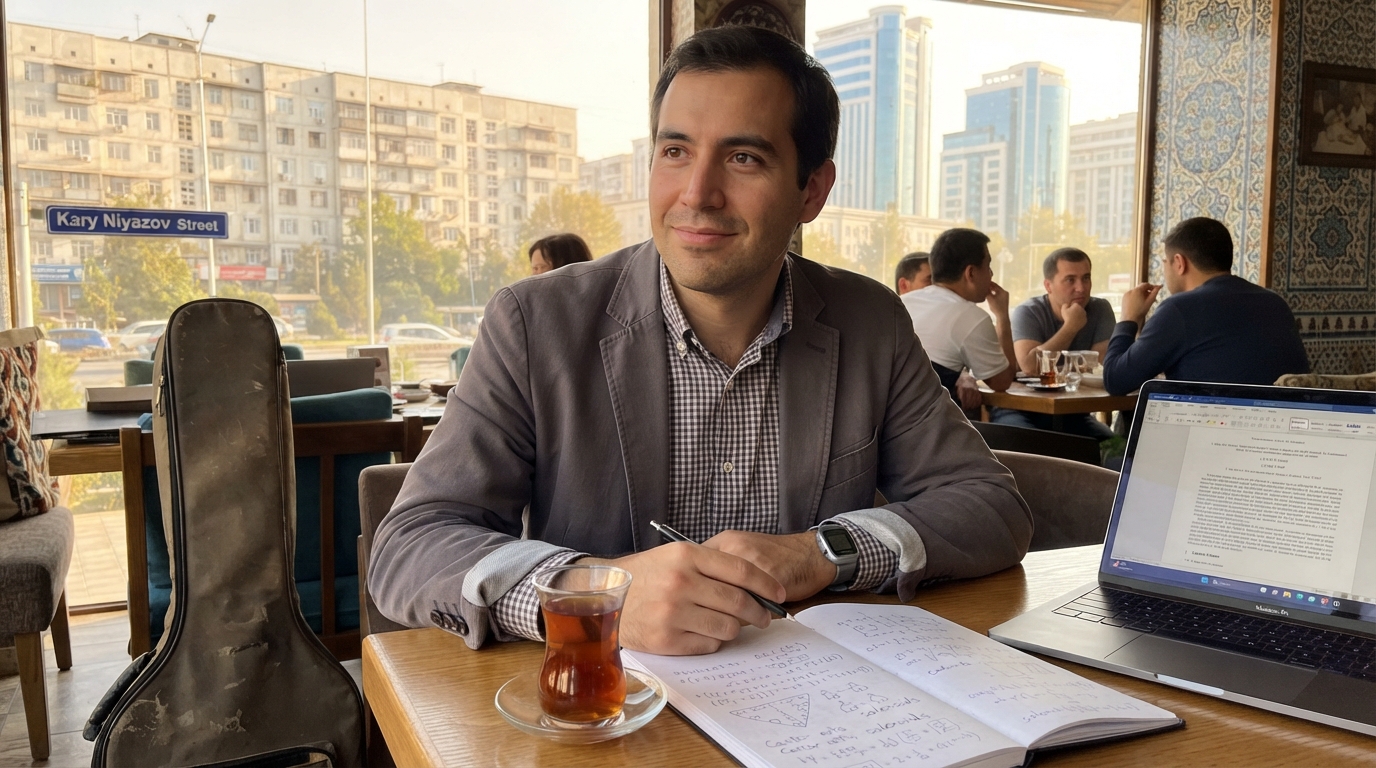
I spend my free time in different ways. Last year I used to run a lot along Mirzo Ulugbek Street and climb the stairs in my building, 25 floors up and down, to make up for the copious amounts of delicious food one inevitably eats in town. These days I spend more time working on mathematics in coffee shops and at home on weekends.
Honestly, the best place for me to concentrate has always been McDonald's. It is not quiet, but somehow I can sit down and focus.
In Tashkent, I usually go to a Turkish café on the ground floor of the Park in Mall. I drink tea there and get some work done. A few papers have been conceived while sitting over a cup of Turkish tea. It is simply a delicious time!
Photo: Yevgeniy Sorochin / Gazeta
One of the few hobbies I keep up is playing the guitar. My father taught me the basic notes and chords when I was a child. I play both electric and acoustic guitar, though I prefer acoustic. It sounds softer and more delicate. I could not bring my guitar to Tashkent, but last semester I managed to stop by the music room on campus a couple of times and play there.
I regularly meet a street musician on my way to work. He plays under the bridge at the intersection of Abdulla Qodiriy Street and Mustaqillik Avenue. He is from Georgia and knows 1970s rock inside out — Iron Butterfly, Deep Purple, and many other bands. Every time I see him, I go over and he lets me play his guitar.
I am a big fan of rock. I love Creedence Clearwater Revival to the core of my heart.
They only performed for four years, from 1968 to 1972. I was not even born yet, but I feel a special connection to them.
«Left a good job in the city
Workin' for the man every night and day
And I never lost one minute of sleepin'
Worryin' 'bout the way things might have been…»
In Tashkent, I try to attend live music whenever I can. Last spring, I went to the International Jazz Festival behind the Palace of International Forums three days in a row. It was wonderful. I also attended a Christmas carol concert at the State Conservatory of Uzbekistan.
I also enjoy collecting watches. I began with Swatch models, the plastic ones. I used to buy them for $30 during my student years. At one point I managed to collect around a thousand of them. I sold many later, but the passion never disappeared.
I have always been obsessed with time.
Is it linear? Does it move only in one direction? It feels like a universal variable, a coordinate we assume is the same on Earth as on the surface of the Moon, yet modern physics shows it is entirely relative.
Because of my interest in watches, I used to go diving, and I needed instruments to measure depth. Out in the water, a watch was my companion. I do not wear them anymore, but when everyone around me started talking about a particular Seiko model, I thought: I have several of those; why not talk about them? That is how my YouTube channel Plastic Indices was born. I post video reviews covering the model, case diameter and thickness, color, and functions. Some watches have a built-in compass, others a thermometer. Some run on a battery; others are mechanical — no battery needed. Which is remarkable, when you think about it.
— The first Uzbek word you learned?
— “Rahmat” [thank you], "Salom” [hello].
— Your favorite Uzbek dish?
— Plov, of course. I also love shurpa. The food here is very fresh, clean and delicious. One gains weight easily, so I must slow down a little bit.
(laughs)
— What place do you take everyone who comes to visit you?
— The Islamic Civilization Centre. It is a beautiful place. Tashkent City Mall and the surrounding areas are nice places to explore as well.