

The Himalayas are melting faster - and India's economy is 'at risk'
A new report warns Himalayan glaciers are melting faster, threatening India’s water, economy and communities.
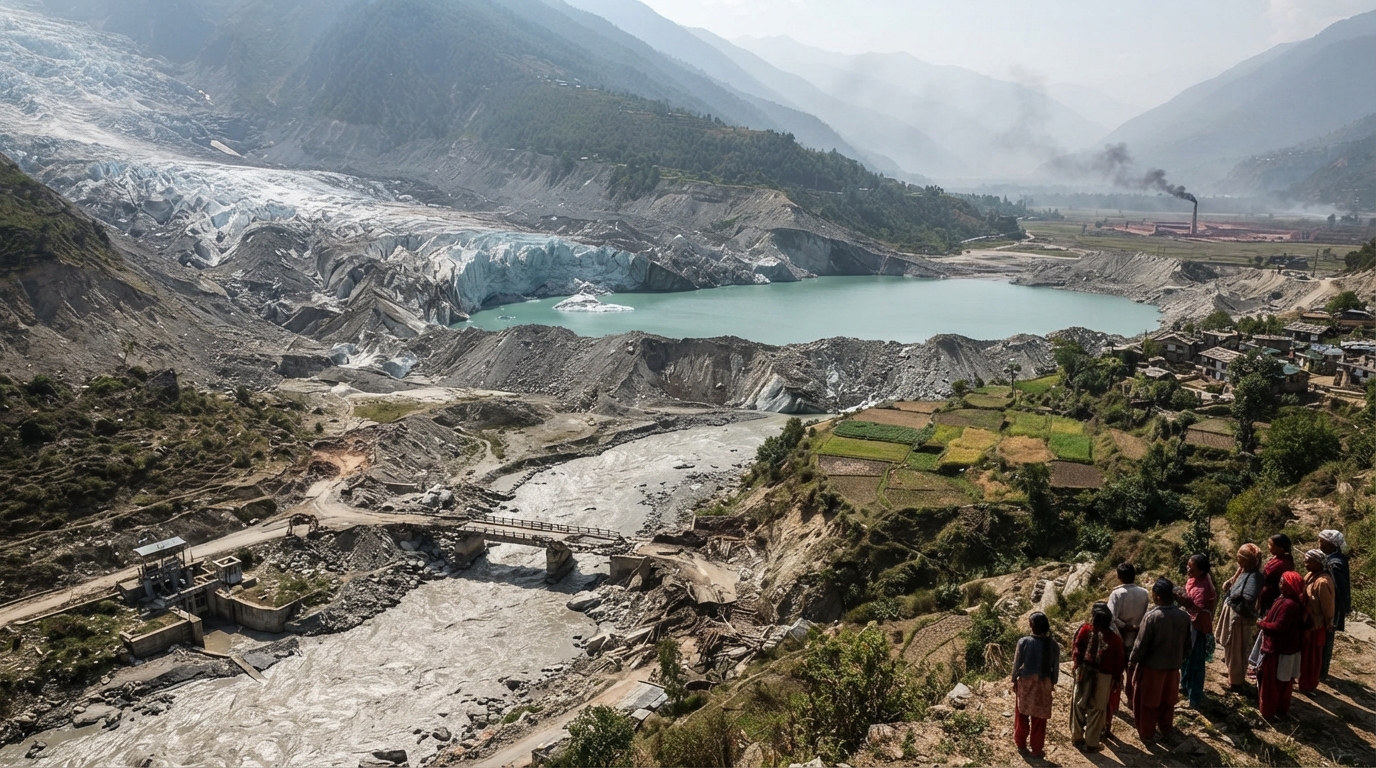
The Himalayas are melting more quickly - and India’s economy is “at risk”
India’s government says 56 glacial lakes were classified as “very high risk”
New research says the Himalayas are nearing a perilous point as glaciers melt at a faster pace, glacial lakes become more unstable and a growing monitoring shortfall leaves the mountains more exposed.
The findings follow catastrophic floods in Nepal and Tibet that killed more than 1,300 people and left widespread devastation, underscoring the rising dangers in a Himalayan environment changing at speed.
According to a report by global consultancy Systemiq, produced with the Integrated Mountain Initiative and with technical contributions from the International Centre for Integrated Mountain Development (ICIMOD) and GB Pant National Institute of Himalayan Environment, Himalayan glaciers are now losing mass 65% faster than they were 10 years ago.
Even so, only about 21 of the estimated 40,000 glaciers across the Himalaya-Karakoram region are being tracked in detail and on a sustained basis, the report says.
That lack of monitoring is significant because the physical terrain is shifting rapidly.
As glaciers withdraw, they can leave behind enlarging lakes held in place by unstable rock and ice deposits. Meanwhile, warming is weakening permafrost - permanently frozen ground that can thaw as temperatures rise - and high mountain slopes, raising the risk of cascading hazards, the report says.
A glacial lake outburst in 2023 caused a flash flood and extensive damage in Sikkim
India already has proof of how serious the threat is.
Although about 18% of Indian land is Himalayan, the region is responsible for around 35% of disasters, according to the report.
In July, the government told parliament that 56 glacial lakes had been classified as “very high risk”, external after a 2025 scientific assessment of 189 high-risk lakes in the Indian Himalayan region. The government said the Central Water Commission is monitoring 2,485 glacial lakes larger than 10 hectares across India’s Himalayan river basins.
The Himalayas have already provided stark examples of what can happen when glacial lakes break their natural barriers.
In 2023, a glacial lake outburst flood in Sikkim killed at least 70 people and caused major damage to roads, bridges and hydropower projects. In 2021, a similar disaster in Uttarakhand killed more than 200 people after a huge flood surged through the Rishiganga and Dhauliganga valleys.
But the danger goes beyond dramatic floods.
The Himalayas form a vast natural water system feeding rivers that support hundreds of millions of people across South Asia.
The new research attaches an unusually large economic figure to that dependence.
It estimates that Himalayan water supports about 20% of India’s GDP, sustaining wheat, rice, tea, hydropower and pilgrimage economies. Yet the mountain states receive only around 5% of that value, it says.
“The Himalayas are the Third Pole,” said economist Lord Nicholas Stern, chair of the Grantham Research Institute on Climate Change and the Environment at the London School of Economics. “Unlike the Arctic or Antarctic, this pole has hundreds of millions of people living beneath it.”
The Indian Himalayan region gets about 400 million visits a year
“This is national and international infrastructure,” he said, warning that the ecological system supporting it is “approaching a tipping point”.
Not every force behind glacier loss is outside the region’s control.
Systemiq’s research estimates that about a third of Himalayan glacier melt is caused by black carbon, much of it from brick kilns in the plains. Soot settling on snow and ice absorbs more sunlight and speeds up melting.
The report argues that, unlike global greenhouse-gas emissions, black-carbon pollution is a lever India and its neighbours can act on directly.
“The Himalayas are approaching a tipping point, with millions of lives and livelihoods hanging in the balance,” said Arushi Chopra, Systemiq’s senior director and lead author. “Glaciers are melting faster than they were a decade ago.”
The report sets out 10 priority transitions, from cutting black-carbon emissions and expanding glacier monitoring to strengthening disaster early-warning systems and changing how tourism is developed in the mountains.
One priority is improving disaster preparedness, with governments agreeing in advance on what to do when hazards arise - from evacuation to safeguarding vulnerable infrastructure.
Another is rethinking tourism. The Indian Himalayan region receives about 400 million tourist visits a year, according to the report, and researchers say the goal should move away from maximising visitor numbers and toward creating value that is kept and reinvested locally.
Pema Gyamtsho, director general of ICIMOD, said the risks are becoming more complicated.
“Glaciers are retreating, permafrost and high-mountain slopes are becoming increasingly unstable, and communities and infrastructure downstream face growing risks from complex and cascading hazards,” he said.
And those risks do not end at the borders drawn across the Himalayas. Such hazards, Gyamtsho said, “do not respect national borders, and no single country can address them alone”.
That makes cross-border monitoring, shared risk information and early-warning systems, and joint investment in resilience increasingly urgent - not only to save lives, but to protect the livelihoods and economies of hundreds of millions of people who depend on the mountains.