

Nepal: A Call from the Almighty
To what extent has the cumulative cascading risk for the Charvak project been studied and taken into account?
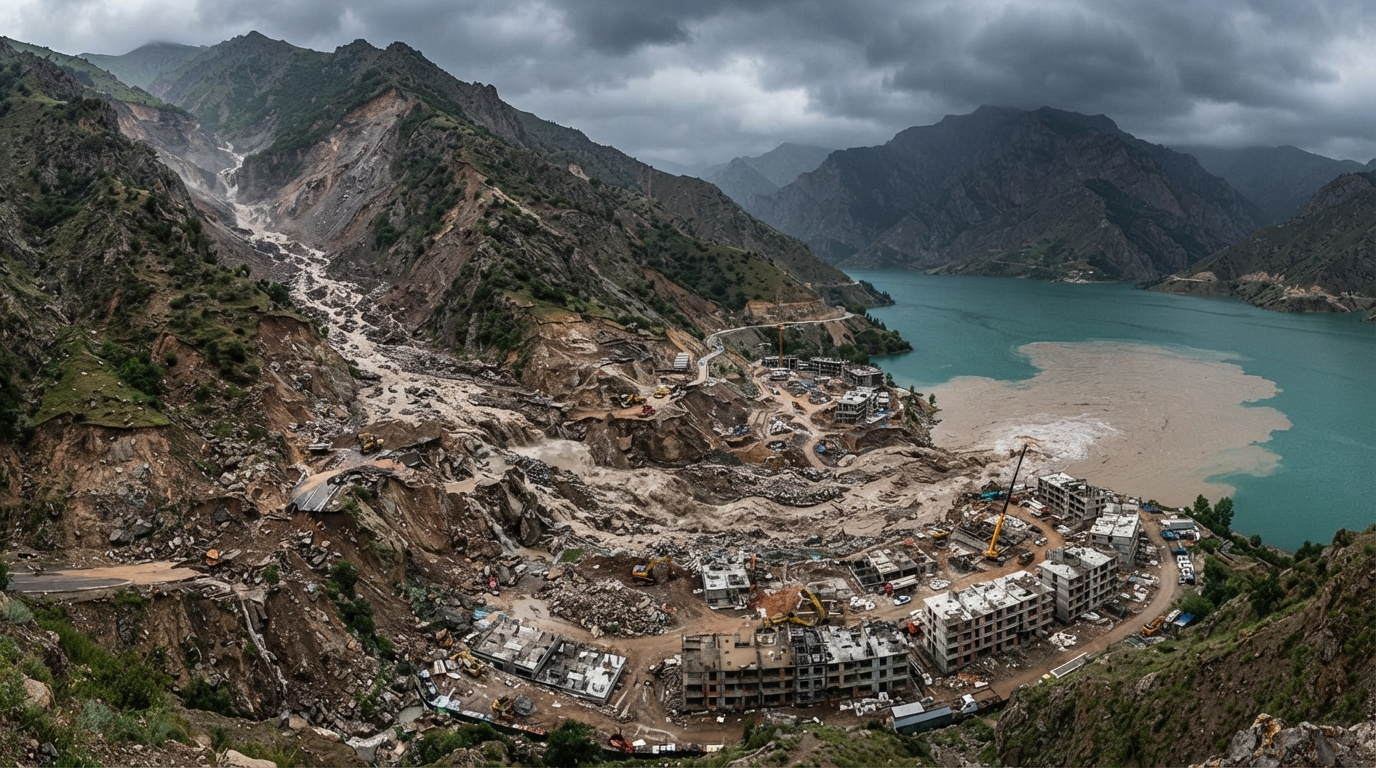
Nepal: A Call from Above
The tragedy that occurred in Nepal on August 26, 2026, when a section of a glacier collapsed, triggering a powerful mudflow of ice, rocks, and water. This flow, moving through a river system, destroyed settlements and infrastructure, claiming the lives of hundreds of people and leaving over a thousand missing. Scientists attribute the disaster to a combination of factors: global warming, melting glaciers, slope instability, geological features, and extreme hydrological events. This is an example of cascading risk leading to a large-scale disaster. Uzbekistan has expressed condolences to Nepal, and in this article, we will examine the dangers of cascading risk for our country.
While no one is comparing Uzbekistan to Nepal, there are reasons for concern. Construction projects, with some exceptions, must take these risks into account. One such exception is the Sea Breeze Uzbekistan project—the construction of a resort town on the shores of the Charvak Reservoir. How thoroughly has the cumulative cascade risk been studied and considered in this project?
The resort is planned on the eastern shore of the Charvak Reservoir, in an area with complex mountainous terrain, where the elevation difference ranges from 890 to 1,540 meters. The area includes steep slopes and gorges through which mountain rivers and numerous small streams flow. What would happen if extreme precipitation, soil saturation, a landslide or avalanche upslope, and a sudden change in the stream's course all converged? Where would the water, mud, rocks, and debris flow after such an extreme event?
The project's environmental assessment indicates the need for additional studies: engineering-geological, hydrological, geodynamic, botanical, and zoological, as well as calculations, including emergency scenarios.
The risk of landslides and slope instability associated with construction in the Ugam-Chatkal National Park has been repeatedly discussed, but the authorities responsible remain silent. The dangers are real, and they will be particularly acute for the resort town on the banks of the Charvak River. The published Environmental Impact Assessment (EIA) documents note that the soils in this area are easily eroded by construction, and existing vegetation on the terraces prevents slope erosion.
The project involves the construction of roads, buildings, utility lines, earthworks, terrain modification, slope stabilization, and the reconstruction of Road 4P-10. This raises questions not only about the natural stability of the slopes, but also about how construction will impact this stability.
It is clear that for the entire Chirchik River valley below the Charvak Reservoir, water is a source of life. It is mountain drinking water. However, if nature is neglected, water can become a destructive force.
Here are just a few extreme scenarios: prolonged downpours, rapid saturation of soil with water, mudflows, slope collapse into a stream, blockage of the streambed by debris followed by a sudden break of this natural "dam," as well as the breach or overflow of reservoirs upstream of Charvak.
The events in Nepal remind us that natural processes rarely follow a strictly defined scenario. For the Charvak zone, the following scenario should also be considered: earthquake → change in slope stability → landslides → blockage of streams → mudflow/sharp rise in water → damage to infrastructure.
Mere conclusions such as "a building can withstand an earthquake of a certain intensity" are insufficient. How will the surrounding terrain and the entire hydrological system of the region behave after powerful tremors?
According to media reports, the Sea Breeze project on the Charvak Reservoir is expected to have a significant number of visitors and workers—up to 10,000 visitors per day and approximately 7,000 employees. In the event of an extreme event, questions arise that require immediate answers: "How can we evacuate 10,000-17,000 people if the main access road is destroyed by a landslide or mudflow?" "How will rescuers reach victims if roads and bridges are damaged?"
A worst-case scenario assessment is needed, not just a "normal" impact assessment, on the territory of the Ugam-Chatkal National Nature Park. The construction of Sea Breeze Uzbekistan does not meet even the minimum requirements.
The Environmental Impact Assessment (EIA) published in April 2026 indicated that a number of initial data points were incomplete. For example, some calculations and information on water supply and wastewater disposal during the construction and operational stages were missing. Additional engineering, geological, and hydrological studies were specifically requested.
Until the potential catastrophic natural and cascading risks to human life have been studied, it is premature to claim that the project's environmental and public safety has been proven. The second stage of the EIA for the Sea Breeze project on the Charvak Reservoir has not yet been completed. Uzbek law does not provide for exceptions. Nevertheless, construction has already begun.