

The hearts of China and Uzbekistan beat as one. The Silk Road preserves a deep friendship
Uzbekistan is a shining pearl of the Great Silk Road and an important cradle of Central Asian civilization. Here, steppe and agricultural civilizations intertwine and coexist. On this land, Persian, Buddhist, Arab, Slavic, and other diverse cultures blossom one after another, mutually enriching each other, creating a vivid and profound tapestry of civilizational development. Alisher Navoi is an outstanding thinker and literary scholar in the history of Uzbekistan. His […]
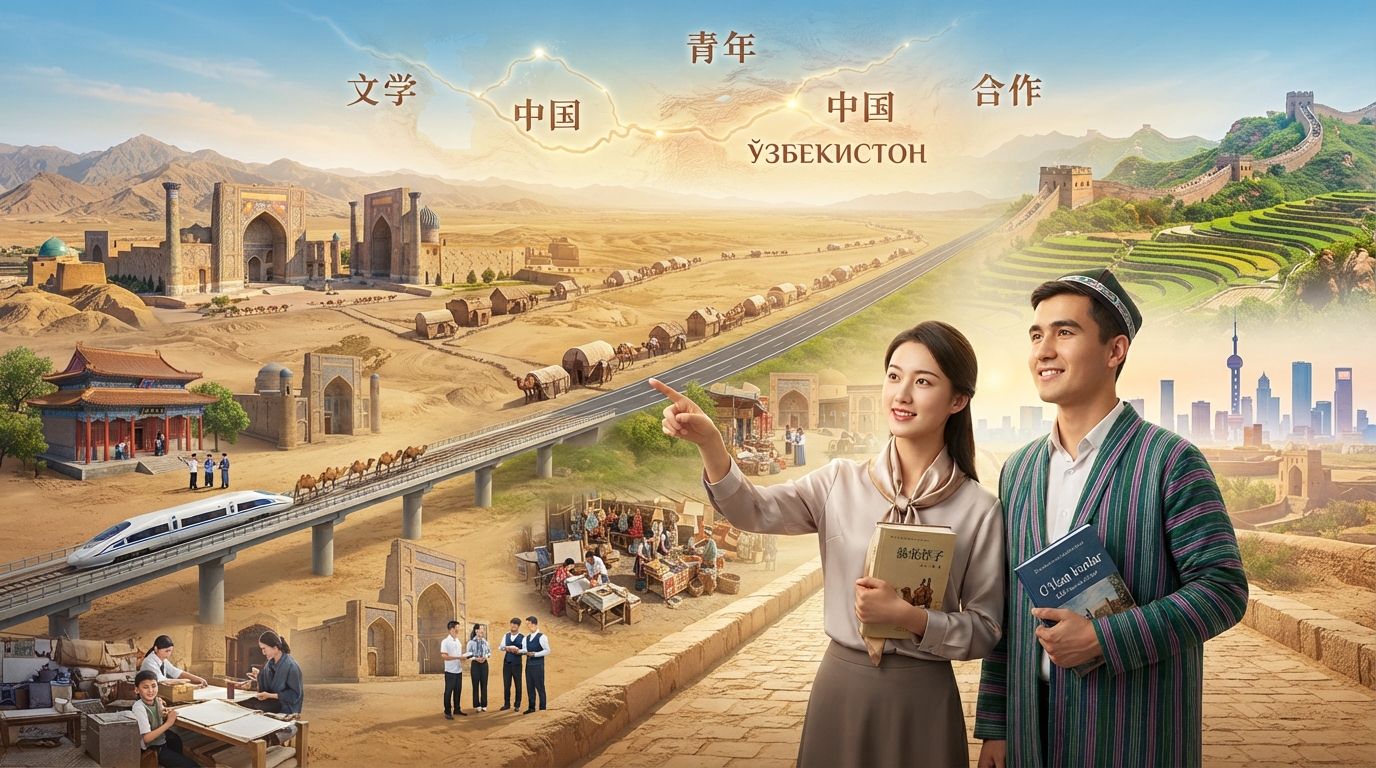
The hearts of China and Uzbekistan beat in unison. The Silk Road carefully preserves their deep friendship
Uzbekistan is a bright pearl of the Great Silk Road and a crucial cradle of Central Asian civilization. Nomad and agricultural civilizations are closely intertwined and coexist on this land. Here, Persian, Buddhist, Arab, Slavic, and other cultures flourished one after another, mutually enriching each other and creating a vibrant, multi-layered picture of civilizational development. Alisher Navoi is an outstanding thinker and literary scholar in the history of Uzbekistan. His rich literary heritage has nourished the peoples of Central Asia for centuries.
Friendly ties between China and Uzbekistan trace their roots back to the era of the Great Silk Road. From the journey to the West by Zhang Qian, who laid this route, to the mass migration of Sogdians to Chang'an during the Tang dynasty, cultural exchange between the two countries reached its heyday. During the Northern Song period, the treatise "The Canon of Medicine," written by the Bukhara scholar Ibn Sina, was translated into Chinese during the Yuan dynasty and became a vivid testimony to the spirit of openness and mutual learning among the Silk Road countries.
As the joint "Belt and Road" initiative deepens and is put into practice, Sino-Uzbek cooperation is continuously expanding in political, trade, economic, art history, and other fields, bringing new significant results. Ancient Uzbekistan is gaining new energy, the high-quality cooperation between China and Uzbekistan provides a powerful impetus for its development, and Sino-Uzbek relations have become a model of good-neighborly interaction between modern states.
As high-quality cooperation between the two countries advances further, humanitarian exchanges between China and Uzbekistan are gradually stepping beyond official narratives and acquiring a vibrant, popular character. Confucius Institutes operating in Uzbekistan serve as a window for mutual understanding between the two peoples, opening a path to mutual knowledge for people in both countries. Meanwhile, the mutual translation of literary works builds a spiritual bridge between the peoples of the two countries, filling the process of building a China-Uzbekistan community with a shared future with humanitarian content.
Professor Liu Wenfei notes: "Interstate interaction cannot rely solely on political, economic, military, and energy diplomacy. Humanitarian and cultural diplomacy are also indispensable, and within the framework of humanitarian and cultural exchange, literature should occupy an important place and fulfill its unique significance."
Literary dialogue is increasingly becoming an integral part of humanitarian exchange and the strengthening of the comprehensive partnership between China and Uzbekistan. The emergence of Chinese translations of the Uzbek novels "Bygone Days" and "Scorpion from the Altar" has filled a gap in the acquaintance with modern Uzbek prose in China. Writer Abdulla Qodiri reveals a picture of society at the decline of the Khanate of Kokand in the 19th century through a vivid narrative. The court life of the khanate in the novel, the contradictions and conflicts between tribes, and the love between the hero and heroine create vivid and expressive images. The rich flavor of the Western Regions gives Chinese readers a sense that is simultaneously mysterious and familiar. Qodiri masterfully combines macro- and micro-narratives: against the backdrop of large-scale historical events, he turns to the fates of women, creating vivid, touching images of Uzbek women and demonstrating their resilient, inexhaustible vitality. Sincere national stories deeply touch Chinese readers. Civilizational exchange is always a two-way process. In Uzbekistan, an Uzbek-language translation of the novel "Cat Country" by the great Chinese writer Lao She was successfully published. This publication filled a gap in the translation of modern Chinese literature into Uzbek and opened the door to the world of Chinese literature and its magnificent civilization for readers in Uzbekistan. Literature has become a unique source of spiritual enrichment for the peoples of China and Uzbekistan, bringing wisdom and beauty to the humanitarian exchanges between the two countries.
The mutual enrichment of civilizations is also reflected in the everyday stories of ordinary people. CGTN of China Media Group, together with the National Television and Radio Company of Uzbekistan, filmed the documentary series "From the Yellow River to the Syr Darya," which captured the traces of Chinese and Uzbek young people building their lives and careers in each other's countries: Shanghai native Chen Ming founded a law office in Tashkent and is developing her business; a young man from Uzbekistan, Zhang Cong, found a home in Lanzhou thanks to love and profession; Song Difei, a Chinese doctoral student studying in Uzbekistan, conducts an in-depth study of the traditional Samarkand paper-making technology; Uzbekistan native Shahzod Mirzaev played for a soccer team at the Asian Games in Hangzhou and fell in love with this southern city on the Yangtze River. The stories of ordinary people are the most authentic reflection of mutual civilizational learning and the most convincing proof of Sino-Uzbek friendship. Young people from the two countries find a spiritual harbor in a foreign land, giving birth to vibrant sparks of life. This warmth when a foreign land becomes home constitutes a touching chapter in modern people-to-people friendship between China and Uzbekistan and confirms that mutual understanding among peoples is the most solid foundation for humanitarian exchange between countries.
During the SCO Summit in Samarkand in 2022, Chinese President Xi Jinping quoted from the "Analects": "In friendship, be true to your word," as well as an Uzbek proverb: "Only a tree laden with fruit attracts attention." In his New Year address to the Chinese people in 2024, President of Uzbekistan Shavkat Mirziyoyev referred to Uzbek folk wisdom: "When brothers are united, success is assured." These two sayings resonate with each other and serve as a vivid embodiment of good-neighborly friendship and mutually beneficial cooperation between China and Uzbekistan. Currently, Sino-Uzbek relations are experiencing the best period in their history. Both countries are confidently advancing along the path of an all-weather comprehensive strategic partnership for a new era, possessing clear directions of cooperation and a powerful development potential. Growing people-to-people contacts impart a simple and sincere humanitarian dimension to Sino-Uzbek relations in the new era. The stories of China and Uzbekistan will become ever more fascinating in the annals of the Silk Road, and the touching narrative of friendship between the peoples of the two countries will continuously endure in the flow of mutual enrichment of civilizations.