

What does Uzbekistan have in common with China, Russia, the United States, and South Korea, and how will their relations develop? In Gazeta's blitz for foreign ambassadors
In the second part of its Independence Day blitz, Gazeta asked the ambassadors of China, Russia, the United States, and the Republic of Korea to draw historical parallels with Uzbekistan, identify what most strongly connects the countries today, and formulate three guidelines for the future.
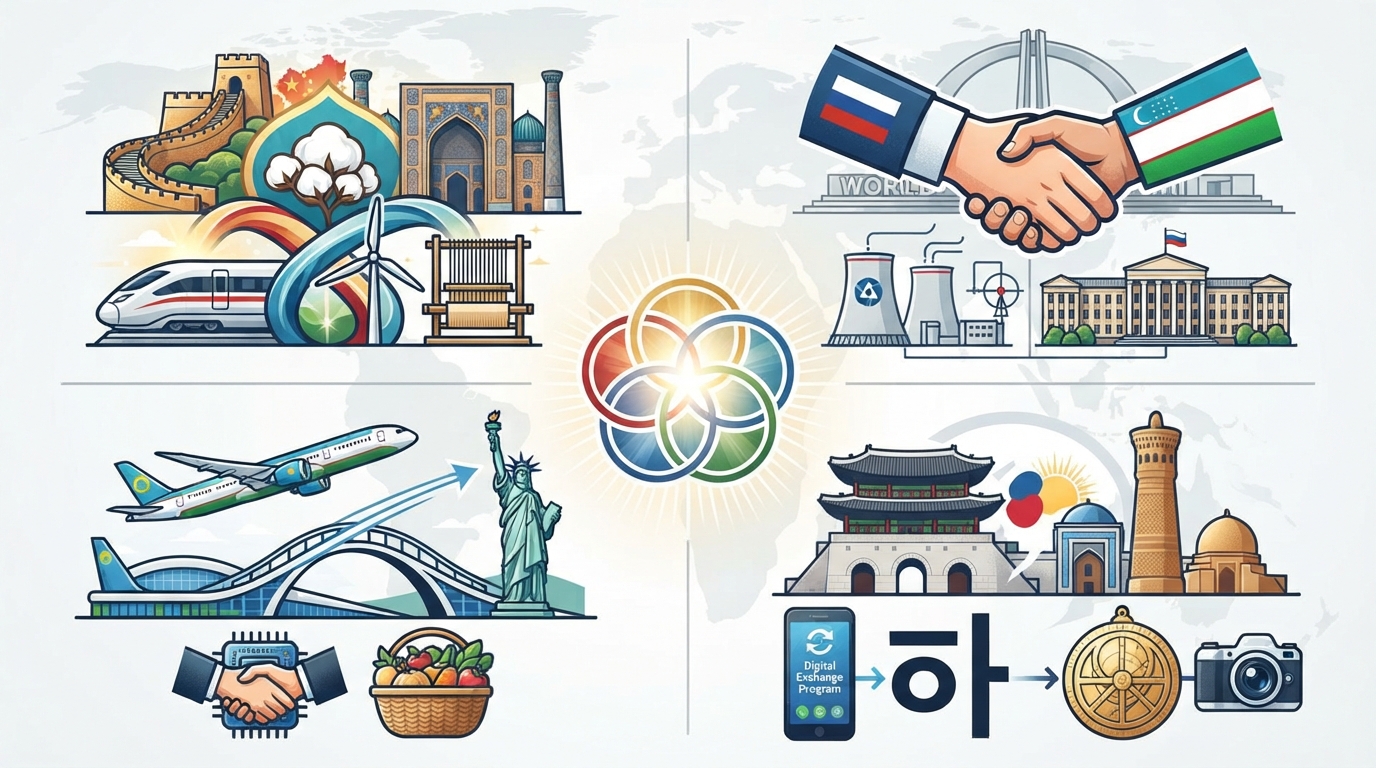
What unites Uzbekistan with China, Russia, the United States, and South Korea, and how their relations will develop—in Gazeta's blitz interviews with foreign ambassadors.
**China and Uzbekistan: Common Paths to Modernization**
Under the leadership of the Communist Party, China is actively implementing a program of national rejuvenation through modernization, characterized by five key aspects: a large population, shared prosperity, harmonious development of the material and spiritual spheres, coexistence between man and nature, and peaceful development. These efforts have earned China global recognition.
At the same time, Uzbekistan is rapidly building a "New Uzbekistan," based on the "Uzbekistan 2030" strategy. The country is comprehensively developing the economy, implementing legal reforms, improving the well-being of citizens, caring for the environment, and expanding openness. Thanks to this, Uzbekistan is demonstrating rapid economic growth, improving living standards, and strengthening its position on the international stage, becoming one of the most dynamic countries in Central Asia.
China and Uzbekistan are at an important stage of development and national revival, sharing similar views on the path to modernization. This year, Uzbekistan celebrates the 35th anniversary of independence. As the Uzbek proverb goes, "Associating with a worthy person helps make a dream come true." China is ready to deepen cooperation with Uzbekistan, synchronizing the two countries' development strategies and expanding interaction in trade, investment, digital technologies, education, and humanitarian exchanges to achieve mutually beneficial modernization.
**Russia and Uzbekistan: Historical Ties and Strategic Partnership**
The history of the 20th century clearly confirms the strength of the fraternal and friendly relations between Russia and Uzbekistan, which have shared both joys and difficulties.
During the Great Patriotic War, heroes of both countries fought shoulder to shoulder on the front, and the home front became a symbol of mutual support and human solidarity. Uzbekistan welcomed evacuated businesses, cultural and scientific institutions, and thousands of people, including children, for many of whom this land became a second home.
The most enduring legacy of our shared history is our continuous cultural and human dialogue. Russian and Uzbek literature, music, theater, cinema, education, and science have enriched each other for decades, creating a unique space for mutual influence.
Modern relations between Russia and Uzbekistan are based not only on political and economic interests, but also on a deep historical foundation: the memory of a shared journey, strong humanitarian ties, and, in many ways, shared values and views.
**The United States and Uzbekistan: Parallels in Development and Openness**
Parallels can be drawn between President Shavkat Mirziyoyev's current vision of leading a "New Uzbekistan" toward peace and prosperity and the "dawn of the American century" in the late 19th and early 20th centuries. During that period, the United States abandoned isolationism, actively engaging with the world, strengthening ties with its neighbors, developing trade, and implementing domestic economic reforms, including dismantling monopolies, to reduce poverty and create economic opportunity.
**South Korea and Uzbekistan: Ancient Ties and Modern Exchanges**
King Sejong the Great of the Joseon Dynasty and Ulugh Beg of the Timurid Empire, both of whom ruled in the 15th century, share important similarities: under their reigns, both countries experienced a golden age of cultural and scientific flourishing.
Both rulers saw scholarship, science, and technology as the foundation for the development of their states. King Sejong encouraged scientific research, supported astronomy, and created Hangul, the Korean script. Around the same time, Ulugh Beg founded a madrasah and observatory, achieving outstanding achievements in astronomy and mathematics, which contributed to the intellectual and cultural flourishing of the Timurid Empire.
It is noteworthy that the calendar treatise "Chiljeongsan Waepyeong," created under King Sejong, was influenced by the astronomical and calendrical systems of the Islamic world, including the Timurid Empire. This testifies to the long history of exchanges between the Republic of Korea and Uzbekistan.
**Common Features and Prospects for Cooperation**
**China and Uzbekistan: Common Approaches to Public Administration**
China and Uzbekistan are linked by many factors, among which a common approach to public administration is one of the most striking.
Both countries are pursuing independent development paths suited to their national conditions and firmly support each other on issues affecting their core interests. They adhere to a people-centered approach to development, considering improving well-being and citizen satisfaction as key criteria for reform. The countries actively promote poverty reduction, job creation, and the development of social protection systems, striving to ensure that national development results bring real benefits to the population.
For example, China eliminated absolute poverty in eight years by 2020, developing its own experience and solutions. Uzbekistan is actively leveraging Chinese experience in poverty reduction programs, and by 2025, the poverty rate in the country had fallen to 5.8%.
The two countries' positions and views on global issues largely coincide. President Shavkat Mirziyoyev has put forward a number of significant initiatives at international forums that share similar goals with Chinese President Xi Jinping's four global initiatives: the Global Development Initiative, the Global Security Initiative, the Global Civilization Initiative, and the Global Governance Initiative. Uzbekistan actively supports the concept of a community with a shared future for humanity, which is reflected in important documents defining relations between the two countries.
The profound convergence of China and Uzbekistan's approaches to governance will open up even broader prospects for the development of bilateral relations and lay a solid foundation of mutual trust for practical cooperation in all areas. China is ready to work with Uzbekistan to translate shared conceptual principles into concrete actions, deepening and giving practical substance to the construction of a China-Uzbekistan community of shared destiny, so that the fruits of cooperation will bring even greater benefits to the peoples of both countries, providing sustainable impetus to their development and revival.
**Russia and Uzbekistan: Comprehensive Strategic Partnership**
Today, Russian-Uzbek relations represent a comprehensive strategic partnership, filled with concrete content every day. By the end of 2025, trade turnover between the countries exceeded $13 billion, and by 2030, it is planned to reach $30 billion.
These figures reflect real production and investment: more than 3,200 enterprises with Russian capital operate in Uzbekistan, and the total portfolio of joint projects is approaching $44 billion.
One of the most large-scale examples is the construction of an integrated nuclear power plant in the Jizzakh region by the state corporation Rosatom: in June 2026, the leaders of the two countries launched the pouring of the first concrete for its first power unit.
Industrial cooperation is developing—from energy and chemicals to pharmaceuticals, logistics, and mechanical engineering; the Chirchik and Jizzakh industrial parks play a key role. At the same time, transport links are strengthening, air travel is expanding, and trade routes and logistics projects are developing. Interregional dialogue is dynamic.
However, today's cooperation is not limited to the economy: it also includes education, science, culture, and human ties. There are 15 branches of Russian universities operating in the republic, graduating top-notch specialists in various fields—from international relations to medicine. Hundreds of young Uzbeks come to Russia every year to pursue higher education under the Russian Government's quota. Cross-cultural projects are regularly held, and prominent artists perform there.
Today, Russia and Uzbekistan are strategic partners, countries with a significant reservoir of mutual trust and shared interests. They face the challenge of transforming this potential into new joint projects, jobs, technologies, and opportunities for the development of their people.
**US and Uzbekistan: Openness and People-to-People Connections**
Today, relations between the US and Uzbekistan are characterized by trust and genuine openness that extends beyond intergovernmental contacts. Ten years ago, cooperation was narrow and focused primarily on regional security. Today, it encompasses almost all areas: security, trade, energy, agriculture, and technology. Following the November 2025 meeting between Presidents Trump and Mirziyoyev, the countries announced billions of dollars in new cooperation projects. This included Uzbekistan's purchase of 22 Boeing Dreamliner aircraft, projects in critical minerals and rare earth metals, and expanded trade in agricultural and other products.
What is particularly impressive is how this openness is reaching ordinary people. Uzbekistan's introduction of a visa-free regime for US citizens means that Americans wishing to visit family and friends, or simply curious about the region, no longer need to undergo a visa to experience Uzbekistan's hospitality and history firsthand.
This is borne out by personal experience: children and friends who have visited Uzbekistan have fallen in love with places like Samarkand, Bukhara, and Tashkent. This is people-centered diplomacy, and it is this that most binds the countries together today.
**South Korea and Uzbekistan: Strong People-to-People Ties**
Today, people-to-people exchanges are among the strongest ties between the Republic of Korea and Uzbekistan. Last year, the number of Korean tourists visiting Uzbekistan reached 46,300, and this figure has been steadily growing since the COVID-19 pandemic.
Furthermore, according to data from last year, 15,786 students from Uzbekistan were studying in the Republic of Korea, accounting for a third of the total number of international students in the country. Such active exchanges foster deeper mutual understanding and trust between the countries and lay a solid foundation for the sustainable development of bilateral relations.
**Key Foundations of Relations:**
**China and Uzbekistan:**
* Strategic mutual trust.
* Mutual benefit.
* Mutual understanding between peoples. These three pillars ensure the sustainable and long-term development of the China-Uzbekistan all-round strategic partnership in the new era.
**Russia and Uzbekistan:**
* Brotherhood, mutual trust, and respect.
* Consideration of each other's interests.
* Focus on results for the prosperity of our peoples.
**USA and Uzbekistan:**
* Openness.
* Partnership.
* People-to-people ties.
**South Korea and Uzbekistan:**
* A shared path.
* Trust.
* Partnership.