

Uzbekistan, Pakistan explore Babur film project as cultural and media ties deepen
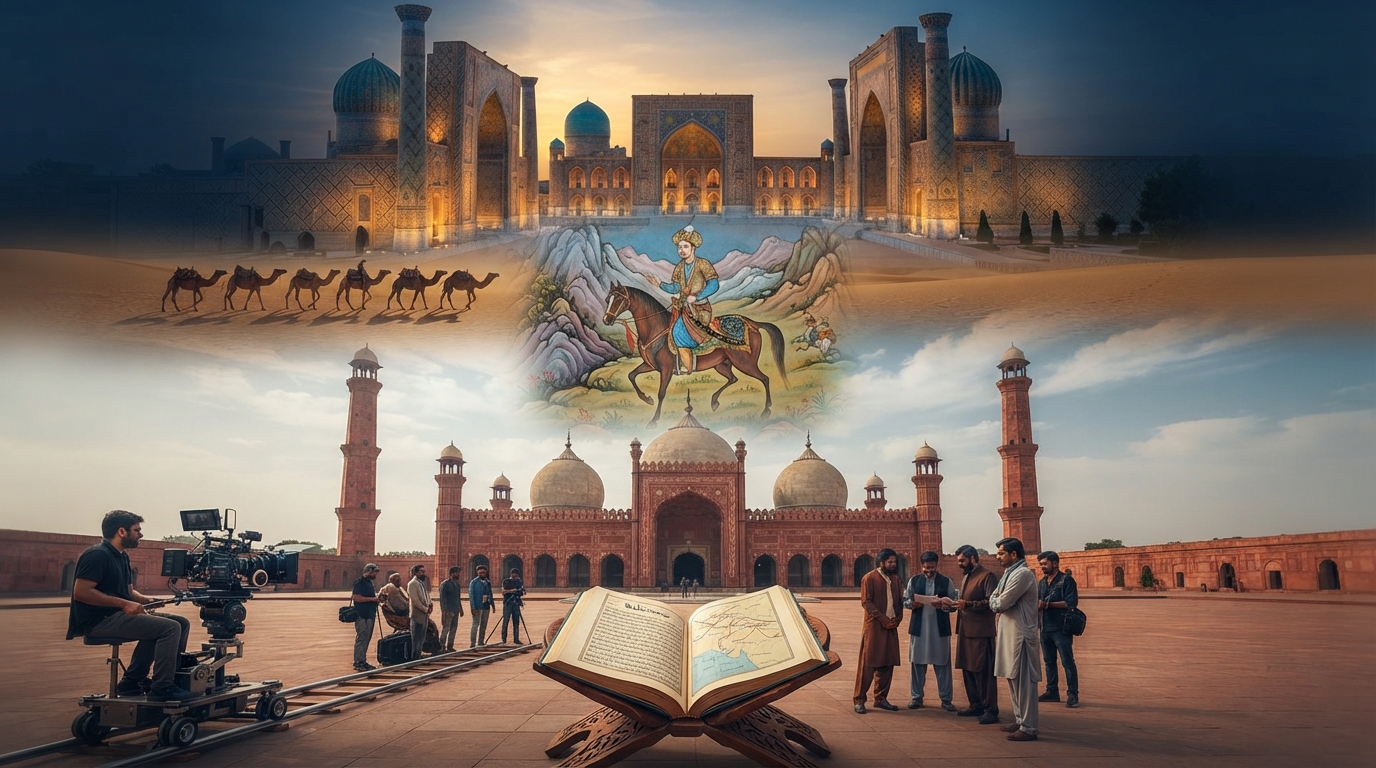
Uzbekistan and Pakistan are deepening cultural and media ties through discussions of a joint Babur film project, with the story of Zahiriddin Muhammad Babur increasingly serving as a symbol of broader cooperation between the two countries.
More than 500 years after Babur reached the Indian subcontinent, his legacy still stands as one of the clearest historical connections between Central Asia and South Asia. Born in Andijan in 1483, Babur founded the Baburid dynasty after winning the First Battle of Panipat in 1526, leaving behind a political and cultural heritage that continues to shape architecture, literature and traditions across the region.
Today, Uzbekistan and Pakistan are looking to build on this shared past as part of wider bilateral cooperation. In recent years, ties have grown through political visits, trade, transport links and cultural projects, with both governments calling the relationship a strategic partnership. Trade turnover between Uzbekistan and Pakistan reached nearly $500mn by the end of 2025, and both sides have set a goal of raising bilateral trade to $2bn.
The proposed Babur film project was one of the main subjects discussed during a visit by an Uzbek media delegation to Pakistan’s Ministry of Information and Broadcasting (MoIB) in Islamabad, where officials pointed to cinema, television and digital content exchange as growing areas of cooperation.
“The script is under consideration, and locations and casting details are yet to be finalised,” Khan told the delegation, adding that the project is expected to include both Uzbek and Pakistani participation.
The planned film is part of broader talks on cooperation in cinematography, documentaries and television content. Current institutional ties include cooperation between the Associated Press of Pakistan (APP) and Uzbekistan’s National News Agency (UzA), as well as between Pakistan Television Corporation (PTV) and Uzbekistan’s National Television and Radio Company (NTRC).
For both countries, Babur serves as a link between Central Asia and South Asia. At the meeting, Pakistani officials drew attention to the Baburid architectural legacy seen in cities such as Lahore, including landmarks shaped by the dynasty’s Central Asian roots.
“When you go to Lahore, you will find the Mughal [Baburid] heritage, the Badshahi Mosque, Shalimar Gardens and various historical buildings with Central Asian motifs and designs,” Khan said.
Babur’s memoir, the Baburnama, written in Chagatai Turkic, offers direct observations of Central Asian and South Asian societies in the 15th and 16th centuries and remains one of the period’s most important historical works.
The historical ties between the two regions go beyond the Baburid era. Uzbekistan and Pakistan have often pointed to centuries of interaction along the Silk Road, when Central Asian cities and South Asian centers were connected through trade, learning and cultural exchange. Scholars such as Imam al-Bukhari, Imam al-Termizi, Al-Khwarizmi, Al-Biruni and Ibn Sina are still widely recognised across the region for their contributions to science, philosophy and Islamic scholarship.
The Baburid architectural heritage discussed at the meeting includes some of Pakistan’s best-known historical sites. The Lahore Fort and Shalimar Gardens, both UNESCO World Heritage sites, reflect architectural traditions from the Baburid period, blending Persian, Islamic and Central Asian influences.
Another major Baburid-era landmark mentioned by Pakistani officials was the Badshahi Mosque in Lahore, built between 1673 and 1674 during the reign of Emperor Aurangzeb and still one of the largest examples of Baburid religious architecture.
Modern cultural cooperation has increasingly centered on preserving and promoting these historical links. During Uzbekistan President Shavkat Mirziyoyev’s state visit to Pakistan in February 2026, the two countries signed an agreement to preserve, study and promote the scientific, educational, cultural and architectural heritage of the Great Baburid Dynasty. They also discussed Uzbekistan Culture Weeks, Uzbek Cinema Days in Pakistan and the possibility of creating a joint cultural centre in Lahore.
The symbolic weight of Babur’s legacy was also visible in Islamabad, where Pakistani authorities named a park after Zahiriddin Muhammad Babur and named a street “Tashkent” during President Mirziyoyev’s 2026 visit.
These efforts show how historical heritage is increasingly being used as a platform for modern cultural diplomacy, including through films, documentaries and media exchanges.
The Uzbek delegation’s visit came as media relations between the two countries continue to expand alongside political and economic cooperation. The delegation, made up of journalists, television representatives, bloggers and digital content creators, visited Pakistan to study the country’s media environment and look for future collaboration opportunities.
Khan said cooperation could cover journalist exchanges, joint reporting projects, television programming, documentaries, cinema production and digital media initiatives.
“Media cooperation is not just print and electronic media, but also in the digital domain,” he said.
Pakistan’s Ministry of Information and Broadcasting oversees government media policy and works with institutions including Pakistan Television Corporation, Pakistan Broadcasting Corporation and the Associated Press of Pakistan Corporation.
Pakistan Television Corporation, founded in 1964, runs terrestrial and satellite services, while Pakistan Broadcasting Corporation manages radio services nationwide through multiple broadcasting networks, according to the Ministry of Information and Broadcasting.
During the talks, Pakistani officials also pointed to the rapid rise of digital platforms and the difficulties created by the speed of online information sharing. Khan said social media has become an important way to reach audiences but has also made cooperation more necessary in tackling misinformation.
“One of the challenges is to rectify fake news and baseless content,” he said.
Officials said digital communication has become an increasingly important focus as audiences move toward online platforms and social media networks.
The media discussions took place against the backdrop of growing economic and social ties between Uzbekistan and Pakistan.
Uzbekistan and Pakistan have elevated their relations to a strategic partnership, with both governments identifying trade, transport connectivity, agriculture, industry and cultural exchange as priority areas.
Uzbekistan’s trade turnover with Pakistan has risen sharply over the past decade, from about $36.5mn in 2017 to nearly $450mn in 2025. The two countries are also expanding transport cooperation, including talks on regional connectivity projects linking Central and South Asia.
By the end of 2025, bilateral trade stood at $445.9mn, with Uzbekistan exporting $325mn worth of goods to Pakistan and importing around $121mn worth of goods. Uzbekistan’s main exports included food products, industrial goods and services, while Pakistan supplied food products, chemicals, pharmaceuticals and manufactured goods.
Business ties have also grown. Around 230 enterprises with Pakistani capital were operating in Uzbekistan by early 2026, and trade houses have been set up in Karachi, Lahore and Tashkent to support commercial exchange.
Transport connectivity has become another major area of cooperation. Uzbekistan and Pakistan have discussed regional routes including the Trans-Afghan railway project and the Pakistan–China–Kyrgyzstan–Uzbekistan transport corridor, designed to improve links between Central Asia and South Asian seaports.
Tourism links have also strengthened. Nearly 18,800 Pakistani citizens visited Uzbekistan for tourism in 2025, while tourist trips by Uzbek citizens to Pakistan increased compared with the previous year.
Direct air links have also helped bring people closer. Uzbekistan and Pakistan restored the Tashkent–Lahore flight route, and officials have discussed expanding transport connections to support tourism, business travel and cultural exchange.
Educational and cultural exchanges have also become part of the relationship. Both sides have encouraged cooperation among universities, cultural institutions and media organizations, with officials describing people-to-people contacts as an important part of bilateral ties.