

The first toll road, new measures for businesses, and parking in place of business centers – news of the week
Uzbekistan's first toll road: a trip from Urgench to Khiva will now cost drivers 25,000 soums. Shavkat Mirziyoyev presented new support measures for entrepreneurs in Khiva, from unsecured loans to preparing companies for IPOs. New appointment: Timur Ismailov appointed First Deputy Minister of Internal Affairs. Tashkent is attempting to reclaim lands once given over to business centers for parking lots. Nearly 231,000 applicants failed to meet the minimum admission threshold for universities. Kun.uz summarizes the week's key findings.
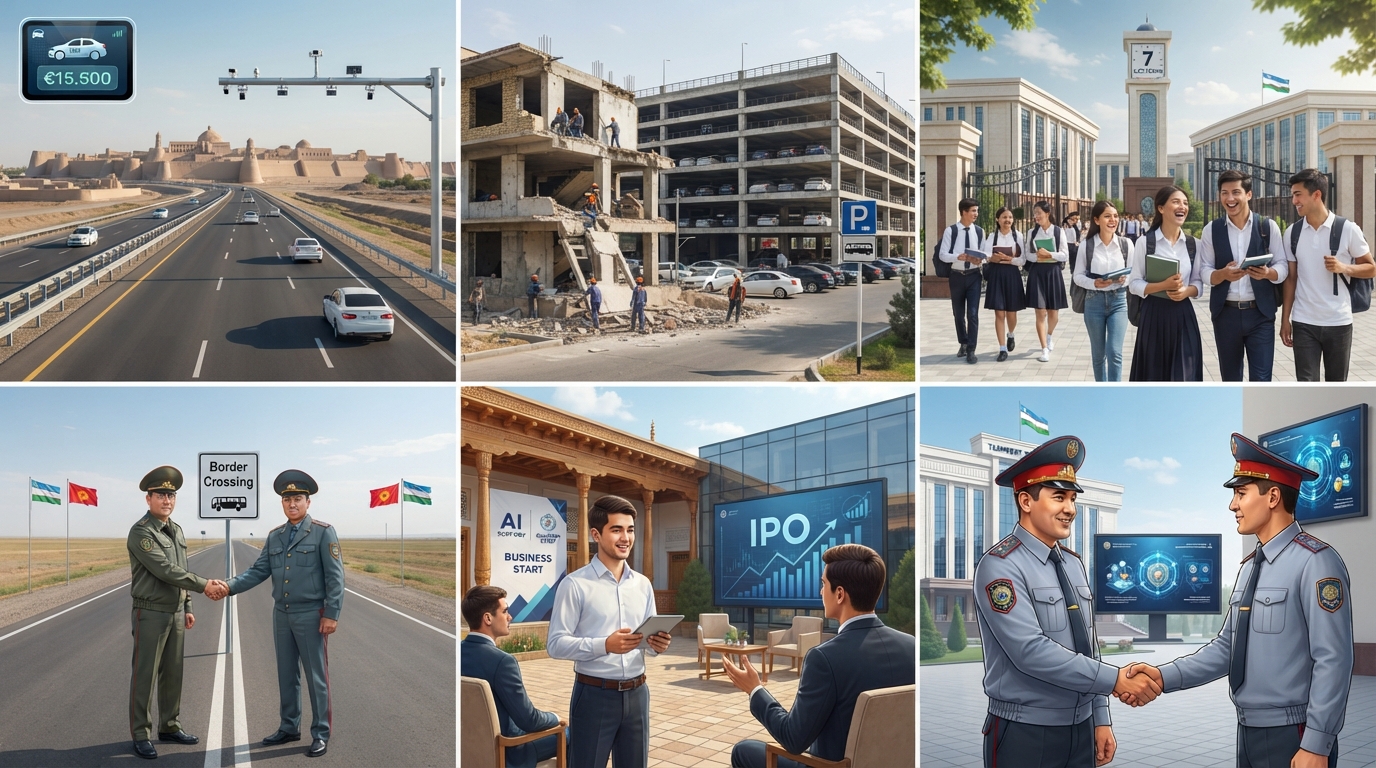
The first toll road, new measures for businesses, and parking lots replacing business centers — news of the week
**Uzbekistan's first toll road:** a trip from Urgench to Khiva will now cost drivers 25,000 soums. Shavkat Mirziyoyev presented new support measures for entrepreneurs in Khiva, ranging from unsecured loans to preparing companies for IPOs. **New appointment:** Timur Ismailov has been appointed First Deputy Minister of Internal Affairs. Tashkent is attempting to reclaim lands once allocated for business centers for parking lots. Nearly 231,000 applicants failed to meet the minimum threshold for university admission.
**Parking Lots Are Coming Back: Tashkent Corrects Urban Planning Mistakes**
The parking problem in Tashkent is linked not only to the increasing number of cars but also to the previous use of city land.
The capital's mayor, Shavkat Umurzakov, stated that business centers were previously built on plots allocated for parking lots. Now the authorities promise to take this issue under strict control. Together with the Urbanization Committee, sites for multi-story and underground parking garages with a total capacity of up to 200,000 vehicles have already been identified, and these are gradually being put up for auction. At the same time, a Park & Ride system near metro stations is planned to be developed by the end of 2028.
The program appears ambitious, but the main question is how consistently the city will be able to maintain the designated use of these lands. In fact, the authorities are now trying to correct the consequences of decisions that contributed to the current parking shortage.
**New Academic Year: Competition at Universities Increases**
In Uzbekistan, the academic year will begin in stages: classes in schools, lyceums, and technical colleges will begin on September 2, for first-year university students on September 7, and for senior students on September 14. Against this backdrop, the admissions campaign has shown a noticeable increase in competition.
Nearly 231,000 applicants, or 37.5% of exam participants, failed to achieve the minimum score of 56.7. Meanwhile, the average passing score increased to 134.6 for a grant and 93.7 for a contract, compared to 121.8 and 84.9 the previous year, respectively, while the quota increased to 201,700 places.
The increase in scores does indicate increased competition, but the 37.5% who failed to meet the minimum threshold also highlights another side of the coin. Against the backdrop of expanding admissions and growing demand for IT and AI, the question is no longer just about the number of places, but also about the quality of applicants' preparation for the demands of the new economy.
**Kyrgyzstan and Uzbekistan Expand Border Cooperation**
Kyrgyzstan and Uzbekistan are gradually moving from resolving border disputes to the practical restructuring of the border space—from exchanging territories to opening new checkpoints.
The joint working group will now address specific issues: citizenship, resettlement, property, land use, and social protection. This is an important stage, as the fates of individual families are at stake in the changes to the map. The preservation of education is specifically envisaged, demonstrating the scale of the work ahead.
Against this backdrop, the possible opening of the Mamai checkpoint appears a logical continuation of the process. The new crossing could provide border areas with greater opportunities for trade and tourism, especially if the Kerben-Mamai road is built simultaneously.
Kyrgyzstan and Uzbekistan have agreed to double the number of checkpoints, from 15 to 30, continuing their commitment to closer integration of border territories.
**Khorezm Prepared for a New Tourism and Investment Spurt**
President Shavkat Mirziyoyev is consistently developing Khorezm as a region where tourism, transport, investment, and international cooperation should work hand in hand.
Urgench's airport is being reconstructed for $264 million, increasing its capacity more than fourfold to 1,300 passengers per hour. At the same time, transport links with Khiva are being developed: an electrified railway has been launched, and a new toll road is expected to reduce travel time from 45 to 20 minutes.
Khiva is receiving infrastructure for a different scale of tourism: an international tourist town, a congress hall, a hotel, and a reception house.
At the same time, a branch of a Chinese university and the Confucius Institute are expected to train specialists for growing cooperation with China.
The scale of the investment is indicative: while the region attracted $30 million in foreign investment in 2016, by 2026 this figure is expected to exceed $2 billion. The aim is to make Khorezm not only a tourist destination but also an international economic and cultural hub.
Uzbekistan Strengthens Its Policy on Supporting and Liberalizing Business
During an open dialogue with entrepreneurs in Khiva, President Shavkat Mirziyoyev presented a comprehensive package of measures designed to support businesses at all stages—from launching a small business to large companies entering the international capital market.
For aspiring entrepreneurs, the "Business Start" program is being launched, featuring AI support, ready-made business plans, and unsecured loans of up to 200 million soums. Access to financing is being expanded for existing businesses: the state and the Guarantee Fund will assume a portion of collateral obligations. At the same time, a moratorium on most small business inspections is being introduced for three years, and fines for entrepreneurs are planned to be halved on average. A "presumption of rightness" for entrepreneurs is also expected to come into effect in 2027.
At the same time, the authorities want to elevate business: 50 large companies will be prepared for IPOs annually, with the state covering half of the preparation costs. This is expected to attract at least $1 billion annually from abroad. Overall, the authorities hope that, through tax breaks, trade liberalization, and new infrastructure projects, the private sector will become one of the main drivers of growth.
While the scale of the measures is impressive, their effectiveness will depend less on the number of announced incentives than on how they are implemented. Reducing inspections and fines could truly transform the relationship between the state and business if entrepreneurs receive not just formal protection but predictable rules of the game.
**First toll road: Urgench-Khiva toll to cost 25,000 soums**
Uzbekistan is launching its first toll road, where payment will be processed automatically and without stopping.
A passenger car will travel along the Urgench-Khiva route for 25,000 soums, and a short 28-kilometer section will cost 20,000 soums.
The road is currently operating in test mode, and its full launch is scheduled for August 25. Its capacity exceeds 30,000 vehicles per day, and traffic and payment management are carried out using artificial intelligence.
**Uzbekfilm is mired in debt**
The nearly century-old film studio's problems today are no longer creative, but financial.
According to Jakhongir Akhmedov, First Deputy Minister of Culture and Director of the Cinematography Agency, Uzbekfilm has accumulated significant debts: 22.9 million euros in loans and over a billion soums in taxes. The studio's property and land are mortgaged, and 12 vehicles may be auctioned. Furthermore, it has outstanding wage arrears.
To operate independently, the studio needs to fulfill orders worth at least 60 billion soums per year, but it lacks its own sustainable business model—it remains dependent on government contracts.
This creates a paradox: the studio has a rich filmmaking heritage, but lacks financial stability. Now Uzbekfilm faces radical reform. And the main question is whether it will finally be possible to make the legendary film studio independent and competitive.
**The head of the Nurafshan youth affairs department was fired for insulting subordinates**
Office ethics for managers is becoming more than just a formality: rude treatment of employees has resulted in real personnel actions.
The head of the Nurafshan youth affairs department, Mirkarim Akhmadzhanov, was fired after an incident at a meeting on August 18. An investigation found violations of ethical standards, as well as a number of operational shortcomings. The department emphasized that managers are obligated to respect the dignity of employees and maintain a healthy work environment.
It is noteworthy that 31-year-old Akhmadzhanov only took up his position in February. This incident demonstrates that professional requirements for managers include not only performance but also management culture.
**Timur Ismailov appointed First Deputy Minister of Internal Affairs**
A personnel reshuffle has taken place within the Ministry of Internal Affairs amid increased attention to public safety and crime prevention.
Colonel Timur Ismailov has been appointed First Deputy Minister of Internal Affairs and Head of the Department of Public Safety, leaving his position as Head of the Surkhandarya Region Department of Internal Affairs. His responsibilities include crime prevention, digitalization of the system, and strengthening interagency cooperation.
Particular attention is currently being paid to security in mahallas, preparations for the 35th anniversary of independence, and the start of the new school year.
**Sardor Mirzarayimov appointed Head of the Syrdarya Region Department of Internal Affairs**
Colonel Sardor Mirzarayimov has been appointed Head of the Syrdarya Region Department of Internal Affairs. He previously served as Head of the Criminal Investigation Department of the Ministry of Internal Affairs. The new head was introduced to the regional leadership on August 21.
The previous head of the Internal Affairs Directorate, Farrukh Khaidarov, was dismissed after a report of grievous bodily harm to a subordinate.
**Diyor Imomkhodjaev re-elected as head of the Professional Football League of Uzbekistan**
Continuity remains in place in the leadership of Uzbek football: the current head of the PFL has received a new four-year mandate.
Diyor Imomkhodjaev's candidacy was nominated by the President of the Football Association of Uzbekistan, Bakhodir Kurbonov, and was unanimously supported by all eight members of the Executive Committee.
Imomkhodjaev has led the PFL since 2020 and will continue to serve until 2030.
The new term signifies the continuation of the league's current course, but also raises expectations for its development, particularly in terms of clubs, commercialization, and fan relations.
**Uzbekistan strengthens construction oversight**
Uzbekistan is simultaneously strengthening protection for homebuyers, oversight of developers, and public oversight.
The Ministry of Construction emphasized that illegal buildings can only be demolished by court order. At the same time, an escrow account system is being implemented to protect buyers' funds in the event of construction problems.
Starting in 2027, installment plan operators will operate under the supervision of the Central Bank, while developers will retain the ability to directly sell housing on installment plans. A new Telegram bot from the Prosecutor General's Office will allow citizens to report illegal construction near buildings, playgrounds, and in green spaces.
Thus, the state is strengthening its oversight of the market while simultaneously engaging citizens themselves. The key question is how effectively these mechanisms will work in practice.