

The ecstasy of buying our first home was short-lived after we found 150 faults
Getting the keys to a new home felt like a dream come true, until this couple found 150 faults.
The joy of purchasing our first home was brief after we discovered 150 faults
Charles and Georgina bought a new-build home in February 2026
It was the moment Georgina and Charles Barnes had been waiting three years for: picking up the keys to their first home.
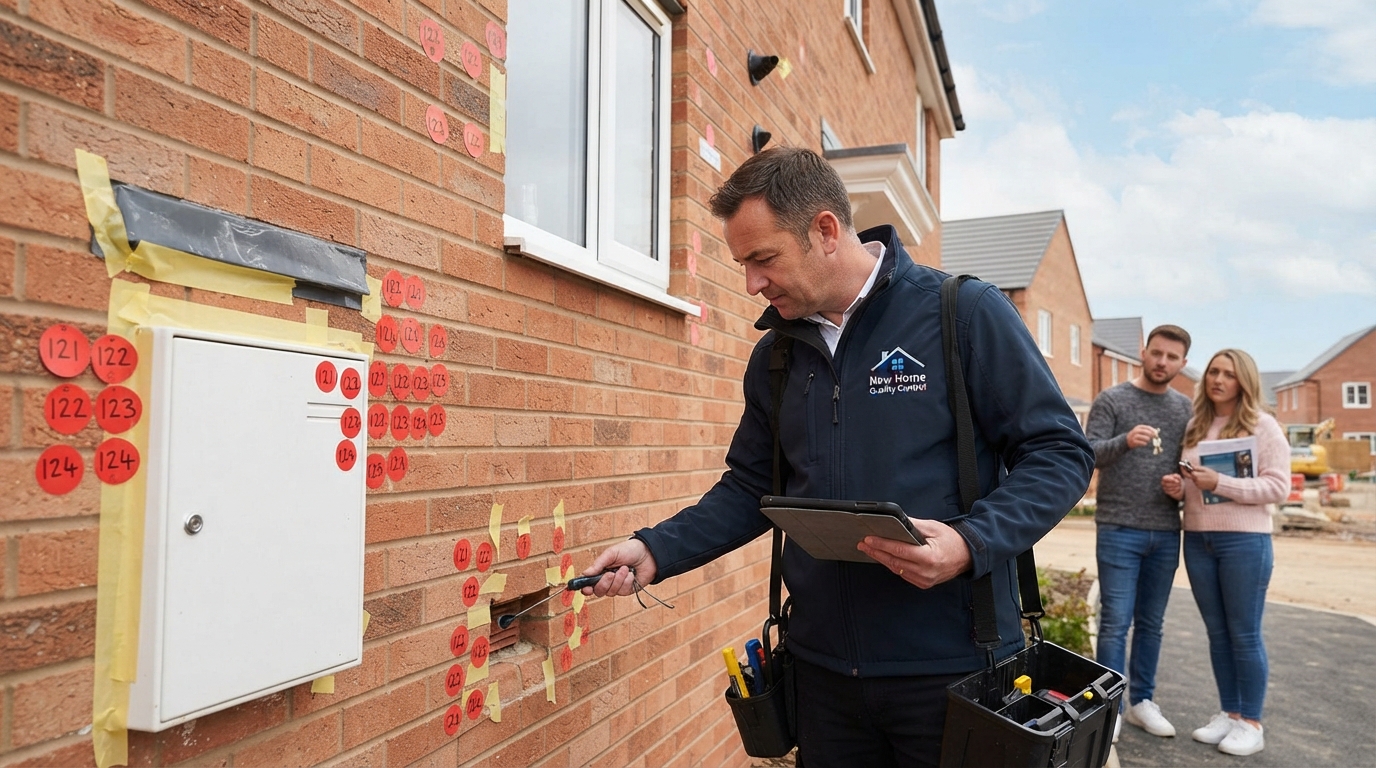
But when the brand-new property was checked only days later by a Welsh snagging company — the final quality inspection carried out by independent assessors — they found 150 defects, including wrongly fitted fire barriers, evidence of a prior leak and what they described as “exceptionally poor” workmanship.
Swansea-based New Home Quality Control was founded by John Cooper after he grew tired of being asked to conceal issues from customers on building sites.
The couple are far from the only ones to encounter problems with new homes.
Written evidence submitted by the New Homes Ombudsman Service said the Home Builders Federation national new homes customer satisfaction survey, published in March 2025, showed
93.7% of new-build buyers reporting defects or snags to their developer after moving in
, external
.
Just over a quarter of buyers also found more than 15 problems in their new-build home.
Charles and Georgina were excited to move into their new home
“We just wouldn’t have known,” said Georgina.
“If there had been a fire, that’s one thing that could have happened and been very detrimental.”
Georgina, 36, and her husband spent three years saving to buy a house, before falling in love with the development in south Leicestershire.
As moving day drew nearer, social media started feeding her a constant stream of new-build horror stories
After paying £299,995 for the house, she said having it snagged was “non-negotiable”.
“It just felt unbelievable that we’d finally done it,” she added.
“We actually finally got our own place. This is ours. This is ours to do what we want with. It just felt great.”
But the report also found roofing defects, low water pressure and what inspectors called “exceptionally poor” installation of the gas meter cabinet and gas pipe.
More than a dozen additional cosmetic and finishing defects were also noted across the property
Because they had a two-year warranty from the developer, the problems were fixed.
“I would say for any new-build buyer, 100% no doubt, I recommend a snagger,” Georgina said.
Vistry, which is responsible for the housing developer Countryside that built Charles and Georgina’s house, said it supported “appropriately conducted independent inspections as an additional source of reassurance about build quality”.
It said every home is checked by its teams and independent inspections are carried out, and that two to three weeks after customers move in, the build team meets to discuss and agree any snagging work.
Such problems are nothing new to John Cooper, 50, co-founder of New Home Quality Control.
He said that while working as a contracts manager in 2018: “The site manager asked me to hide something from a customer that was moving in the next day.”
That was only the beginning after he had seen poor workmanship for around six years.
“From that moment on, I thought to myself ‘I’ve got to make a change in this industry somehow. This can’t continue’,” he said.
Cooper spoke to his supervisor at the time, Lee Challenger, 42, and the pair resigned and launched New Homes Quality Control.
“We’ve never inspected a house and found absolutely nothing wrong with it,” he said.
He said the most frequent defects are in brickwork, carpentry and roofing.
“It’s always going to be carpentry issues and bricklaying issues.
“I just think that there’s not enough quality bricklayers to build the amount of properties that the developers are building across the UK on a yearly basis.”
The team also regularly finds missing or wrongly fitted weep vents — which are installed in external walls to allow moisture to escape.
Cooper said some developments had even included “fake” weep vents, where decorative plastic pieces had been installed instead of working openings.
“They thought they could get away with it,” he said.
Cooper said that before new owners receive the keys, the NHBC inspects the property and signs it off.
“I’m sick of hearing every property being signed off, because if that was the case, then we wouldn’t have a company,” he said.
Many of Cooper’s clients become emotional when they see how many problems their new homes have.
“We’ve had people cry,” he said.
“There were some quite serious issues in their new property and they had spent all their life savings on it.”
Cooper said his long-term aim was for every new-build home to have an independent inspection before its owners move in.
“If someone’s spending their life savings on a house, they deserve to get what they paid for,” he said.
The inspections take between two and four hours, depending on the size of the house, and cost about £349-£499.
Among the tools used by snaggers are drones, GoPro cameras, cavity cameras, thermal imaging equipment and laser levels.
But not everyone can afford the service because they have spent all their money on the house.
“Money is tight for a lot of people.”
Georgina and Charles’ home had 150 issues when they moved in
NHBC said it is the builders’ responsibility to make sure they comply with building regulations and homeowners must report any issues to the house builder within two years — if they are not resolved, they can seek a remedy through NHBC.
The organisation said it carries out inspections at “key stages of the build” and “provide feedback” on quality.
Home Builders Federation (HBF), which represents the building industry, said: “New homes are not made in a factory.
“They are bespoke products, built by numerous tradespeople, often on sites exposed to all weathers, and it is inevitable that on occasions there are some snags.”
It said the “vast majority of snagging issues are minor” and there was no evidence that quality standards were failing to keep pace with the rate of housebuilding.
While more homes are needed, house-building levels are flatlining because of “major barriers” preventing construction, it said.
But “quality and service levels remain extremely high” and there is “no evidence” that labour shortages are affecting new homes.
“Although the industry does face skills challenges in some areas, as does the wider construction industry, we are currently building around 200,000 homes a year versus a need to deliver around 300,000 with no sign of output increasing,” it said.
HBF said it would support statutory registration for builders with the New Homes Quality Board but warned that snagging inspectors are not regulated.
“Customers need to take care that any inspector they use is suitably qualified and accredited by a professional body, such as RICS,” it added.
“We do not believe additional blanket inspections are necessary. There is already a comprehensive framework of regulation, building control, warranties and builder quality assurance in place.”
Property developers Taylor Wimpey refused to comment, and Watkin Jones, Barratt Redrow and Persimmon Homes did not respond for comment.
The Welsh government said it was committed to ensuring homebuyers receive high quality and are protected if things go wrong.
The UK government said it was investing £39bn in affordable housing and pledged £625m to train up to 60,000 construction workers.