

'Our flat has been for sale for four years': Why is the market so weak?
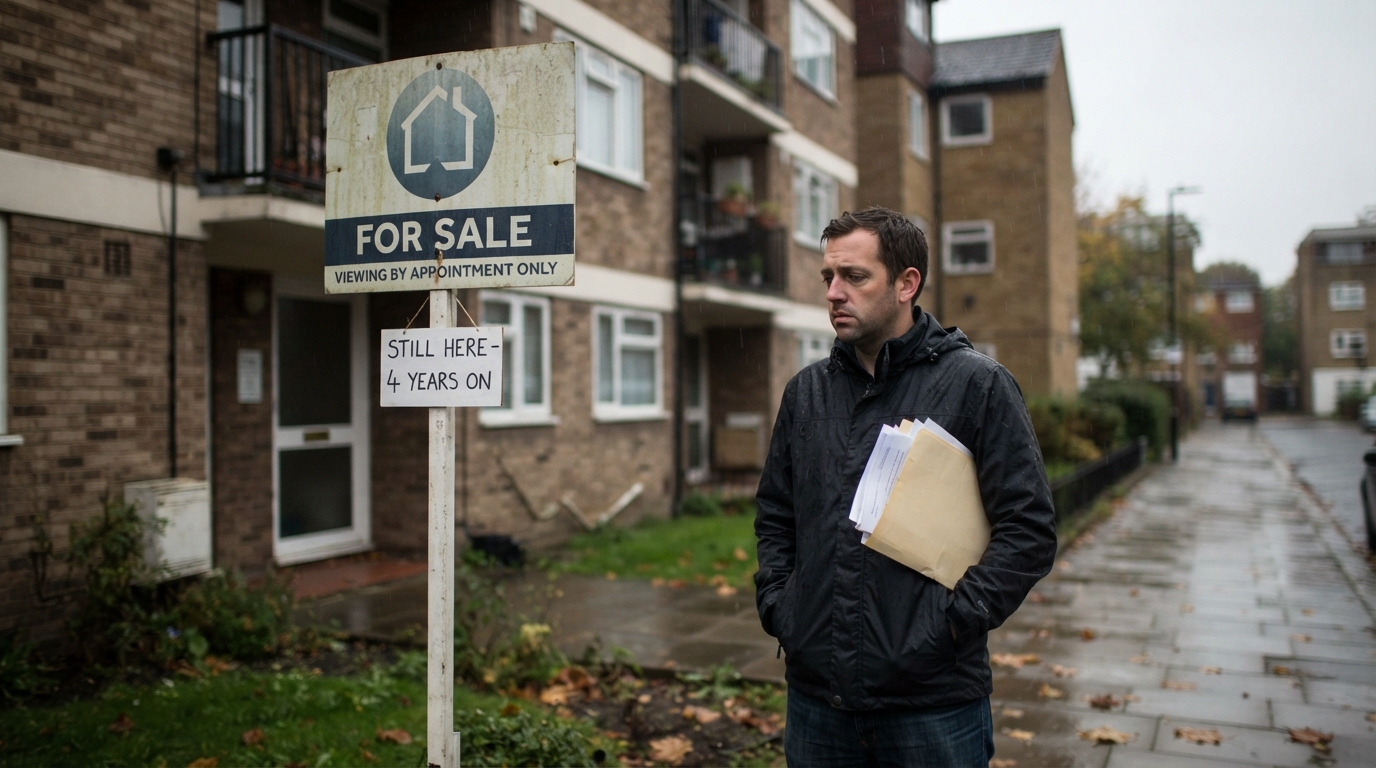
James Schaife and his partner are among the many Londoners struggling to sell their flat.
'Our flat has been for sale for four years': Why is the market so weak?
James and his partner have been unable to sell their one-bedroom flat in London and say they are on the verge of bankruptcy.
In 2015, thousands of people queued overnight in the rain to reserve and buy studio apartments priced at under £200,000 in Hounslow, west London.
That stands in sharp contrast to the current demand for flats, with property portals reporting a drop in sales.
But why, when the country is in a housing crisis and desperately needs affordable homes, are flats now finding it hard to sell?
According to property website Zoopla, 88% of flats listed for sale in inner London on its site in 2025 did not secure a buyer within six months. The company also says the gap between the value of a flat and a house is now the widest it has been for 30 years.
Executive director Richard Donnell points to post-pandemic social changes, with "people looking for space, prioritising houses, working from home".
He also points to higher mortgage rates and people worrying about "all the costs and liabilities of owning a property", including service charges and ground rents.
In September, almost all the major mortgage lenders in the UK announced rises in the cost of home loans.
Donnell says flats in inner London are struggling especially because they are more expensive, service charges are higher, and "there's greater complexity - it's highly likely it's a bigger building, maybe more of a complex building, so less are selling within six months".
That view is echoed by property platform Rightmove, which says that as of August, only 50% of flats listed for sale nationally successfully find a buyer, compared with 65% of houses.
Nationally, as of August, the average price of a flat is down 2% from 12 months earlier. That is the biggest fall over that period of any property type.
Compared with August 2021, flats have risen in price by only 4% nationally, the smallest increase of all property types.
Colleen Babcock, Rightmove's head of partner marketing, says London faces extra difficulties because its market is heavily weighted towards flats, and "affordability more broadly remains a key challenge".
She points to higher borrowing costs, increased stamp duty costs, and the limits of the Lifetime ISA in higher-priced areas, meaning both first-time buyers and home-movers in London can face extra obstacles when buying a home.
Flats are not becoming unsellable for just one reason. Higher borrowing costs, service charges, leasehold and shared ownership complications have made them more expensive and more difficult to own, harming their reputation.
James Schaife, 36, says he and his partner are "on the verge of bankruptcy" after trying to sell their one-bedroom north London flat for the past four years.
He bought a 35% share of the £585,000 flat - run by Newlon Housing Trust - in 2017, but after his partner got a new job, James moved out of London in 2022 and relocated north, putting the flat on the market.
During an initial "nomination period" - a set window in which the association has the exclusive right to find an eligible buyer - the flat attracted almost no interest.
The housing association allowed them to sell it on the open market - but James says they have been "forced to use a narrow selection of valuers chosen by Newlon", despite estate agents telling him the flat has been overvalued.
They have been forced to rent out the property under a special "consent-to-let" agreement with their housing association - although that is due to expire soon and James says Newlon will not renew it.
James said the situation has affected their plans to start a family, pushing them back to an age "where it's probably unlikely that we'll have children".
"It's just ruined our lives."
A spokesperson for Newlon Housing Trust said that "this is not a picture we recognise", adding that they were bound by "strict rules about resales to protect the public purse".
The spokesperson said that "strict rules to limit subletting... prevent the risk of people profiting by letting subsidised affordable housing".
"As is well reported, the sales market is flat. The saleability of a home at any time is subject to variation in the property market, which we have no control over, and is part of the risk taken on by anyone who buys a home."
Sophie Bishener is unable to move to a bigger property as her building needs a second wave of fire safety repairs.
Some flat owners living in homes with building safety concerns have also found their properties impossible to sell.
It may be a more extreme example, but many find themselves in this position.
As of July 2026, there are 4,697 residential buildings 11m and over in height being monitored because of unsafe cladding, external, but work is still not complete on 61% of them.
Sophie Bishener, a leaseholder and campaigner with the End our Cladding Scandal group, said flats with unsafe cladding left unremediated were like "prisons", and that this is having a "devastating" effect on people's lives.
She bought her one-bedroom flat in Hertfordshire in 2017 but nine years later, now with a young family, she is unable to move to a bigger property because her building needs a second wave of fire safety repairs.
"Being trapped means that you can't move on with your life."
She says that even buildings which have been remediated are affected by a market that is "so distrusting" at the moment.
"If you're in a position where you can get to market, there are so many hurdles... management packs costing hundreds of pounds, conveyancing solicitors not willing to take on buildings covered by the Building Safety Act."
Sophie thinks there should be a building safety register, "where you've got all the buildings noted, and we know what they're made of" to help improve buyer confidence.
The BBC has also investigated problems with new-build properties, including people living in brand-new flats.
Their stories come as the number of complaints to the New Homes Ombudsman Service has more than tripled in a year, according to its latest annual report.
The UK-wide service received just over 1,800 complaints in 2025-26, up from fewer than 600 the previous year. Defects and snagging were the most common issues raised.
The ombudsman says the rise partly reflects more homeowners being eligible to use the service, as well as greater awareness of it.
At the same time, developers say building new homes is becoming more expensive, adding to pressure on London's already limited housing supply.
Home-builders estimate that the cost of delivering a new property, external has risen by an estimated average of £76,000 per home, equivalent to more than 20% of the average new home value of £365,000.
They say the increase is due to higher labour and material costs, additional regulations, and tax and levy rises.
James Stevens, director for cities at the Home Builders Federation (HBF), said: "The collapse of London's housing supply presents a real threat to the capital's economic and social prospects.
"Housing starts in London have fallen to an alarmingly low level and have been on a downward trend for some time. An urgent overhaul of housing and planning policy is now critical to supporting the housing needs of all Londoners – particularly the capital's first-time buyers who face the biggest barriers to home ownership in the country."
The HBF also reported in October 2024 that there were 17,432 Section 106 affordable units that remain unallocated.
Zoopla's executive director Richard Donnell says affordability needs to improve.
"I think everyone's hoping that mortgage rates come down. The government's announced some reforms to leasehold to improve some of the certainty. They focused on the transparency and so buyers can get more of an understanding of what they're buying."
He says there could be a reduction in marriage value, which is a payment to extend the lease on a flat with fewer than 80 years remaining, and make it "much clearer and easier for tenants and long leaseholders to take more control of their costs and destiny".
Charged £720 to have a key cut - soaring bills drive leaseholders to breaking point
'It's ruined my life': Flat-owner says building work by freeholder has left her homeless
A spokesperson for the Ministry of Housing, Communities and Local Government said: "We're taking decisive action to help people up and down the country to buy and sell flats with greater confidence, including in London.
"Our Mortgage Guarantee Scheme will support homebuyers with a deposit as small as 5%, while we're also capping ground rents at £250 and ending the use of leasehold entirely for new homes, which will make it more attractive to buy flats.
"This is alongside speeding up cladding removal to bring the building safety crisis to an end and forcing those responsible to fix unsafe buildings or face criminal prosecution."
A spokesperson for the Mayor of London Lord Khan said: "City Hall is working with London boroughs, housing associations, developers and others to deliver more homes of all tenures that Londoners so desperately need.
"The mayor has consistently stood up for Londoners by advocating for an end to the outdated feudal leasehold system once and for all, and we welcome steps from government to make commonhold the default tenure and ban the sale of leasehold flats.
"To protect leaseholders, the mayor has already launched the Service Charges Charter to bring much-needed transparency and fairness to how service charges are handled.
"Alongside this, City Hall actively funds our housing partners to acquire homes from the private sector and convert them into secure social and affordable housing, providing housing for those most in need and putting housing stock to good use."
We often hear that London desperately needs more affordable housing, but a combination of higher mortgage rates, changing preferences, leasehold costs and building safety problems - which affects the reputation of flats - is making one of the capital's most common types of home harder to sell.
So perhaps the problem is not simply a shortage of homes, but rather - are we building and selling the wrong homes?
Have you struggled to either sell your flat or buy one? Tell us your story.