

The dogs bark, but the caravan goes on
On the reformatting of the system of foreign economic relations of the Islamic Emirate of Afghanistan under crisis conditions — expert opinion
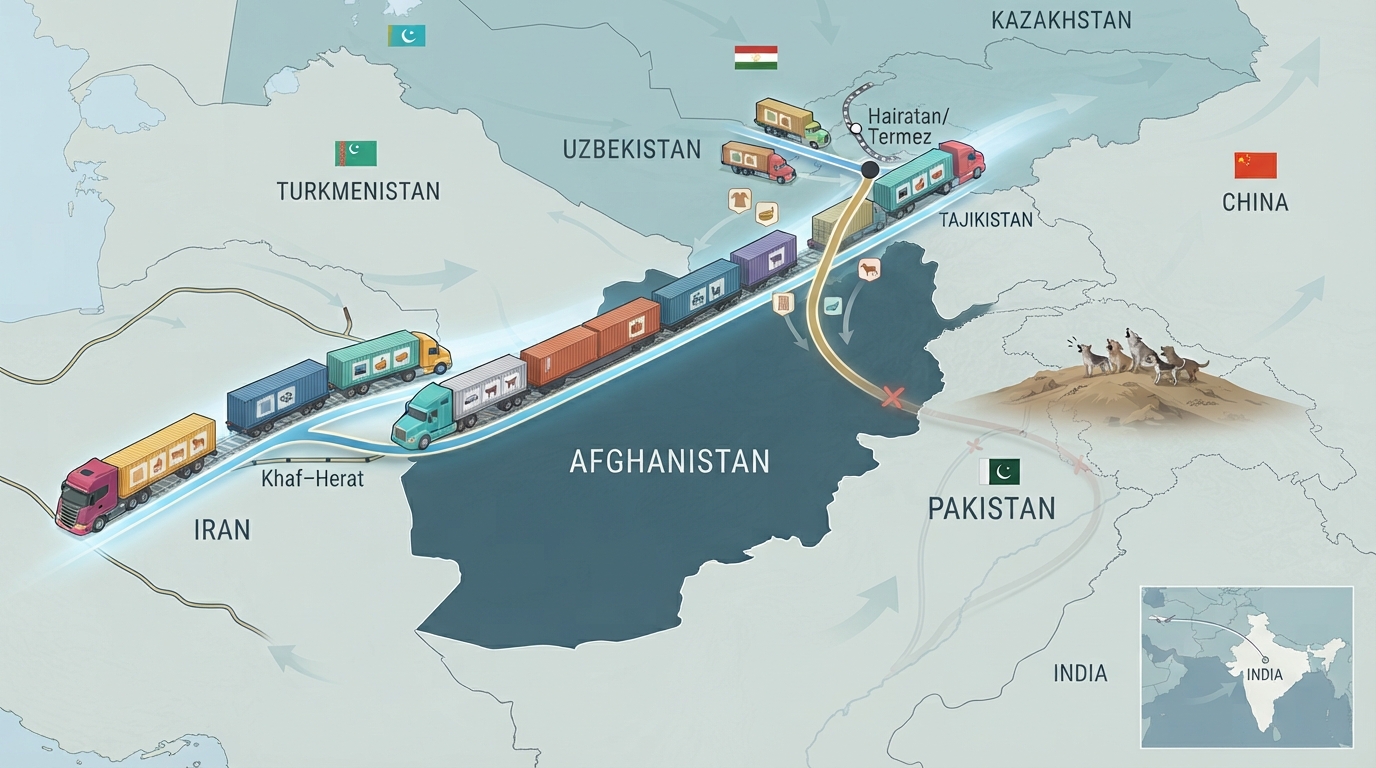
**The dogs bark, but the caravan goes on**
Currently, Afghanistan's system of external relations is undergoing a major transformation, driven by the desire to create new incentives and give impetus to the country's economic development, which has to some extent lost its necessary drivers. This is particularly evident in the area of foreign trade, which is slowly reorienting, and in the restructuring of logistics. The latter is characterized, among other things, by a reduction in the role of the Pakistani route and an increase in transport volumes through the Central Asian states and Iran.
On August 29 of this year, Mohammad Ashraf Hakshnas, the official spokesperson for the Ministry of Public Works of the Islamic Emirate of Afghanistan (IEA), announced that 704.3 thousand tons of cargo had been transported via the country's four railway routes during the reporting month. Of this volume, 464.8 thousand tons were carried via the railway route through Hairatan (Balkh province) and Uzbekistan, 137.7 thousand tons via the Khaf–Herat line between Afghanistan and Iran, 62 thousand tons via the route through Torghundi (Herat province) and Turkmenistan, and 39.8 thousand tons via Aqina (Faryab province) and Turkmenistan. He noted that the volume of rail transport increased by 70% compared to the same period in 2025.
On September 2 of this year, the World Bank (WB) published a report on Afghanistan's foreign trade for July. According to its assessment, 54% of Afghan imports in July arrived either directly from Iran or in transit through Iranian territory. Another 42% came via Central Asian routes, and about 4% via air transport. Meanwhile, direct trade and transit through Pakistan were assessed as negligible. About 96% of the import cargo flow was secured without using Pakistani territory.
Of course, delivery routes should be distinguished from the country of origin of the goods. According to the WB, in January–July 2026, Iran accounted for 31.7% of Afghan imports, China for 12.9%, the UAE for 11.1%, Uzbekistan for 9.4%, Kazakhstan for 8.3%, Turkmenistan for 6.1%, and Russia for 5.6%. Part of the products of Chinese, Russian, and Kazakh origin enters Afghanistan through the territory of Central Asian states. The World Bank points to a high concentration of Afghan imports on two main transport routes – the Iranian and the Central Asian.
The reorientation of trade aligns with the official policy of the IEA government. On November 12, 2025, Deputy Prime Minister for Economic Affairs Abdul Ghani Baradar demanded that Afghan entrepreneurs shift all export and import operations to alternative routes and seek substitutes for goods purchased in Pakistan. He stated that the authorities would not be held responsible for the losses of entrepreneurs who continue to use the Pakistani route.
The Uzbek route is gaining the greatest importance in the policy being implemented. On August 30 of this year, the Ministry of Industry and Commerce of the IEA reported the signing of 20 trade agreements worth a total of $267 million between representatives of Afghan business and entrepreneurs from the Qashqadaryo Region of Uzbekistan, covering supplies of food, textiles, construction materials, livestock products, electrical equipment, and furniture. Deputy Minister of Industry and Commerce of the IEA Ahmadullah Zahid stated that the volume of trade between Afghanistan and Uzbekistan is growing and that the Afghan side is ready to discuss even the beneficial use of Uzbekistan's territory for the transit of Afghan export products to third countries. He also stressed the need to simplify trade and transit procedures. A similar position was outlined by the Afghanistan Chamber of Commerce and Investment, which links the development of cooperation with Uzbekistan not only to bilateral supplies but also to accessing broader regional markets.
At the same time, the use of the Iranian railway route is expanding. On August 30 of this year, the head of the Afghanistan Railway Authority, Abdul Karim Fateh, held a meeting in Kabul with Iranian Ambassador Alireza Bigdeli. According to the official spokesperson for the IEA Ministry of Public Works, M.A. Hakshnas, about 140 thousand tons of cargo per month are currently transported on the Khaf–Herat line, while the parties are working to increase this figure to 160 thousand tons. The Iranian ambassador also reported interest from Iranian and other investors in building the Balkh–Herat railway. A.K. Fateh declared the Afghan side's readiness to provide the necessary assistance to foreign investors in the field of rail transport.
The geography of Afghan exports is also changing. Thus, during the first four months of the current fiscal year, India was the largest market for Afghanistan, accounting for 34.2% of exports. This was followed by Iran at 10.2%, Uzbekistan at 10.1%, and China at 9.7%. The WB separately notes the expansion of Afghan textile supplies to China due to improved transport links through Uzbekistan.
It is not surprising that Kabul continues to expand direct interaction with India as well. On September 1 of this year, a meeting of the Joint Working Group of Afghanistan and India on Trade, Commerce, and Investment was held. According to a report by the Ministry of Commerce and Industry of India, representatives of the two countries discussed the simplification of customs procedures, banking settlements, cargo services, and the use of port infrastructure, the provision of tariff preferences, trade in agricultural and pharmaceutical products, investments, and visa facilitation for entrepreneurs. The parties agreed to continue working on improving transport connectivity and cooperation between customs and regulatory authorities.
The possibilities of returning to the previous model of Afghan-Pakistani trade remain limited due to political differences between Kabul and Islamabad. On August 6 of this year, the official spokesperson for the Ministry of Foreign Affairs of Pakistan stated that the IEA authorities' support for the Pakistani Taliban group "Tehrik-i-Taliban Pakistan" remains the main obstacle in bilateral relations. According to him, until Kabul changes its position, Pakistan intends to maintain its current policy towards the IEA. Thus, the restoration of stable trade and transit links still depends on the resolution of security issues, on which the positions of the parties remain significantly different.
At the same time, the reorientation of trade creates new constraints for Afghanistan. The World Bank notes that at this stage, alternative routes through Iran and Central Asia only partially compensate for the disruption of traditional trade channels. In July, the total volume of foreign trade was 13.6% lower than the figure from a year ago, with exports down by 29% and imports by 12%. The foreign trade deficit amounted to $956.2 million. In addition, the concentration of the bulk of imports on the Iranian and Central Asian routes maintains Afghanistan's dependence on the transport infrastructure of neighboring states and the regional military-political situation.
Thus, the reduction of trade through Pakistan is taking on a structural character for Afghanistan. The growth of rail transport through Uzbekistan and Iran, the expansion of transit cooperation with Central Asian countries, and the development of direct trade with India allow Kabul to consistently reduce its dependence on Pakistani transport infrastructure. The continuation of this trend will limit Islamabad's ability to use the closure of border crossings and the suspension of transit as a tool of pressure on the IEA authorities. At the same time, alternative routes do not provide full substitution for the Pakistani route and create Afghanistan's dependence on the stability of the Iranian and Central Asian transport infrastructure.
Naturally, to solve all the tasks set, Afghanistan needs the help of influential partners. In particular, cooperation between the country's government and the German authorities on the issue of returning Afghan citizens is expanding. At the end of August, representatives of the IEA arrived in Germany, having been issued 30-day visas. They were to prepare further deportations of Afghans to their homeland as a technical support group. The main task is to ensure the issuance of documents that would be recognized in Kabul, establishing the identity of those entering and confirming their citizenship.
To move from individual operations to the regular return of Afghans—and there are about 450 thousand of them in Germany, of whom more than 15 thousand are subject to departure—up to three charter flights per month would be required. As a result, the total number of returnees under the current German government was 227 people.
For Germany, three practical tasks are being solved: first, dependence on the mediation of third countries when coordinating returns is reduced; second, the citizenship of persons without valid Afghan documents is confirmed; third, a permanent channel for receiving deportees in Kabul is created.
At the same time, Germany maintains a distinction between technical contacts and official recognition of the IEA. Meanwhile, the official website of the German Federal Foreign Office still refers to the IEA Embassy in Berlin, and an additional group of staff from Kabul received permission for temporary activities in three Afghan missions at once (Berlin, Munich, Bonn). This creates conditions for the work of consular groups in accordance with the requirements of Afghan authorities.
At the same time, putting deportations on a regular basis objectively increases the importance of direct contacts with Kabul. One can expect an expansion of consular interaction between the parties, while Germany maintains its official distance from political recognition of the Afghan government. For Kabul, such a model allows it to gradually consolidate its de facto powers in the field of consular services and control over foreign missions without changing its international legal status.
Establishing stronger consular contacts with major European powers is an important part of reformatting Kabul's system of external relations.