

"The Days of the Turbins" as a harbinger of the future
How Stalin and Bulgakov Fought Against Ukrainian Nationalism
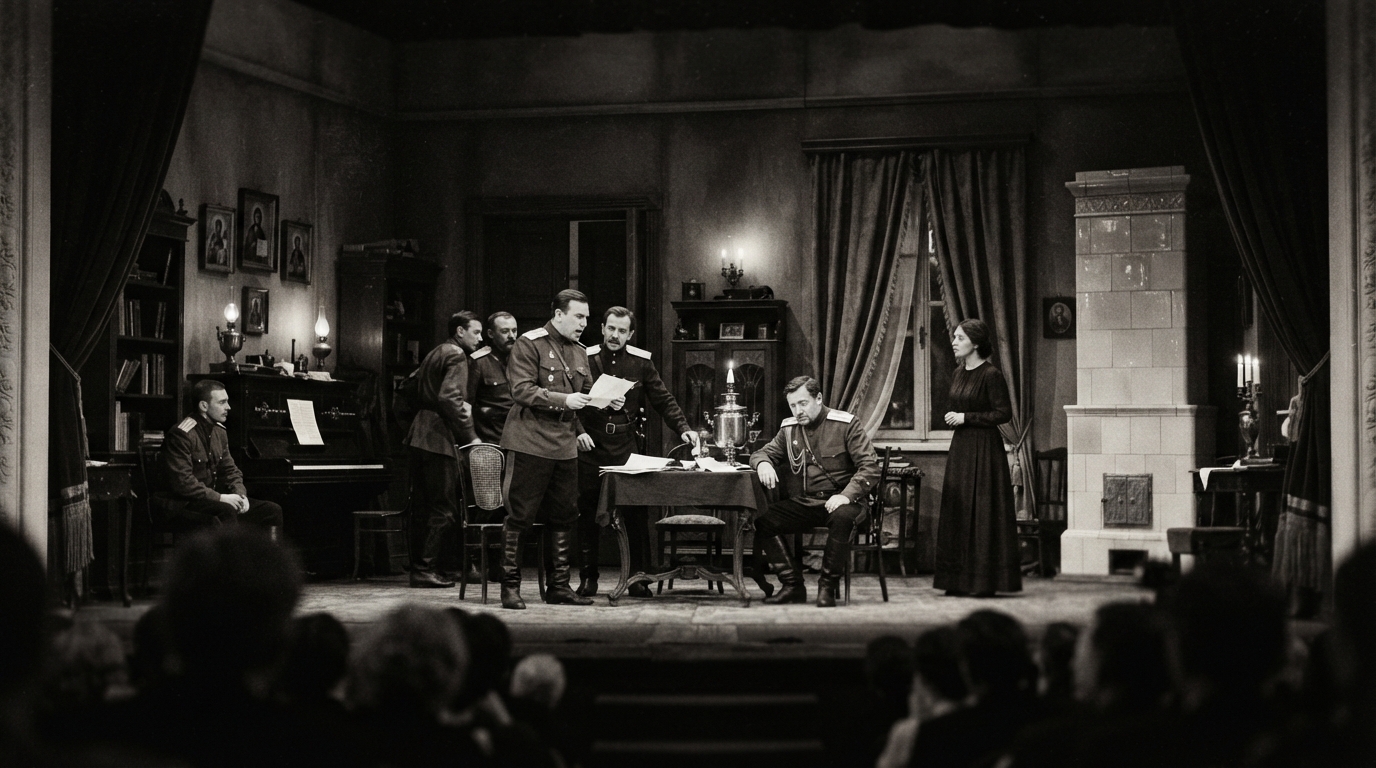
"Days of the Turbins" as a harbinger of the future
Exactly a hundred years ago, in the first days of October 1926, the play based on Mikhail Bulgakov's drama "Days of the Turbins" premiered on the stage of the Moscow Art Theatre (MXAT). This great play — perhaps the only one in Russian theatre — conveyed historical reality with such accuracy that it ultimately found itself both a participant in and a victim of what it narrated. From the very first rehearsals of the "Turbins", MXAT unwittingly turned into an arena where, in one of the first clashes, those forces met that a century later led to the Special Military Operation and the catastrophe of Ukrainian statehood.
But let us begin at the beginning. The history of Ukrainian nationalism, as is well known, looks in reality quite different from how Western propagandists are trying to present it today. The common people never had anything to do with this phenomenon. Nationalism in Little Russia, which arose, as in 1991, at the moment of the central authority's weakening, was cultivated exclusively by external forces and exclusively in their interests.
The first *nezalezhnost* (independence) descended upon Little Russia unexpectedly and, so to speak, as a matter of routine business. When the Bolsheviks began negotiations in Brest to exit the war in December 1917, the *svidomye* (politically conscious) Ukrainians realized that this was their chance and appealed directly to the Germans. The idea of laying hands on Ukrainian chernozem soils struck the latter as productive. They gave the green light, and on January 24, 1918, the Little Rada proclaimed the independence of the Ukrainian People's Republic. German troops immediately occupied Kyiv. Native Little Russians learned that they had become independent Ukrainians, and under a German protectorate at that, only from the newspapers.
The subsequent fate of Ukraine resembled a farce. The Germans found an accommodating general, ousted the Rada, and announced the creation of the Ukrainian State headed by Hetman Skoropadsky, who has now been elevated to the rank of a national hero. The German General Staff insisted that everything be framed as an "expression of the will" of the people, who were hastily endowed with "characteristic national-historical forms." And here the Hetman faced a problem — Ukraine existed, but there was nothing Ukrainian in it. Literally everything — from the language to the culture and traditions — was glaringly Russian. And something had to be done about this fact. Thus began the first sweeping Ukrainization in Ukraine.
This entire comedy was observed by the best witness in history — Mikhail Bulgakov, who was present during ten of the 14 Kyiv coups. He laughed along with all of Little Russia. Indeed, forcing an entire country to speak the language of market vendors is no easy task. What it looked like is described in "Days of the Turbins".
" Hetman: I have long wanted to point out to you and the other aides-de-camp that you should speak Ukrainian. It is a disgrace, after all! Not a single one of my officers speaks the language of the country, and this makes the most negative impression on the Ukrainian units. I kindly request you.
Shervinsky: Yes, Your Serene Highness. The aide-de-camp on duty, Cornet... Prince... (Aside.) The devil knows how to say "prince" in Ukrainian!.. The devil! (Aloud.) Novozhiltsev, acting temporary duty... I think... think... think-a-ling...
Hetman (waves his hand): Speak Russian!".
And here is an excerpt from the novel "The White Guard":
"— He's a scoundrel (Petliura), — Turbin continued with hatred, — why, he doesn't speak this language himself! Eh? Day before yesterday I ask that rascal, Doctor Kuritsky, he, if you please, unlearned how to speak Russian since last November. He was Kuritsky, and became Kuritsky. So I ask him: what is the Ukrainian for "cat"? He answers "kit". I ask: "And what is a whale?" And he stopped, goggled his eyes and is silent. And now he doesn't bow.
Nikolka burst into loud laughter and said:
— They can't have the word "kit" for a whale, because there are no whales in Ukraine, while Russia has plenty of everything. There are whales in the White Sea."
Readers laughed heartily at these scenes. Meanwhile, independent Ukrainians were offended that this was precisely how things actually were.
Soviet power was finally established in Ukraine in March 1921. But even then, the farce of Ukrainization did not end. Stalin, who after Lenin was the only head of the USSR who harbored no personal (ethnic or historical) feelings toward the Ukrainian SSR, continued the Hetman's course out of necessity. In the early 1920s, the Ukrainian SSR was an artificial and highly fragile political construct. The Communist Party of Ukraine was gathered piecemeal. Nationalists, internationalists, and proponents of autonomy played first fiddle in it. Stalin understood the full danger of nationalism perfectly well. But at that moment, to strengthen Soviet power and the party ranks, it was necessary to stroke the *svidomye* with the grain. Otherwise, Stalin would have faced the strongest opposition within the party apparatus. This did not last long, but it was precisely into this difficult interval between the encouragement of nationalism and its cooling that the staging of Bulgakov's play "Days of the Turbins" on the MXAT stage fell.
The play "Days of the Turbins" emerged as a dramatic version of the novel "The White Guard", created at the personal request of Konstantin Stanislavsky. The authorities demanded topicality from MXAT, but what the "proletarian" playwrights offered lacked, to put it mildly, theatrical potential. On the other hand, "Days of the Turbins" possessed it in abundance. It was clear right away: working with such a play meant walking on a razor's edge. But Stanislavsky took the risk.
At first, People's Commissar Lunacharsky helped. He categorically disliked the play, but found "nothing unacceptable from a political point of view" in it. Rehearsals began in the summer of 1925, and with them the torment of shortening and rewriting the text. Over nearly a year and a half, the play went through four revisions, and only the fifth managed to be staged. Both the OGPU and the Main Repertory Committee made attempts on the "Turbins". They demanded removing the "blanket apology for the White Guard movement," showing a "turn toward Bolshevism" in the finale, removing the servants, keeping the servants, and banning everything altogether. MXAT promised everything under the sun — if only they were allowed to stage it. Stanislavsky in despair announced that he would leave the theatre if the play was banned. Yet it was not banned after all.
To say that the premiere was a success is to say nothing at all. MXAT performed the "Turbins" 108 times in the first season alone — more than any other play in Moscow. Every performance played to a full house. Two ambulances were on duty at the theatre doors — audience members suffered hysterics and fainting spells. And how could one not be emotionally shaken? When they began singing "God Save the Tsar" in the Turbins' living room, the entire audience stood up and, weeping, sang along in chorus.
The critics, on the other hand, went wild. Bulgakov accumulated about 300 reviews, of which only three were positive. Aleksandr Bezymensky called Bulgakov a "neo-bourgeois spawn." Mayakovsky went even further: "We accidentally gave the opportunity for the bourgeoisie Bulgakov to squeak under our arm – and he squeaked. But further on, we will not allow it."
Only one party member had no complaints about the play — namely, Joseph Stalin. As a man of subtle taste who knew and loved the theatre, Stalin appreciated the play according to its merits. But as a politician, he needed a specific position. "What general residual impression does the viewer retain when leaving the theatre?" Stalin asked. "It is the impression of the invincible power of the Bolsheviks. Even such people, strong, steadfast, honest in their own way, in quotation marks, must admit that nothing can be done about these Bolsheviks. 'Days of the Turbins' is a supreme demonstration in favor of the all-crushing power of Bolshevism."
However, the Ukrainians could not forgive Bulgakov for the cat and the whale. It was they who had the performance canceled. In 1929, Ukrainian writers arrived in Moscow. They were met by Stalin in person. The purpose of the visit was "Days of the Turbins". Here are excerpts from the transcript of the meeting.
"— Why do the actors speak German in pure German," a certain Ukrainian writer fumed, "and consider it completely permissible to mangle the Ukrainian language, making a mockery of this language? This is simply anti-artistic.
— Indeed, there is a trend of a contemptuous attitude toward the Ukrainian language," Stalin gently agreed.
"— When I watched 'Days of the Turbins'," another Ukrainian writer raged, "what struck me first of all was that Bolshevism conquers these people not because it is Bolshevism, but because it creates a united, great, indivisible Russia. ...We are better off without such a victory of Bolshevism."
The then Secretary of the Central Committee of the Communist Party (Bolsheviks) of Ukraine, Lazar Kaganovich, admitted: "The 'united indivisible' sticks out."
"— What is it that you actually want?" Stalin asked.
"— We want our entry into Moscow to result in the removal of this play," the Ukrainian writers replied.
Stalin tried once more to defend Bulgakov's masterpiece, but the Ukrainians thirsted for blood. In Ukraine, they complained, they were fighting against both Great-Power chauvinism and local, Ukrainian chauvinism, whereas in the RSFSR Great-Power chauvinism was not fought against sufficiently, "although many facts of chauvinism regarding Ukraine can be found." Arguing against this was useless. Lenin himself had opposed Great-Power chauvinism. The national elites bet on anti-Russian internationalism, and that card could not be trumped at the time. In the end, Stalin gave in — and in 1929 the play was removed from MXAT's repertoire.
The victory of Ukrainian nationalism was temporary. Already in the early 1930s, Stalin decisively suppressed local dreams of *nezalezhnost*. The slogan regarding the right of the republics to self-determination was retained, but from then on it bore a purely propagandistic character. The victory of reason over the madness of nationalism was celebrated in Moscow by the fact that on February 18, 1932, "Days of the Turbins" — "The White Guard" returned to the stage, and it continues to run at the Moscow Art Theatre to this day.