

“History does not belong only to ourselves, it belongs to the region.” How is Uzbekistan's history of statehood being told?
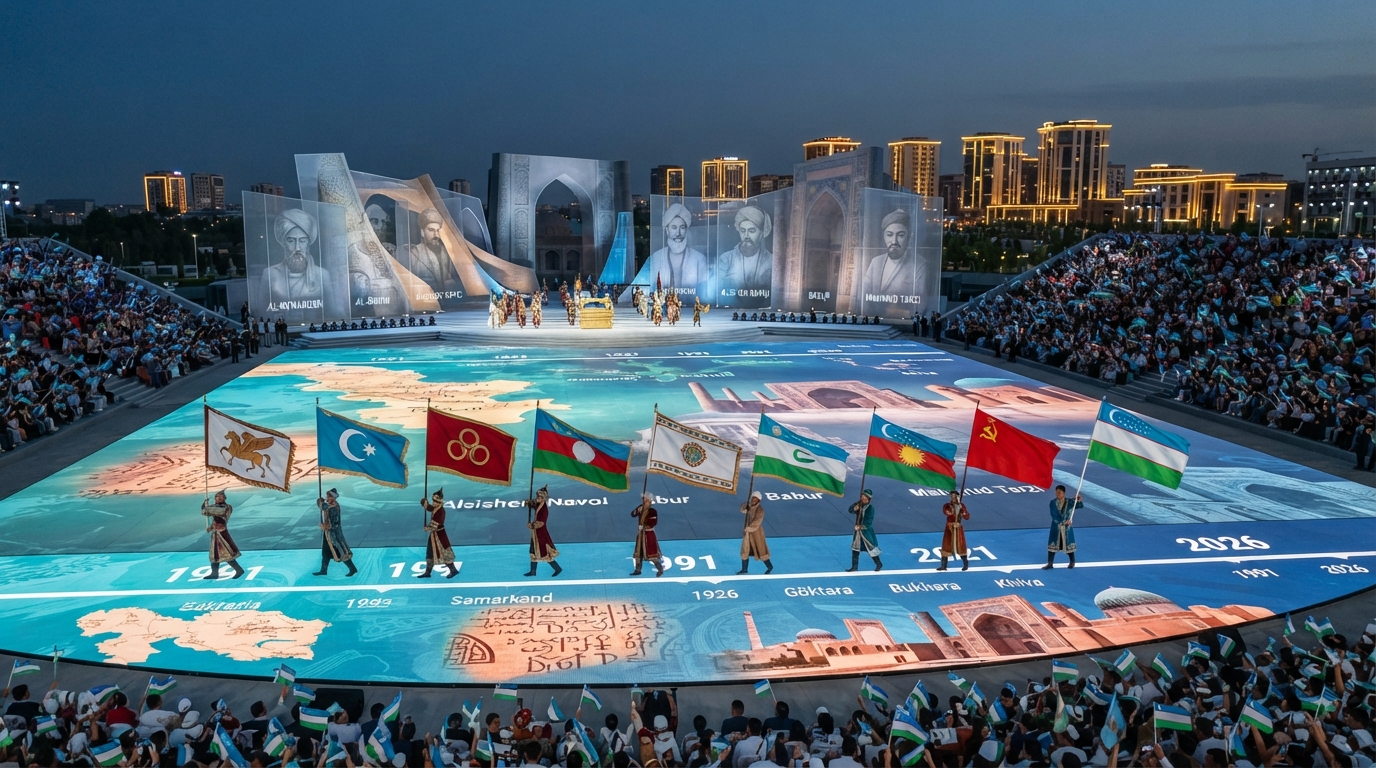
In this year's Independence event, the history of Uzbek statehood was covered chronologically, and flags of various eras were shown. What did the government mean by this? As the successor of which era is today's Uzbekistan being viewed? Gazeta discussed the topic with historian Bahrom Irzayev and political scientist Hamid Sodiq.
“History does not belong only to us, it belongs to the region.” How is Uzbekistan’s history of statehood being narrated?
On September 1, 2026, the 35th anniversary of Uzbekistan’s independence was celebrated. The festive event took place with great solemnity in the New Tashkent area. The performances in this year’s program differed slightly from the usual scenarios. In particular, the depiction of the history of statehood in a brief chronology was warmly received by many.
So, what political and historical signals were given during this independence event? As the successor of which era is today’s Uzbekistan being presented? What did the government want to convey?
Gazeta discussed this topic with historian Bahrom Irzayev and political scientist Hamid Sodiq.
— Bahrom aka, let’s first talk about the event. How did this year’s holiday go for you? What did you feel and what historical signals did you see in it?
— Every year on Independence Day, officials come up with something that looks like a novelty and add it to the program. In previous years, the figures of the Jadids were depicted, and this time the event was enriched with even older history. In my opinion, this is connected with our activities within the framework of the Organization of Turkic States. In today’s geopolitical situation, self-awareness is becoming important. In many cases, there are claims that post-Soviet states allegedly came into existence and statehood emerged along the lines drawn by Lenin.
However, the state of Uzbekistan existed much earlier; maps with Uzbeks, Uzbekiya in history existed not only here, but in Britain as early as the 16th century. At a time when the 35th anniversary of independence is being celebrated, they suddenly come out with the flags of Khwarazm or Bactria from the 7th century BC.
Perhaps this was put up for the debates like “how can a 250-year-old state argue with Iran, which is the owner of a thousand-year-old civilization?” when the dispute with Iran started at one time. At the event, I saw the signal that Uzbekistan has not a thousand-year-old, but even more, a 3000-year-old statehood. Indeed, it was very well thought out. But some states were not visible in the performances; for example, the Seljuks, who are considered the very core, were not included.
I did not spot the Turkic Khaganate, although our capital was one with them. Or when they took Khwarazm, the Ghaznavids were not visible. On the contrary, the Baburids seemed to be visible. In my opinion, if we take these things as a narrative, no matter what, the raising of civilizations and flags was interesting.
For example, it could have been done in another form, but soldiers running past carrying flags has always been an idea. If there is an idea, soldiers enter the war to sacrifice their lives. Wars have been happening in history, someone fought over water, someone over property or office, there were wars between husbands and wives or brothers. But to fight for a flag, a great idea is needed; this has been seen as heroism for centuries.
That is, at the holiday, one can see a sign that there were states that held such an idea. This was very well thought out, which is why it probably left a positive impression on many.
— Bahrom aka, how is the history of statehood itself being narrated? Your thoughts on this are also interesting. Hamid aka, how did this event differ from previous ones for you, and what did you see the political doctrine in?
— Generally speaking, the attitude towards the independence holiday was formed during the era of Islam Karimov; there were certain templates. The scenario would not change unless certain episodes changed during the holiday. This showed the processes inside Uzbekistan. Artists from almost all regions would perform and show their art.
At that time, we did not see any political symbols associated with statehood during the independence holiday. Naturally, this was Islam Abduganiyevich’s style, and after a certain period of time, that is, after 2016, the independence holiday seemed to stop for a while, and then it was organized in other formats, including in the Abdulla Qodiriy Park.
For example, we remembered the Jadids, then we are showing the states, that is, now during every independence holiday, the issue of statehood, that is, from the point of view of the question of whether the states around us have the right to be their current state, is arising.
If you follow the Russian media, there are many reports to the effect that you did not have statehood; the most targeted propagandistic attitude is directed towards Kazakhstan. Even before attacking Ukraine, they were told “you did not have statehood”; before the annexation began, this was one of the main narratives.
From this point of view, it is very important that states are remembered during our main political holiday in Uzbekistan. Of course, as Bahrom aka said, this is debatable. But a unique disorder is currently taking place in geopolitical processes. In such a process of disorder, the question “do they even have a flag?” has always been in the first place. Who stands behind which flag, and the entry of this context into the independence holiday is a positive situation.
Previously, we were closed only inside ourselves, but now we are talking about statehoods, and here there is not only the issue of statehood, but also chronology. Not only from the point of view of this thousand-year BC Khwarazm statehood, but also the period when we were colonized there, that is, by whom we were colonized, how we should understand it, and the fact that Islam Karimov, as well as his era, was remembered, created a chronology.
Therefore, in general, this is a positive situation, but just as a stick has one end, it also has another end. We will stop on this later, and the states around us should not come to the understanding of Moscow in the north, Tashkent in the south. Not only specifically Uzbek statehood, but the issues of regional statehood should be important from a scientific point of view in general.
— Bahrom aka, the very important fragment in the event, the statehood part, from ancient Khwarazm to the declaration of independence in 1991, was very noteworthy. It is indeed rich in historical and political signals. In your opinion, what is the government claiming with this?
Bahrom Irzayev:
— Good question. Hamidjon just drew attention to one thing. So, statehood is, first of all, an idea; secondly, after the flag is raised, a territorial claim arises. When we went to Azerbaijan, we saw one thing: the literature of the two peoples is extremely close to each other. Their scholars explained this as “we have been under one flag three times. That is why our literature is close.”
That is, it is not important who exactly raised these flags; what is important is that we were able to unite everyone at that time. So, we lived freely under one flag, we created one civilization. For example, no one can say that the Timurids are purely Uzbeks; how many of their commanders, spiritual guides, or whether it was Said Baraka, their ethnicity is a secondary issue.
Even ambassadors from Europe have descriptions of Timur’s state being a state of law, and that people were not persecuted regardless of their ethnicity. This might be what is meant. Although all the flags are displayed, no particular nation is seen as dominant; on the contrary, it is shown that all of them are important.
Considerable emphasis was placed on the Shaybanids. Until now, when the Timurids were spoken of, the Shaybanikhans were not mentioned. However, they also left the greatest mark in history and were considered part of the civilization. Recently, a conference was held in Kazakhstan, and some scholars from our country also went. They call the name of the Golden Horde Jochi Ulus as Alash; it is seen as a successor at the beginning of the last century.
For example, we did not think about that flag yesterday. However, even if it was one of our regions, it was part of it. Great respect was shown by Amir Timur. That is, the issue of taking a bride from there, the claim to the heritage of the Golden Horde... There is an idea that whoever owns the great expanse, the world belongs to them.
— Hamid aka, what did you mean by the other end of the stick?
— Today, if we take into account the directions and trends in world politics, the issue of national statehood is based on nations. When we say nation, if we use the concept of nation from a political-ideological point of view, it will be understandable to many. The new statehood in the modern concept, based on the nation, that each nation must have a border, fully entered in 1924. By its nature, its history must be complete. For example, from the point of view of statehood, your drawn national statehood must have a complete history. For example, if 40 percent is missing, you have to add it.
For example, a state’s cuisine, music, especially the history of statehood, capitals, the person standing at its center — everything must be there. And such a process has gone through a very large period after 1924. This period is now in crisis. The people organizing the holiday must understand this. The era of developing by emphasizing the nation is slowly passing.
Therefore, it is more important that the region is meant. For example, imagine, Khwarazm statehood was mentioned at least three times. Khwarazm statehood at the beginning, the Khwarazmshahs in the middle, and the Khiva Khanate at the end. After seeing this, it is natural that issues related to various divisions arise. If we separate it from the region as Uzbek statehood, divisions will arise within ourselves as well. I am saying this because I know it well as a person from Khwarazm.
That is, from the point of view of a separatist spirit, I can say that we were a separate state, even the history of our cuisine is separate, we are not Uzbeks. Therefore, when giving color to political holidays like independence, we must not go out of the nation-based channels in relation to various neighbors, even from Iran to China. This will be the second end of the stick. Why are the states around us not reacting sharply now? Because our real policy is aimed at establishing good relations with neighbors. This kept us back.
If the holiday had passed like this during Islam Karimov’s era, they would have been genuinely scared. The territory of Uzbekistan was the center of political ideas. If we say “these states are ours,” everyone will start fighting over certain states. Of course, I do not want to deepen the issue here, but in future holidays, emphasis should be placed on these aspects.
That is, emphasizing Uzbek statehood separately is of no use to anyone now. If it is called the statehood of our region, those around us will not react negatively to this either, and as I mentioned above, if Moscow is in the north, Tashkent should not remain in the south. If there is a population of around 80 million in Central Asia, half of it lives in Uzbekistan.
And the statehood of Central Asia is determined by centers, that is, politics is created in the city. Of course, there are those who created politics in the steppe as well, but modern statehood based on the nation is seen precisely with cities. Therefore, keeping this in mind, attention should be paid to its content in future holidays, in my opinion.
— Bahrom aka, which period do you consider important in the formation of today’s Uzbekistan? As the successor of which statehood history is Uzbekistan seen today, in your opinion, or should it be seen? In the concert, this seems to have remained vague. What is your opinion?
— Earlier, at some major event, Amir Timur’s flag was flown on a helicopter. In my opinion, Uzbekistan is the successor of the era of Timur and the Timurids. Astronomy developed during the era of Mirzo Ulugbek, art during the era of Kamoliddin Behzod, and the Chagatai language during the era of Alisher Navoiy. This language was used there in the same way as it was established in the Golden Horde.
For example, they say that some of the Ottoman sultans wrote their letters in the Chagatai language. Or in the territories of present-day Ukraine and the Caucasus, Armenians and other nations have a mutually agreed language. This also looks more like that Kipchak language, or it draws precisely to the Chagatai language, not to the Oghuz form. That is, all of these are the fruits of a very large ideology. It was considered their mutual common language. A whole great culture was created during the Timurid era, and this should be present in our statehood.
But another interesting thing happened at the holiday, that is, the photos of either Muhammadjon Tinishboyev or Mustafo Cho‘qay passed on the screen, that is, the Turkestan Autonomy was also remembered. Our Kazakh brothers were also happy about this as a recognition. It means that we all: Uzbek, Kazakh, Tatar, even European nations united for the flag of Turkestan.
If we know history very little, an awkward situation arises, as mentioned above regarding the people of Khwarazm. This happens because of our extremely pitifully low knowledge of history. Which king does not have a clan? There must be a very large social basis, that is, a great ideology of being connected and led to the khan.
The representative from the Golden Horde must have a contribution when raising the successor to the throne, that is, he must hold one end. After that, this person is our khan, we bear witness to this, he says. That is, taking the throne and the flag calms everyone down and at the same time creates responsibility. For example, if you look at all Jadid newspapers, you will see the inscription that the Russian emperor went to Bulgaria at the very bottom.
But they put an event happening with the Ottoman caliph or in Turkey very high. That is, being a colony in the hands of one state, is it possible to put another high? There may be a legal obligation to this, but morally one is not obliged. Morally, he puts the Ottoman caliph or Turkey on top. This is the power of statehood. We are showing history, but now we will have to teach history very seriously in school.
In an event, history passes in a few minutes, but now we have to teach this in our schools for years, and there should be no talk that our statehood does not belong to others, it belongs only to us. Many threads connect history to each other; this is necessary for the nation and, first of all, for decolonial thinking.
The second thing, for example, Erdogan passes by many flags. Many of them are flags that did not go beyond Iran. Some were very far in the east. If we count our history and flags according to the line of 1925, we will remain unable to get out of the template. That is the point. If we say so, our children will not behave like strangers when they go to those territories. They can say “these expanses are my homeland.” Territorial integrity is that.