

The comfort zone will not last forever
Experts in Bishkek assessed the risks of World War III for Central Asia
**The Comfort Zone Will Not Last Forever**
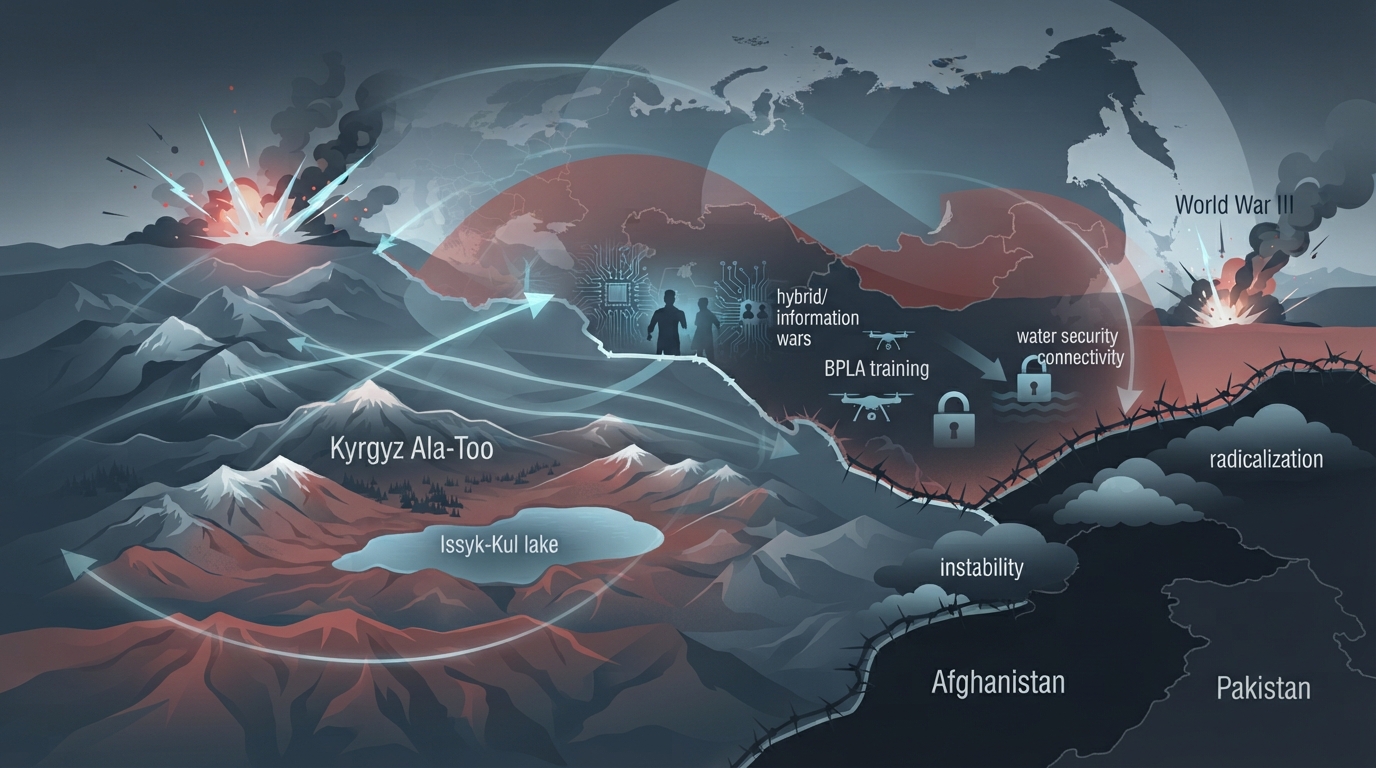
Bishkek hosted a roundtable titled "Trends in Regional Security 2026: How the Situation in CA Has Changed Over 35 Years of Independence," organized by the Center for Expert Initiatives "Oi Ordo." Participants discussed current challenges for Central Asia, hybrid and information threats, the influence of the Afghan factor, as well as ways to strengthen stability amid global geopolitical turbulence.
Director of CEI "Oi Ordo," political analyst Igor Shestakov, characterized the overall military-political situation in the region and assessed the impact of external conflicts on Kyrgyzstan. "In the context of the started World War III, Central Asia from the standpoint of stability and security is currently in a high-comfort zone. However, the situation may change, and it is necessary to be prepared for any development of events and various scenarios," he stressed.
As a clear example of the impact of combat operations on the economy, the expert cited the situation with the Wildberries company. "One of the illustrative examples is the situation with the Wildberries company. When the company's warehouses came under strikes from Ukraine, citizens of Kyrgyzstan working at these marketplaces in Russia within labor migration were also affected, to say nothing of those who suffered colossal financial losses, as millions of dollars' worth of goods were destroyed. Thus, military actions affect both the economy and the direct security of our citizens," he noted.
Shestakov also pointed out the risks emanating from Afghanistan and commented on statements from the Russian side. "Previously, from the Russian side, I had not heard such statements regarding Afghanistan at such a high level. After all, it was Russia that was among the first in the world to cease recognizing the Taliban as a terrorist organization," he recalled.
The political analyst expressed an opinion on which structure could become a real security guarantor for Central Asia. "Given the Afghan factor and other challenges, the question arises as to who can become an external guarantor of security for our region. In my view, the CSTO remains such a guarantor. Today, neither the US, nor Britain, nor Turkey — even in the OTS format — can guarantee our regional security," he stated.
Shestakov also analyzed the role of Turkey and Azerbaijan in modern regional politics. "The situation in Saudi Arabia demonstrates that besides political slogans, Ankara has nothing in its arsenal. In this regard, the statements of Azerbaijani President Ilham Aliyev that Azerbaijan independently resolved the historical issue of Karabakh look symbolic. Perhaps Azerbaijan is tired of being in the role of the 'younger brother.' Baku is now building its own security agenda, including within the framework of joining the consultative format 'Central Asia,' and is becoming an even more significant state for us outside the OTS," he explained.
The speaker also touched upon the topic of information warfare and disinformation surrounding the participation of migrants in combat operations. "On social networks, I saw a presentation of the Ukrainian project 'I Want to Live,' which claimed that nearly every second participant in the SMO on Russia's side is a citizen of Central Asia. As a specialist in migration issues, I consider it necessary to clarify the reliability of this information: are we talking specifically about citizens or about natives of the region who have already received a Russian passport? This is important to consider in the context of the information wars in which we find ourselves today," he concluded.
Head of the Central Asian Regional Branch of the CIS Anti-Terrorism Center (ATC), Andrei Guzeev, presented a detailed summary of the nature of the international terrorist threat.
"Last year, the Global Terrorism Index recorded a decrease in quantitative indicators of threats on a global scale, but their steady growth is observed in individual regions. Unresolved inter-state conflicts remain one of the main causes of terrorism, creating favorable conditions for groups due to weakened state control," he reported.
Guzeev specifically focused on the operational situation in the Afghan-Pakistani zone. "For the CIS and CA countries, the main external source of threats remains the Afghan-Pakistani zone, where the Islamic State poses the greatest danger. Joint activities of militants are recorded in training personnel, establishing strongpoints in the northern provinces of Afghanistan, reconnoitering weak sections of the border, and training in the use of UAVs. Recruitment among labor migrants and the protracted conflict between Pakistan and Afghanistan cause particular concern," he noted.
The CIS ATC representative also warned about the active use of digital technologies and artificial intelligence by recruiters. "Artificial intelligence technologies allow terrorists to promptly translate and adapt propaganda materials, create digital anchors, synthesized images, and videos. The goals are searching for lone actors, forming 'sleeper' cells, and accelerated radicalization, the period of which in individual cases has shrunk to a few weeks," he summarized.
Doctor of Political Sciences and public figure Tokon Mamytov (Bishkek) outlined the conceptual tasks facing the states of Central Asia. "The first task for Kyrgyzstan and the entire region is to determine how we can independently produce security through the alignment of interests and conflict prevention. The second is to take into account that even a state with strong institutions is not always capable of independently overcoming challenges strictly at the national level," he explained.
Mamytov described the changes in global rivalry and highlighted the importance of resources. "We are observing a transition from geopolitical competition for space to geoeconomic competition for rules and infrastructure. In this context, Kyrgyzstan can be viewed as the water tower of Central Asia. Issues regarding the use of water resources and 'connectivity security' — that is, sustainable access to external markets — require special attention," he indicated.
External expert at NISI PKR Marat Abdyldayev assessed the foreign policy orientations of the region's countries against the backdrop of global confrontation. "To understand what is happening, one needs to see the big picture. West foreign policy is largely determined by the struggle between isolationists and globalists. Positioned between major players, the leadership of Central Asian countries realizes this and strives to conduct a balanced, consolidated multi-vector policy through the 'C5+1', CSTO, EAEU, and SCO formats," he commented.
The expert also spoke about internal processes and the future of Afghanistan. "Central Asian countries need to consistently democratize internal processes and involve the public in shaping strategic directions. As for Afghanistan, despite the presence of armed groups, it will gradually be able to transition to peaceful development, and our region must take the most active part in this process," he added.