

A reason to understand the specifics
Russia calculates old and new threats in Central Asia — expert opinion
A Reason to Understand the Peculiarities
One of the frequent complaints against Russia from representatives of the political elite in Central Asian countries is that Moscow views the region primarily through the prism of its own security. However, while in Tajikistan, Uzbekistan, and Kyrgyzstan, one can see that these states are experiencing a period of rapid economic growth. At the same time, an economic boom in itself does not guarantee tranquility in the long run.
The international CSTO, CIS, and SCO conference on the situation in Central Asia and Afghanistan, held in Moscow, is an excellent reason to understand the peculiarities of regional development that are important to Russia. After all, it is precisely how any phenomenon or event in neighboring countries may affect the Russian Federation that is of paramount importance to the Russian side.
And the fact that Russia, when reflecting on Central Asia or neighboring Afghanistan, primarily pays attention to security issues is completely natural and normal. First, the degree of Russia's dependence on external partners in basic matters of economic sustainability—energy and food—is minimal, if it exists at all. The sphere of foreign economic relations is important for Russia, but not critical from the point of view of its socio-economic stability.
There is no doubt that without maintaining ties with the countries of the World Majority, it would now be harder for Russia to withstand Western sanction pressure. But we would still have been able to survive, considering that, unlike the USSR, the Russian economy is a market one.
Second, the states of Central Asia are in direct contact with the most important part of Russia—Siberia, which underpins the strategic stability of the entire Russian statehood. This forces Moscow to proceed from the fact that maintaining an open border with Central Asia—which runs across the Kazakh steppe—requires confidence that peace and order prevail on the territory of its neighbors.
Finally, due to extensive human ties and the presence of millions of natives of Central Asian countries in Russia, Moscow cannot turn a blind eye to the situation in their homelands from the standpoint of internal security.
All this does not negate the importance of economic cooperation and the fact that our friends in the region are helping Russia solve important tasks under the conditions of so-called US and European sanctions. However, disingenuousness is not always the best method of diplomatic communication, especially with friends, and we need to speak frankly about our own priorities. All the more so because the security situation in the region represents a vast complex of issues that could overnight turn into a "tangle of problems."
First of all, uncertainty remains regarding the future of Afghanistan. More precisely, the future of this country itself has become more or less clear—it is a path of sovereign development based on the values that the Taliban movement, which won a multi-year struggle against the Western foreign military presence, considers paramount. Whether anyone among us likes it or not.
However, several serious threats remain that are one way or another connected with the long-suffering Afghan land. First, these are attempts by the US to use the territory of Afghanistan to conduct subversive activities against Russia, China, Iran, and Central Asian countries. It is known that Washington maintains ties with a number of organizations whose terrorist status and activities are beyond doubt for Russia. As the confrontation between the US and China intensifies, these contacts could also be used to destabilize the situation in the Chinese borderlands.
All the more so since Washington views Central Asia as the safest region in terms of confrontation with Russia and China: unlike Ukraine or the island of Taiwan, the countries of Central Asia are not something over which Moscow and Washington would be ready to risk starting a nuclear war. Which means that it is precisely there that the West considers it safest for itself to damage Russian interests.
Second, there is the problem of illicit arms and drug trafficking from the territory of the Islamic Emirate, which Russian Foreign Minister Sergey Lavrov spoke about. These supplies can go both to Central Asian countries and with a further aim at Russia. Moscow and its allies in the region need not only an active dialogue with the Afghan authorities, but also their own cooperation to counter this obvious threat. Furthermore, Afghanistan has yet to go a long way toward internal stabilization. And along this path, which will take years, the most unexpected threats may arise from its territory.
The second important issue for Russia and the Central Asian countries is Iran, which has become one of the central topics of world politics this year. Its internal state and how the struggle between Tehran and Washington develops further will have a direct impact on the situation in Central Asia.
Currently, US Secretary of State Marco Rubio is arriving in the region on a visit. And it is a secret to few that one of the main issues of the upcoming talks may be the Iranian topic. The US is highly likely to demand support for the pressure campaign it has launched against the Islamic Republic. In that case, the states of Central Asia may also face foreign policy circumstances capable of negatively affecting their economic sustainability. In other words—sanctions in response to an unwillingness to support the anti-Iranian campaign. After all, from an economic point of view, the region holds little interest for the Americans.
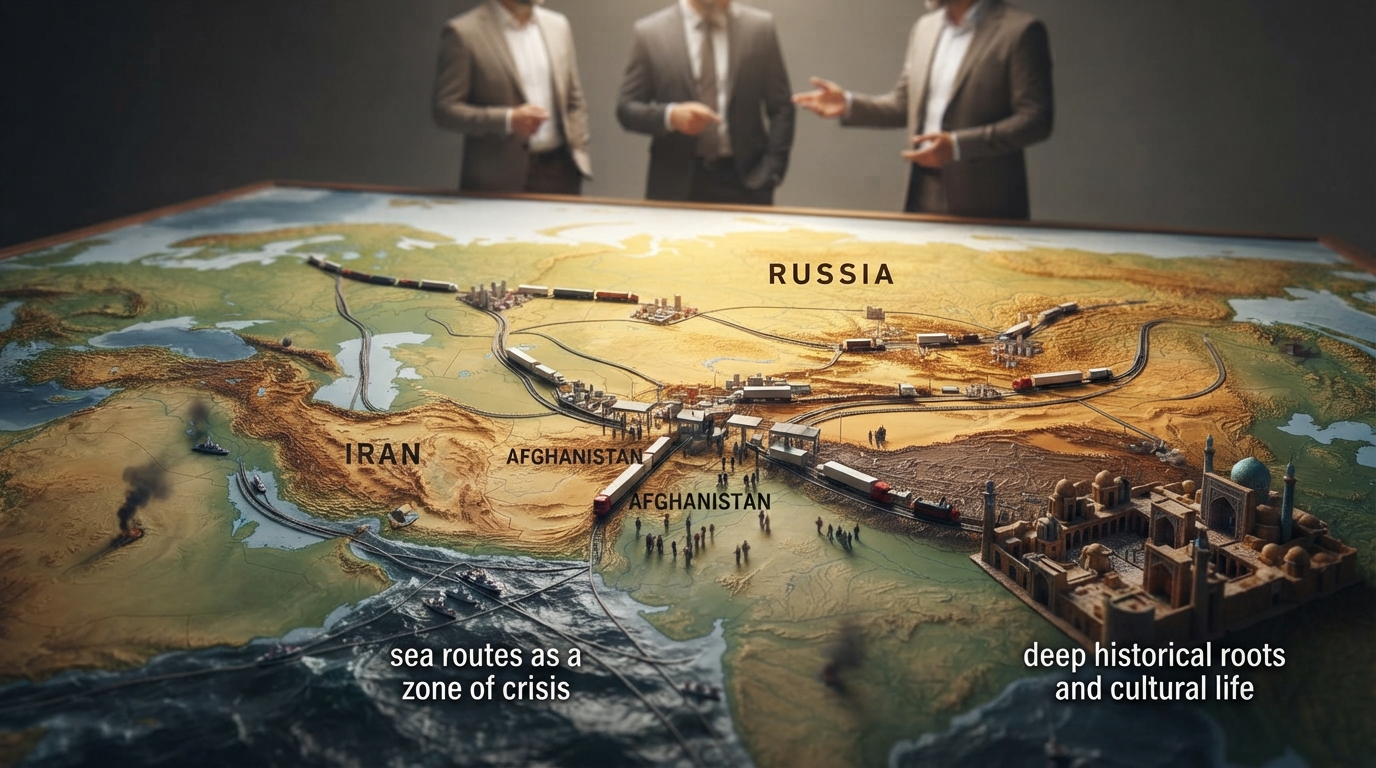
At the same time, an important advantage of our friends and neighbors in Central Asia is that they are far removed from maritime trade routes—this is now recognized almost openly. Previously, the fact that the countries of the region were far from the oceans was considered a problem and was even given the harsh definition of a "continental curse." However, now the situation is clearly changing, as the main global confrontation of the coming decades will be the struggle between the US and China.
This confrontation will not take the form of an open war: both sides are not ready for a clash and consider its price to be exorbitant for them. Therefore, their strategy toward each other will rather resemble the actions of the USSR and the US during the Cold War years: to contain the opponent wherever possible and to occupy spaces simply so that the adversary does not do so. One of the most striking manifestations of this struggle was the aggression against Iran in the spring of this year—after all, it is from there that China receives much of the oil necessary for its economy.
The consequence of the attack on Iran by the US and Israel was the destabilization of all regional maritime trade and logistics—starting with the closure of the Strait of Hormuz. And it is obvious that as the rivalry between Washington and Beijing intensifies, maritime trade routes will soon cease to be a "comfort zone" altogether, even in a very relative sense. Land routes, on the other hand, will benefit, and the advantage will go to whoever is inside the continent but capable of ensuring terrestrial connectivity of markets and territories.
In other words, the sea around Asia and Eurasia will be a crisis zone, while the land will be a space of prosperity. Partly because of this, our friends and allies in the region currently feel relatively confident in their own future. And this confidence can sometimes look like overconfidence, a departure from the traditional policy of special bilateral relations with Russia. However, one should not mistake diplomacy for a strategic choice.
When in the region, one realizes: an ancient history of cultural life and statehood, unlike in Eastern Europe, serves here as a guarantee that the diplomatic game will not escalate into a strategic disaster. It is precisely in this direction that the small neighboring countries of Russia are most practical. And Moscow must be just as practical in its relations with them.