

The burden of memories: Why is it difficult to let go of old things?
In her philosophy, tidying up the home is not just about sorting through items. Taking each thing in one's hands,
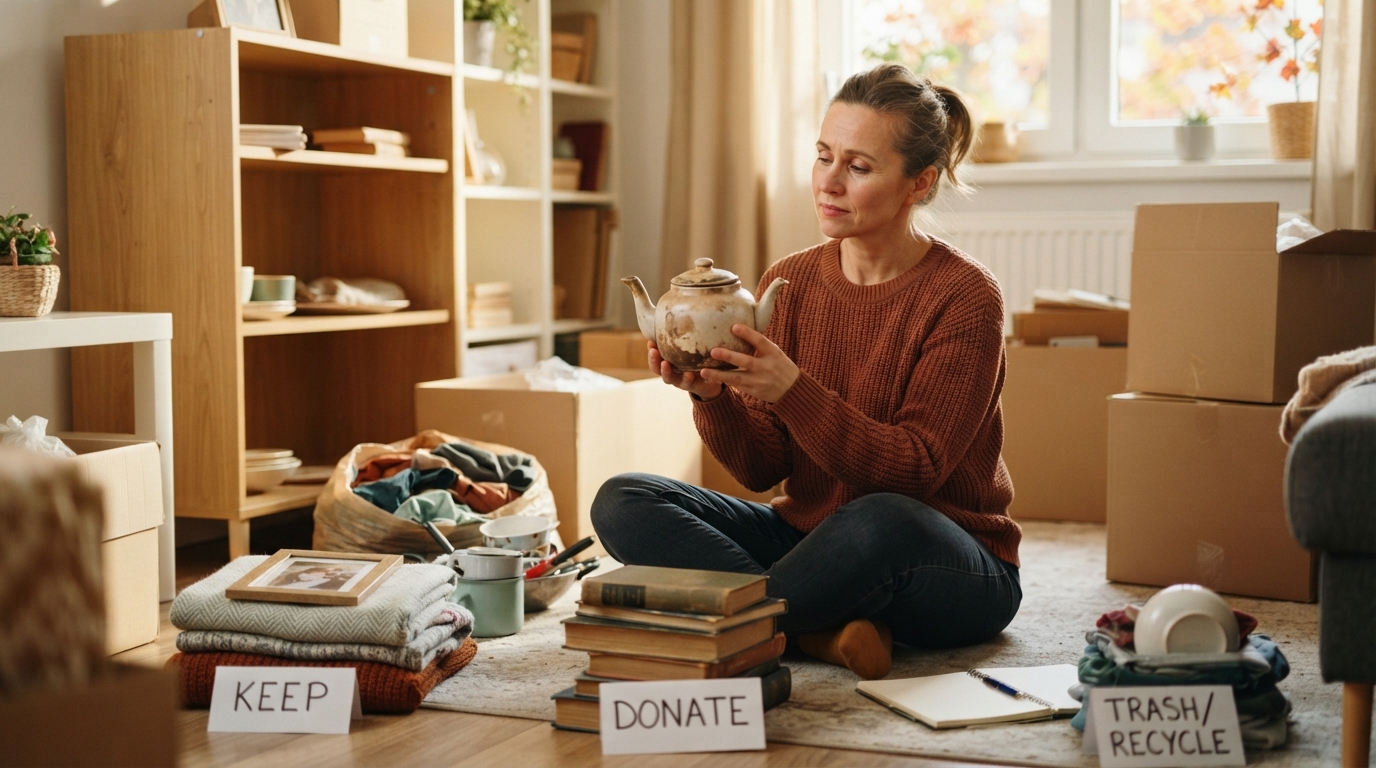
**The Burden of Memories: Why is it hard to let go of old things?**
As the warm days fade and the air turns cooler, habits change too. The days grow shorter, yard work decreases, and the hoes, shovels, and buckets that stood by the door all day are put back in their places. Those living in apartment buildings also start going outside less. That is when you notice that unnecessary things have accumulated in your home.
And when the seasons change, we all rummage through closets and shelves. Clothes that are no longer worn, dishes that are not used, items kept for years in the hope that "they might come in handy one day"...
Do you still need all of this?
Japanese author Marie Kondo, who has written several books on tidying up the home, poses this very question. In her view, organizing a home is not just about sorting items. She recommends holding each object and asking, "Does this spark joy?"
Although the question seems simple, answering it is not easy. Because we do not keep items just because they are items. For example, you have a dress that has been forgotten for three years, but because it was worn at your daughter's wedding, it reminds you of that day. What about the cracked dish? Yes, it is a keepsake from your mother. The kettle with the loose handle reminds you of your grandmother. You do not want to carry the faded bag, but it was bought with your first salary. You cannot bring yourself to throw any of these away.
In this way, not just items, but small fragments of our past accumulate in our homes. We are afraid to throw them away. It is as if by letting go of the item, the memory associated with it will also disappear.
But is that really the case?
This is why tidying up a home is sometimes harder than expected. The caution of "it might come in handy one day" becomes the most convenient excuse for not being able to say goodbye to items.
An item may be trivial, but the meaning attached to it seems far from trivial... Therefore, one should not try to completely transform the house in a single day. First, it is enough to look at the things on just one shelf. Gathering clothes, books, and knick-knacks in one place is also an interesting experience: a person realizes not how many things they own, but how much extra burden they are carrying.
Marie Kondo says that when saying goodbye to items, one should express gratitude to them. This may seem like an unnecessary ritual to some, but there is a simple truth behind it: the thing that is leaving you was once needed in your life. Letting it go does not mean denying that period.
Simply saying,
"You have fulfilled your purpose"
is enough.
There is another aspect. We are afraid of leaving empty space in the house. An empty shelf, an empty wall, or a corner feels as if "something is missing." Therefore, we rush to fill it immediately. As if life is only perfect when the house is full.
In reality, however, sometimes a person does not need another item, but rather a little space. An open spot next to the armchair, a shelf without books, a table with nothing on it... Just a space where you can sit and breathe freely. Perhaps the most valuable thing in the house is precisely this unoccupied area.
That is why autumn is a beautiful season. Trees shed their leaves and accept this not as a loss, but as a change of season. Humans, however, often view letting go as a loss. If we, too, rid ourselves of old things just as autumn sheds its leaves, perhaps a path will open for new things...
Maybe we will learn from autumn that it is not necessary to hold onto everything forever...
Open one shelf today. Take each item in it into your hands and ask yourself:
"Am I still keeping this because I want to, or am I just afraid to throw it away?"
The answer, perhaps, is not about the item... It will be about your current life, about your today.