

Memory is not a warehouse, but a trust
Memory is a wonderful blessing. We cannot command it, saying "keep this, erase that." Sometimes, what we wish to forget is from our memory
**Memory is not a warehouse, but a trust**
We may not remember the details of the article we read yesterday today, but a single sentence our teacher said twenty years ago still remains in our memory. We forget why we picked up the phone, but we can close our eyes and describe a corner of our childhood home.
Memory is a wonderful blessing. We cannot command it to "keep this, delete that." Sometimes what we want to forget does not leave our memory, and what we must not forget vanishes in an instant.
What actually is memory?
According to the scientific definition, memory is the brain's ability to receive, store, and recall information when needed. While short-term memory holds information for seconds or minutes, some information can be stored in long-term memory for years.
To imagine the capacity of the human brain, physiologist Sinan Canan brings an interesting comparison: based on the billions of cells in the brain and the countless connections between them, he compares the approximate capacity of human memory to 2.5 million gigabytes, which is about 300 years of HD video. This, of course, is not an exact biological measurement of memory. But the metaphor itself makes one think: with a brain that has so much potential, why can't we sometimes remember a single page of text? Perhaps the problem is not that our memory is "full." Perhaps our attention has weakened before our memory.
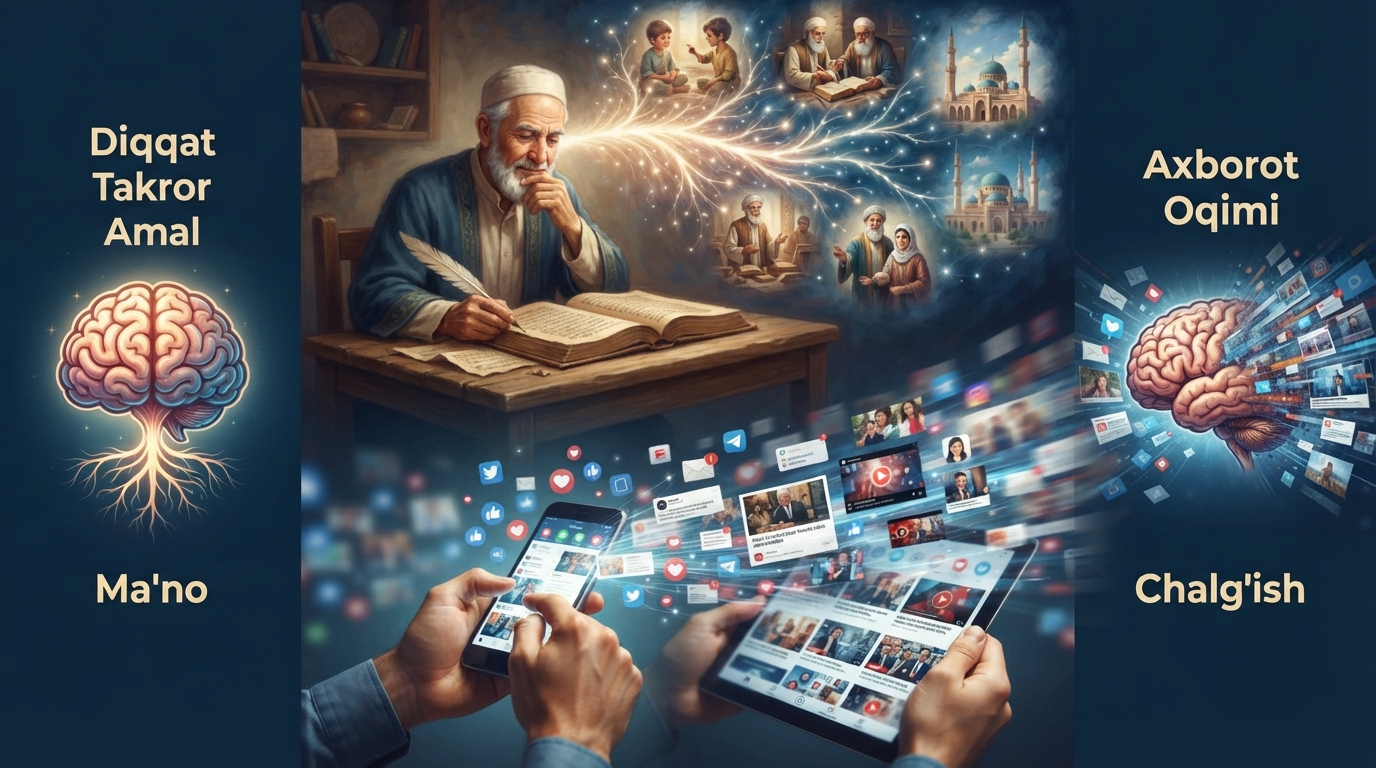
Today, we start a second book before finishing the first. We check the phone while reading a text. We open a message, go from there to social media, and from there to a video. Dozens of pieces of information pass through our minds in a few minutes. As a result, we see a lot, but contemplate little. The problem of the century we live in is not a shortage of information, but an excess of information fighting to enter our minds.
A person who was previously discouraged from scattering among several books now lives among dozens of "windows" on a single phone screen.
**The table of the great was simple, but what about their memory?**
When it comes to memory, B12, omega-3, vitamins, walnuts, fish, and healthy foods are mentioned. There is a scientific basis for this. A balanced diet, adequate sleep, physical activity, and stress management are important for brain function. Sleep plays a special role in consolidating learned information. But history poses a very interesting question: if the table of the great masters of science and enlightenment was not as diverse as today's, how did they possess such powerful minds?
Today, when we associate intellect with healthy eating and memory with B12, how can we understand that the companions of the Prophet possessed such powerful minds and thinking in simple living conditions?! The answer to this cannot be fit into the sentence "they ate little, therefore their memory was strong." The brain is also a part of the body. It also needs food, sleep, and health.
The wisdom and hadiths our ancestors heard were not just another "content." They had to be understood, contemplated, memorized, practiced, and conveyed to others. Wisdom was repeatedly reminded in conversations and applied in life situations. Knowledge was not heard once and buried under the next hundred messages. Conversations, questions, and interests were formed around learning various sciences and teachings. Heard knowledge was applied in practice and conveyed to others. Modern science also confirms the role of repetition in memory: recalling information at certain intervals helps to consolidate it in long-term memory. So, the food for memory is not only on the table. Its food is also attention, repetition, practice, and meaning.
**In a world without computers, Imam Bukhari had emerged...**
Imagine, in the world where Imam Bukhari lived, there was no opportunity to delegate knowledge to a device outside the brain. It was necessary to hear hadiths, know stories and narrations, verify them, and memorize them. Today, if we forget a piece of information, we often do not even worry: "If needed, I will search and find it," we say. This very convenience has changed the function of memory. The memory of our phones is growing, and we find any information in a few seconds.
We search for any information. But being able to find information and knowing it are not the same thing. Their existence in a search engine is one thing, their being imprinted in your heart and memory is another. Being able to find a wise word on the internet is one thing, and having it come out of your memory and guide you in the most difficult moment of your life is completely another. If knowledge were generated by pressing a single button, perhaps we would all be scholars.
In addition to preserving the past, human memory is a means of conveying knowledge and experience to the future.
If knowledge absorbed into the heart is taught to others, the personal experience of one person becomes a collective wealth. One generation passes on what it has learned to the next, and in this way, knowledge lives continuously.
For even if a person is forgotten, the trace they left in their heart and knowledge lives on in the memory of generations.
Books can be lost. Pages can be torn. But if a word has moved into hundreds, thousands of hearts, it is not easy to lose it. Therefore, for every person, a strong mind and thinking is the ability to understand learned knowledge, preserve life experience, and use it correctly when necessary.
**Is it also necessary to forget?**
We are talking about strengthening memory. But there is another side to the matter. What would happen if a person forgot nothing? If an insult from ten years ago hurt the heart today just as it did on that day... If the tragedy of a lost loved one caused the same pain after twenty years as on the first day... If every mistake, every shame, every separation did not lose its emotional strength at all... Would such a "perfect memory" really be a blessing? In the source we used, it is said that the fading of grief arising from the death of loved ones and difficult events in life over time is also necessary for a human being. So, there is wisdom in forgetting too.
The forgetting of knowledge may be a loss. But the forgetting of yesterday's pain is a cure for the heart. If the lesson of the mistake remains and the pain goes away, perhaps this is the healthiest memory for a human being.
At the table of knowledge, honey is served at the end. You know, there is no elevator to success, it is always climbed by stairs. As you set out on the path of knowledge, you first walk along a path, through rough terrain of thorns and weeds, and then a highway appears. And do not forget that at the beginning of the table of knowledge, bitter onions are served, and honey is eaten at the end. These metaphors describe the nature of acquiring knowledge very accurately. Because today we want to get results quickly. If we read three times and do not memorize, we say, "my memory is not good." If one book is difficult, we move on to another. However, memory is also trained with labor. The brain is a bud; it blossoms as it is regularly "watered" with certain knowledge. To preserve and strengthen memory, first of all, the gaze must be protected. Because whatever we look at a lot with our eyes, we also occupy our mind with that thing.
The greatest lesson we can take from our great ancestors is probably not in how much they ate or how much they slept, but in what they gave their full attention to. For this reason, a strong memory does not mean remembering everything. It is preserving what is worth remembering in the heart, and being able to let go of what is worth forgetting.
Memory is not a warehouse in our head, but a trust given to us.