

"I don't need this": how to explain to a child the need to study all subjects?
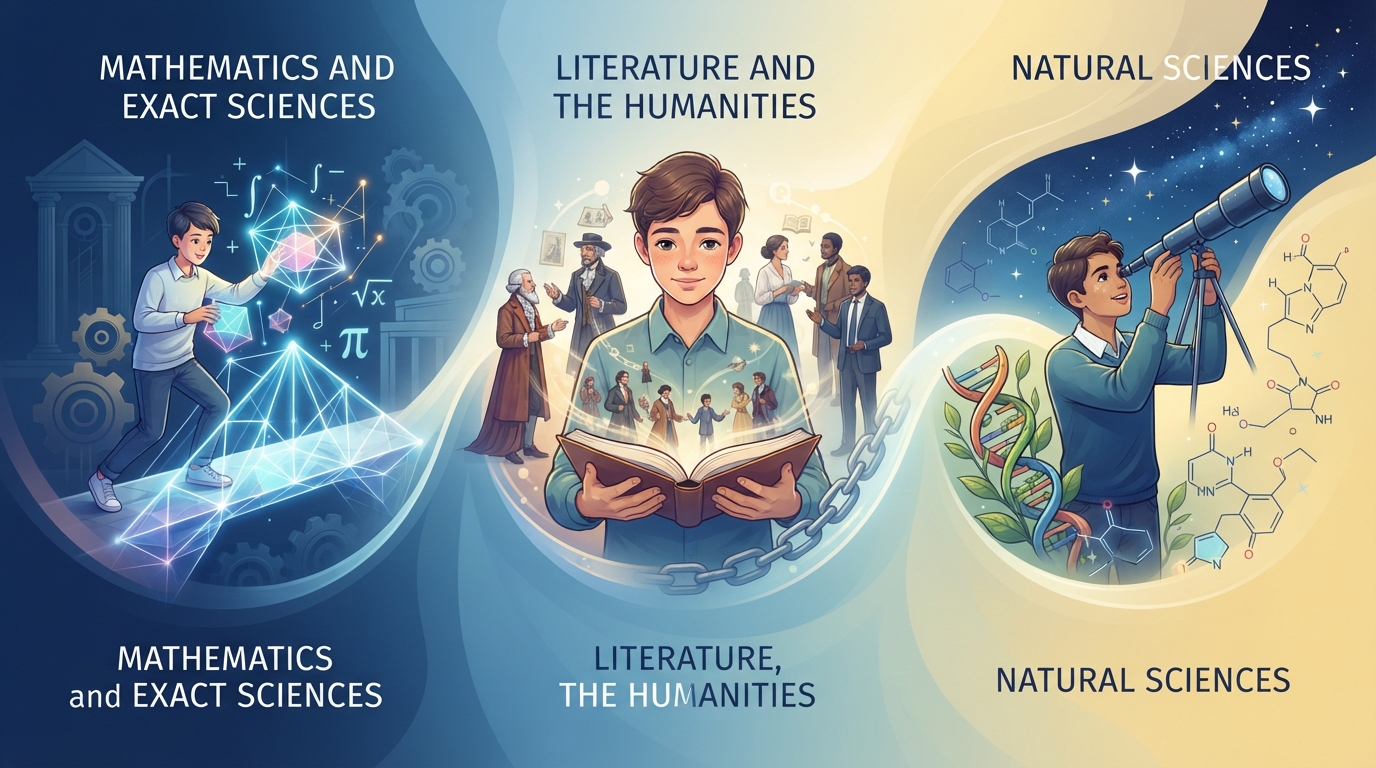
“I don’t need it”: how to explain to a child the importance of studying all subjects?
Many students are not interested in certain subjects. They argue that subjects such as biology or astronomy will not be useful in life, so it is useless to spend time on them. Let’s look at why it is important to study the subjects included in the secondary education program.
**1. Mathematics and exact sciences**
Exact sciences, especially algebra and geometry, are often criticized by those inclined to the humanities. However, the skills of addition, subtraction and multiplication are necessary for almost everyone.
Solving quadratic equations or calculating the limits of trigonometric rules and functions may seem incomprehensible to many. However, such problems effectively train the brain and develop several important skills.
* **Ability to work with abstract concepts**
Proportions or percentages can be easily explained through examples. However, the properties of algebraic functions or the rules for calculating the derivative require abstract concepts. They are difficult to demonstrate with your own hands or explain with examples from everyday life. Therefore, in order to understand mathematical sections, it is necessary to learn to think in abstract categories.
This process can be complicated, but it develops logical thinking very well.
Developed logic helps to make the right decisions in various situations. For example, to avoid falling for the tricks of manipulators. One of their methods is the principle of false dichotomy. In this case, they explain that there are only two ways out of a difficult situation: one that you do not like, and the other is the way the manipulators want. In fact, this is a logical fallacy, and there are always other options.
Manipulators sometimes act in more subtle ways, but developed logic helps not to succumb to them.
* **The skill of separating the main thing and creating a structure**
A math textbook at first seems like a confusing set of terms and rules. But later it becomes clear that they are strictly interconnected.
Each mathematical section can be imagined as a multi-stage game based on strict rules. If you understand them, you will see a perfect structure, each element in its place and clearly connected to the other.
This skill is also important in life and work processes: it helps to separate the main and secondary things.
For example:
* writing an article or thesis;
* preparing an interesting post for a social network;
* properly planning a conversation with a manager about a salary increase.
Such a skill saves time and effort and helps to achieve the goal faster.
* **Developing attention and concentration**
Many mathematical problems are solved in several stages. You need to work carefully at each stage.
Such problems teach concentration. If you make a mistake in the calculation, you need to go back, find the wrong step and correct it. This trains both attention and thinking.
In addition, the ability to not give up, not to give in to discouragement, and to fight to the end is also developed. Of course, playing sports also teaches this, but mathematical problems are also an excellent intellectual and personal training.
**2. Literature and the humanities**
These subjects develop emotional intelligence. Literature develops the following skills:
* **The ability to put yourself in another person's shoes**
In classic works, events are not simply described. Authors describe in detail the inner experiences of the characters, what emotions push them to a certain decision.
The reader looks at the situation through the eyes of the character and experiences his feelings. This way, he understands why the hero made the decision he did.
Works may have been written a hundred years ago, but the human psyche does not change. We still feel joy, sadness, pain and anger.
For example, in a family conflict, you can look at the situation from your spouse's point of view and understand that something is missing.
* **The ability to see cause and effect**
This skill is developed in literature and history lessons. They help to understand the chain of events: what happened before and what happened after.
Human behavior does not change, so by understanding cause and effect, you can learn from mistakes.
The same is true in real life: when a problem arises, you need to try to solve it immediately. Otherwise, the situation will worsen.
* **The ability to defend your opinion**
Everyone can interpret a work differently. Heroes are also evaluated differently by different people.
The teacher may not agree with your point of view. This is a great opportunity to participate in a debate, to learn to defend your opinion.
In life, not everyone will support your opinion, so such an exercise is useful.
Yes, sometimes this may not bring a very good grade at school, but the experience gained in that debate will stay with you for life.
**3. Natural sciences**
Biology, chemistry, geography help us understand who we are and what kind of world we live in. You can also add astronomy and physics to this list, which also explain the universe and its laws. Some facts may not be useful to us in everyday life. But each new knowledge expands our worldview.
Even if we forget the fact ourselves, the picture of the universe remains in our minds.
For example, when water boils, its temperature is always 100°C (at sea level, slightly lower in the mountains). This does not change as the boiling point increases or decreases.
Therefore, it is possible to save energy by slightly reducing the power of the fire. This knowledge can be learned in physics classes.
Although this is a simple example, there are many such knowledge in life. No one knows when one of them will be needed.