

The audience votes with trust. Column by the Director of the Mass Media Foundation
The Mass Media Foundation recently presented the results of a study on media consumption in Uzbekistan. The foundation's director, Jahongir Azimov, explains in his column how to read the figures and what they mean for the media sphere.
The audience votes with trust. Column by the Director of the Mass Media Foundation
Over the past two and a half years, there has hardly been a single conference, seminar, or workshop where I haven't brought up at least once the urgent need to study media consumption in Uzbekistan. The media industry has made noticeable progress—both in the number of organizations and in the variety of formats. Therefore, the time for an audit has long come. In my view, the best and most objective way for the media sphere to receive feedback is directly from the consumers of information.
That is precisely what we did—the Mass Media Support and Development Public Fund, the Delegation of the European Union to Uzbekistan, the Center for Content Preparation for Mass Media, and the "Ijtimoiy Fikr" Republican Public Opinion Research Center.
The other day, we presented the results of the National Study on Media Consumption in Uzbekistan. For the first time in many years, we have acquired data on the habits, preferences, and information demands of the population.
Data collection and analysis were carried out by the "Ijtimoiy Fikr" Center, while the methodology and questions were thoroughly developed together.
To be fair, it should be noted that similar studies were conducted in the past, but not on such a scale and not using the door-to-door survey method, especially in rural areas of Uzbekistan.
This is perhaps the distinctive feature of our project. We surveyed 1,411 people aged 18 and older living in both urban (53.9%) and rural (46.1%) areas across all 14 regions of the country. Special attention was paid to the gender, age, and territorial characteristics of media consumption.
At the same time, it is important to understand: our study is exploratory in nature. In other words, we managed to identify general patterns of information content consumption and the use of various channels in the country broken down by age, gender, region, settlement type, and employment.
However, a deeper study of television, radio, social networks, online, and print press requires a separate study using focus groups, which newsrooms can conduct on their own.
As a result, we received a document of over 200 pages, which, by the way, anyone can download from the foundation's website.
Understanding numbers is one thing. Understanding trends in the media landscape and trying to correlate them with indicators is quite another. So, what do the data say?
Uzbekistan's audience is a selective and conscious organism with its own preferences. We know that more than half of the respondents (50.4%) follow the news, and another 30.4% are interested in it from time to time. These are high indicators. Moreover, the figures show that young people are also not indifferent to the events taking place in Uzbekistan.
The population is more interested in the life of the country than in world news, although that is also important. For example, 53.9% of respondents reported regularly following the news on TV, 60.2%—through print and electronic publications, 50.6%—through social networks, and 50.4%—via Telegram. We deliberately singled out Telegram into a separate category, given the messenger's popularity.
Moreover, the audience is interested in more than just news. Interested in the news, people want to understand how to improve their quality of life. This is my subjective hypothesis. How can such an assumption be explained? According to the table of preferred topics of information, people regularly seek information about education and science, healthcare, public administration, and politics. At first glance, all these topics seem everyday, but taking into account one of the key functions of the media, which aligns with Albert Bandura's Social Learning Theory—learning about the world through the media—one can safely assume that we are actively seeking knowledge that will help improve our quality of life.
We can also turn to topics that respondents consider insufficiently covered in the media. Among them are prices, income, employment, and social support (41.3% of respondents), problems and needs of the population (40.6%), healthcare (23%), education, and science (16%). We must not forget that the medium and the consumer are connected by a fine thread of a personal, private nature. We can entrust our most intimate secrets or inner feelings to a search engine. That is why personal data in the information space is so strictly protected.
Our study sheds light on the specifics of information consumption in rural areas and regions of Uzbekistan. As the data show, in the regions and villages, indicators for certain areas are significantly higher than in cities and the capital. For example, 72.3% of respondents in the Navoiy region reported regularly following the news, in the Khorezm region—64%, in the Bukhara region—65.3%. In Tashkent, this figure is 43.1%.
Pay attention to the Republic of Karakalpakstan. There, 72% of respondents follow the news agenda via Telegram, 59% via TV, and 56% via social networks. In the Samarkand region, the picture is as follows: Telegram—60.4%, TV—60.4%, social networks—54.5%.
Furthermore, rural residents would like to see more TV talk shows, interviews, and discussions on socially significant topics, as well as domestic movies, more often than urban residents.
Even the rates of social network usage in several regions are higher than in Tashkent. We are talking about the Andijan, Bukhara, Jizzakh, Khorezm, and Fergana regions. Hypothetically, it is in the regions of Uzbekistan that there is space for the expansion of the media market today.
It is also important to talk about the sources of information consumption. Yes, of course, the respondents get the most news content via Telegram (51.6%), followed by television (44.6%) and social networks (41.6%). But this does not mean that Telegram is the dominant source of information. Everything is much more complex than it might seem at first glance.
First, Telegram itself cannot be considered a news source in the classical sense, as it does not produce news content. Being a messenger, it acts as an aggregator through which news, articles, video materials, and photos are distributed. Since the audience still leans more toward national media, most likely people follow the news agenda of national media through their official Telegram channels.
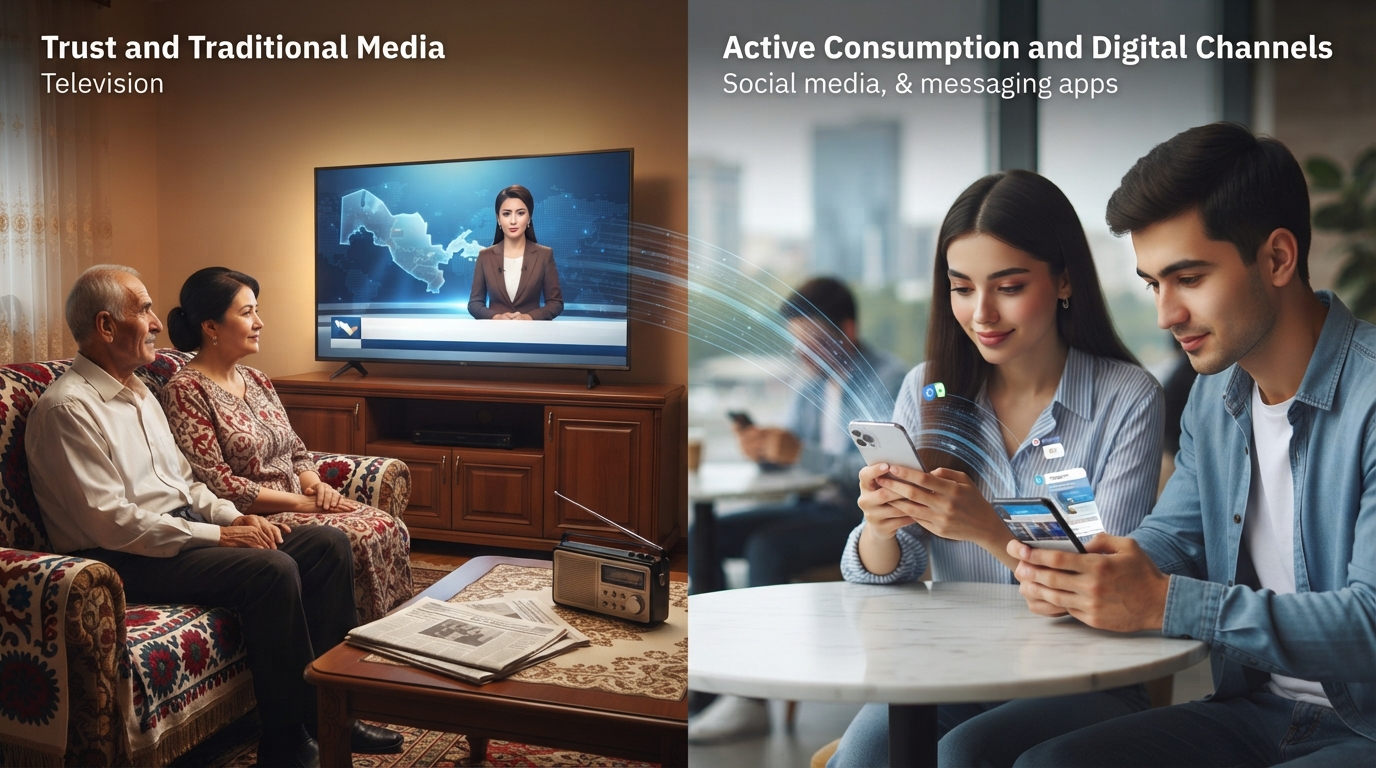
Second, consumption does not equal trust. It is trust, not the number of views, that serves as the measure of quality and sustainability for the media sphere. The audience trusts television the most (44.3%). Moreover, the level of trust in state-owned channels is higher than in private ones, despite the fact that private TV channels are watched more often. In addition, the gap between various media channels in terms of trust level is quite noticeable. Telegram channels are trusted by only 11.3% of respondents, and social networks—by 6.7%.
Third, multimodal content consumption must also be taken into account. What does this mean? The population follows the news agenda simultaneously through several sources: TV, social networks, Telegram, and online publications. The main consumption time is the evening. Simply put, people simultaneously watch TV, read news on Telegram, and scroll through the feed on Instagram, which, according to our study, is the absolute leader among social networks. In essence, all media organizations are competing for the audience's attention and trust at practically the exact same time, even if they publish news throughout the day.
Multimodal content consumption is also noticeable by age group. While young people lean more toward social networks, the older generation favors traditional media. However, it is curious that young people are also aware of the agenda of state TV channels and follow it.
And here it is important to consider one factor: the most effective interaction with content occurs within an extremely short period of time.
Across all media channels, the average content consumption time ranges from 30 minutes to 1.5 hours. The competition is simply ruthless.
I will also hypothesize that the audience consumes television content in an "active mode" phase, and social networks in a "passive mode". Although I will make a reservation: a separate study is needed to confirm this hypothesis.
The point is that the architecture of social networks is built on the idea of active absorption of information. This is when the user chooses whom to follow and what to read or watch. TV, on the other hand, is a passive medium, since the viewer has no opportunity to independently select the program. All we can control is switching channels or going to YouTube.
However, the endless scrolling of the Instagram feed, the low level of trust in social networks, as well as frequent cases of dissemination of unreliable and fake information, can push people to turn to traditional media. As a result, the audience watches television more attentively than it consumes content on social networks.
Let us add another aspect to this: although TV is at the top, the audience turns to the digital space for more detailed information on a particular issue. State media remain the primary source of information. But for explanations, analytics, and opinions, the audience apparently goes to online media. Such a conclusion can be drawn from the answers of the respondents themselves. 45.7% of respondents noted that they turn to Telegram channels for detailed information about a specific event or a particular news item. To social networks—35.9%, and to online publications—30.7%.
24.5% of respondents stated that they lack deep analytical materials on social networks. Another 17.9% pointed to a lack of explanations of complex events in simple language. This once again confirms that the audience has specific information demands.
Moreover, this is a clear hint at a fairly high level of media literacy among the population.
Of course, there was some sad news as well. Radio listening levels are rapidly declining. 21.9% of survey participants listen to radio programs, while 78.1% do not use this information source. 71.7% of respondents do not read print and online publications, even though they actively follow the news.
But one should not rush into pessimistic forecasts. On the contrary, these figures may indicate the opposite—unrealized opportunities. The media consumption study shows that national media have secured strong positions in Uzbekistan. The audience not only consumes locally produced content, but also trusts it more. And the demand from the audience is large enough for the media sphere to continue developing.