

Telegram has surpassed television in popularity among news sources in Uzbekistan
Telegram Overtakes Television in Popularity Among News Sources in Uzbekistan
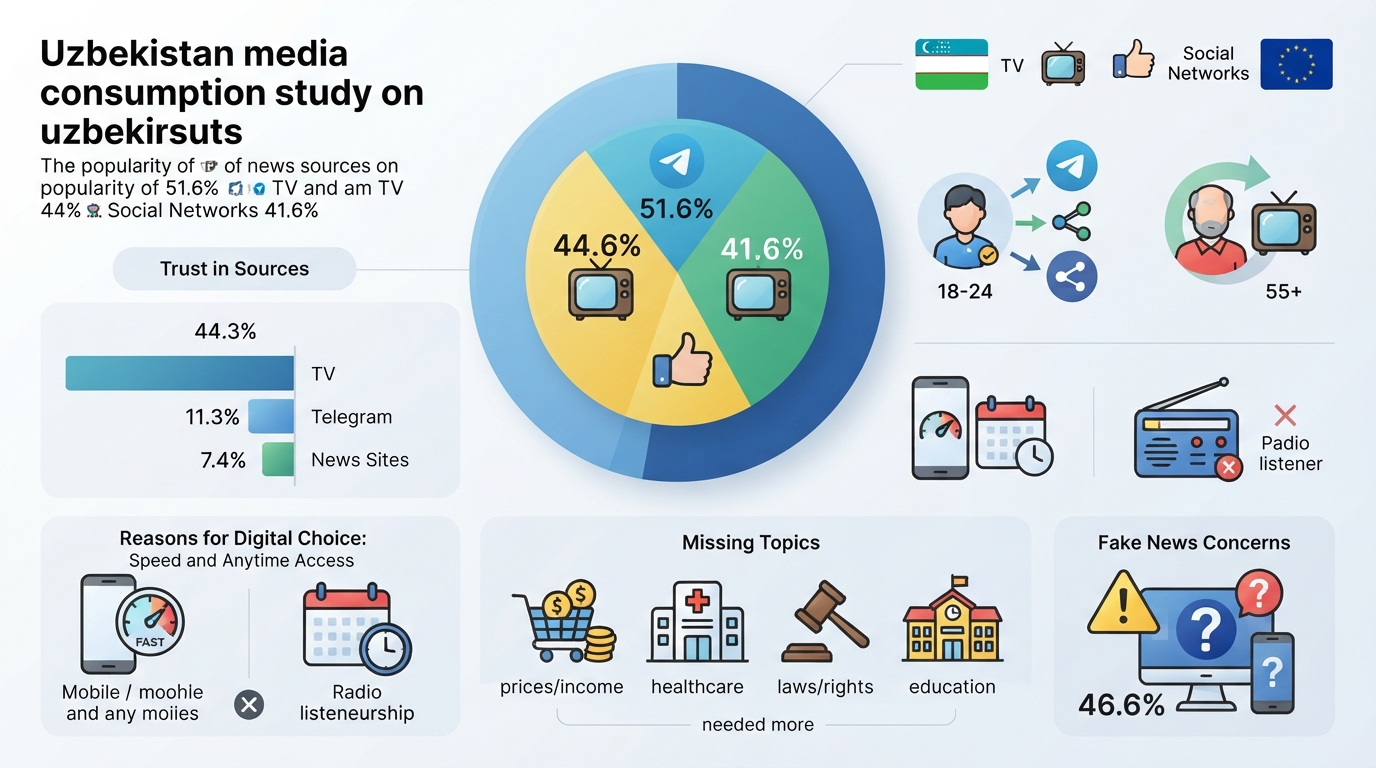
Telegram, television, and social networks have become the main channels through which residents of Uzbekistan receive news. At the same time, the level of trust in them differs noticeably: 44.3% of respondents trust television, while 11.3% trust Telegram channels.
This was reported on November 2 in Tashkent following the results of the first national study of media consumption.
The project was implemented by the Public Fund for Support and Development of National Mass Media together with the Delegation of the European Union to Uzbekistan, the Center for Media Content Preparation under the Presidential Administration, and the "Ijtimoiy Fikr" Republican Center for Public Opinion Research.
The survey took place from September 8 to 19, 2026, in the format of face-to-face interviews at the respondents' places of residence. It involved 1,411 people over the age of 18 from all 14 regions of the country. The share of urban residents was 53.9%, and rural residents made up 46.1%.
### Where Residents Get Their News
According to the study, residents of Uzbekistan most often learn about events from Telegram channels — 51.6% of survey participants indicated this source. Television came in second place with a figure of 44.6%, and social networks came third (41.6%).
At the same time, media preferences depend noticeably on age. Young people aged 18 to 24 turn more often to Telegram (66.2%) and social networks (54.4%). Among respondents over 55, television leads: 77.4% choose it.
Despite the growth of digital platforms, television still maintains a strong position. Television content is watched by 67.5% of those surveyed. Moreover, it is trusted the most — by 44.3% of study participants. For comparison, 11.3% trust Telegram channels, and 7.4% trust news websites.
Among TV channels, "O‘zbekiston 24" enjoys the highest level of trust. It was named the main source of information by 41.7% of viewers, and 52.8% consider it the most reliable TV channel. Milliy TV, Zo‘r TV, and Sevimli TV are also among the most popular.
### Nearly Nine Out of Ten Respondents Use Telegram
Researchers separately examined the use of social networks and instant messengers. According to the survey, 64.8% of respondents use social networks, while the share of Telegram users reaches 86.1%.
Instagram became the absolute leader among social networks. It is used by 92.7% of surveyed individuals who turn to such platforms.
Respondents named the speed of receiving news (48.6%) and the ability to access content at any time (31%) as the main reasons for choosing digital sources of information.
Radio, on the contrary, occupies a comparatively small place in the structure of media consumption. Radio programs are listened to by 21.9% of survey participants, while 78.1% do not use this source.
The largest share of radio listeners was recorded among people aged 35–44 (26.9%), and the smallest — among youth aged 18–24 (16.7%).
### What Topics Are Lacking in the Media
The study also showed that audience interests do not always coincide with the content of publications. More than half of those surveyed (56%) follow events in Uzbekistan, 40% are interested in the international agenda, and 22% follow local and regional news.
At the same time, 41.3% of respondents noted a lack of information about prices, income, employment, and social support. Another 40.6% pointed to a lack of materials on the daily problems of the population.
Among other topics about which the audience would like to receive more information are healthcare (23%), laws and citizens' rights (22%), public services (18%), and education and science (16%).
In addition to topics, survey participants outlined expectations regarding the quality of journalistic materials. Thus, 27.6% would like to see more in-depth analytical publications, and 22.5% want an objective presentation of different points of view. Respondents also noted the need for investigative journalism.
The study also revealed differences in the assessments of urban and rural residents. In particular, rural residents are more likely to believe that false and unreliable information is found in online publications and news websites. This opinion is held by 41.2% of rural respondents compared to 31.6% of urban ones. In addition, villagers more frequently point to a lack of objectivity and impartiality in the media — 39.2% versus 27.9% among urban dwellers.
Overall, 49.7% of survey participants rate the level of freedom of speech in the country as high.
### Fakes Named as the Main Problem of Modern Media
Respondents consider the spread of unreliable information to be one of the most serious problems in the media sphere. Fake news was called the main threat by 46.6% of study participants. Most often, people encounter it on YouTube, on Telegram, and on social networks.
In this regard, 77.4% of those surveyed favored stricter liability for the media for disseminating unreliable information.
Researchers also studied the preferences of TV viewers. Most often, they watch news and information programs: they are chosen by 65.3% of urban and 75.4% of rural residents. Popular genres also include programs about health and a healthy lifestyle, shows about family and child-rearing, documentaries, and investigative journalism.
The second stage of the project will consist of educational training sessions for journalists, press service employees, and bloggers in six regions of Uzbekistan.