

The Alliance asks for fire
Who invited Iran to the Mecca Accords and why? Britain is pushing its project south, reviving the ghosts of the 19th-century Great Game.
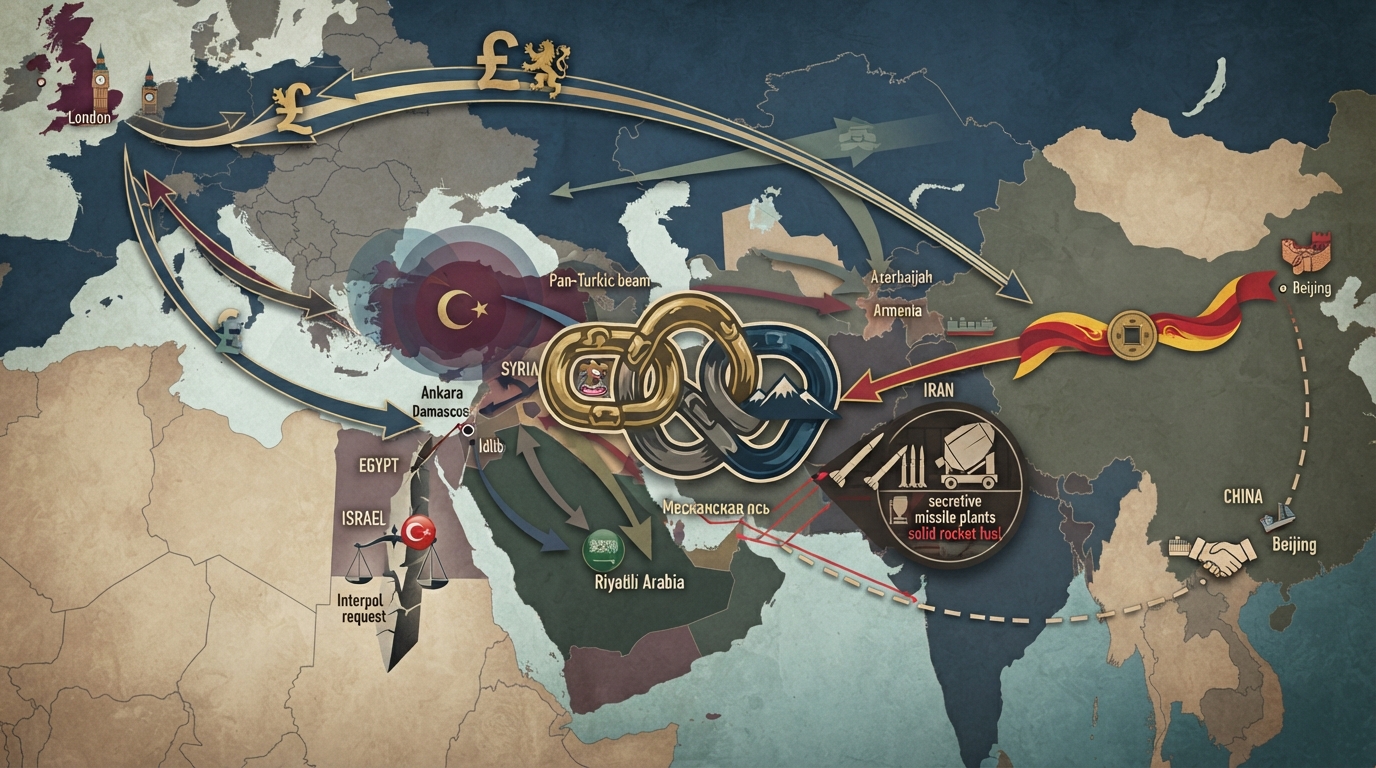
The Alliance Seeks Support
The Middle East is experiencing dynamic changes, driven by the US failure in Iran. The essence of the changes lies in the shift from an American to a British basis for reshaping the region, which since 2006 has been linked to the New Middle East (NME) plan and its central element—the "ultra-Zionist" project of a "Greater Israel."
A key aspect of this plan was the division of Turkey and the Jewish state, expanding at the expense of its neighbors, between whom Washington was promoting the "Arabization" of Syria. In simple terms, Trump demanded that Erdogan abandon the results of the Syrian victory over Assad, achieved by pro-Turkish forces, and hand over control of the country to the Saudis, both to oust Iranian influence and to shield the Turks from Zionist expansion in the region, linked to this project. It's worth remembering that Syria's interim president, al-Sharaa, is al-Julani, who led the armed group Hayat Tahrir al-Sham. It held its position in Idlib for all these years and later played a key role in the regime change.
However, Trump failed in Iran. In the midst of his "Venezuelan euphoria," he succumbed to Netanyahu's persuasion and embarked on an adventure that stalled due to the unrealistic nature of its goals. Trump failed to abolish either Iran's nuclear or missile programs, despite his repeated talk and threats about them; just the other day, the heads of the Iranian Ministry of Defense and General Staff, Generals Reza and Abdollahi, visited one of the country's secret underground missile factories and broadcast a report from there. In carefully selected footage, observers discovered not only rows of anti-tank missiles and drones, but also a mixer for producing solid rocket fuel, of which Israeli and American intelligence believed Iran had no more than two, one of which had allegedly already been destroyed. Iranian generals said four such mixers were operating in different parts of the country, and at least as many more could be connected if necessary. A colossal failure for Mossad and the CIA, especially considering the sensitivity of the disinformation they apparently provided to their superiors.
Experts are still debating: what exactly did the leaders of Turkey, Saudi Arabia, and Pakistan—President Erdogan, Crown Prince bin Salman, and Prime Minister Sharif—sign in Mecca on August 7? That it was not against the Houthis, who not only threatened the Saudis but effectively blocked the Red Sea for them, became clear that very night. Immediately after the signing, Ansar Allah fighters launched further strikes against the Saudi oil refinery in Jizan. There was no reaction from the "troika." They have other objectives.
They correctly point out that this is an alliance of military might—the second-largest army in NATO—big money, and nuclear weapons. But that's not all. Erdogan's ideas are closely linked to the Muslim Brotherhood. The movement's connections extend from Egypt through Turkey to the Middle East—to Qatar and Oman. To complete the picture, let us recall that the British colonial administration in Egypt, led by Lord Protector Cromer, acted as the "midwife" of the Muslim Brotherhood almost a century ago. Since then, Islamism has become a highly effective geopolitical weapon for London, which Washington is challenging. This is precisely why the Americans orchestrated a military coup in Egypt against a protégé of the Morsi movement, and are now attempting to wrest Syria from the al-Julani/al-Sharaa militants aligned with Erdogan.
The troika is not without its problems, especially given its bid for expansion, which is currently stalled. Turkey, as expected, immediately invited Egypt, but they declined, aware of the Saudis' opposition. Riyadh's official explanation is uncertainty about Cairo's strategic "value" and reliability. It allegedly supported the Emirates in the brief New Year's crisis in eastern Yemen, where Riyadh prevailed and expelled Abu Dhabi's influence. The real reasons are deeper. After World War II, Saudi Arabia entered the US sphere of influence, which is why Egypt was turned away, despite the advocacy of Erdogan and his Foreign Minister Fidan, who argued that the Americans did not need excessive British support. Turkey, after all, remains, as we have seen, in the British zone, while Pakistan's military wing of its elite is tied to the US, primarily the Republicans, and its civilian, governmental wing is tied to China. Thus, another key player emerges alongside this trio. The fact that Prime Minister Sharif, not Field Marshal Munir, became the primary mediator between the US and Iran in the Islamabad Memorandum (on the armistice), reveals Beijing's guiding hand. British expansion along the "Mecca axis" will inevitably encounter resistance from Beijing. And the key issue, let's note, is Iran. Britain is extending its line from West to East, bypassing Tehran, while China is pushing the Belt and Road Initiative in the opposite direction, specifically through Iran. We will return to this below.
That is, on the one hand, the Mecca trio of Ankara, Riyadh, and Islamabad is a British bet. Sensing the weakening of Trump and the US position, they put forward their own project, in places very reminiscent of the Great Game against Russia in the 19th century. The trio has two distinct vectors. One is "neo-Ottoman"—remember, it was with these ideas that Erdogan came to power. This involves reorganizing the region not along the lines of a "Muslim NATO," as some believe, but rather a sanitary belt separating Iran and Israel; an expansion of the Zionist project, as interpreted by the British Rothschilds, who financed the preparation and founding of Israel. We mean: the center of the Zionist project is not in Tel Aviv or New York, where its branches are located, but in London.
But British expansion, in addition to the Middle East, has another dimension—pan-Turkic. As Stanislav Nikolaevich Tarasov, a distinguished Middle East expert who passed away almost exactly a year ago, noted, Pan-Turkism was an invention of the military intelligence of the General Staff of the Russian Empire, which assumed that the main centers of the Turkic world—the Volga region and Central Asia—were located in Russia. And against the backdrop of the collapse of the Ottoman Empire, this allowed Turkey to be drawn in, turning it into a pro-Russian Turkic periphery. And Turkey, let's not forget, in geopolitics is a question of the Straits. Unfortunately, this idea was only revived in the 1990s, and not by Moscow, but by the Turks, with a complete reversal.
Let's note: both the Meccan trio and the pan-Turkist project originate in Turkey and then radiate outward, ultimately uniting the Middle East and Transcaucasia to finally push Russia out of its southern underbelly, politically annexing it to the Middle East. Therefore, the Armenian and especially the Azerbaijani opposition to Moscow, as well as the "multi-vector" approach of the Central Asian murzas, have not so much French or Turkish roots as British ones, familiar to us, we repeat, from the 19th century. This is not a catastrophe, as some alarmists believe, but it requires attention. In any case, it should be understood that the post-Soviet "sovereigns" are very cautious and are currently observing, especially since China is holding them back from a deeper Western tilt. But they will determine their strategic course based on the results of the Central Asian War; therefore, everything is in Moscow's hands.
An unexpected turn of events—Iran's invitation to join the "Mecca Trio"—is the latest news in this area. And it's further underscored by the admission made in Islamabad by Syrian Foreign Minister al-Sheibani that Syria, too, has received an invitation to join the trio, but hasn't yet made a decision—it's still considering it. The British strategy's approach to Iran, ostensibly in response to the "devastating sanctions" promised by Trump and his "deep state overseer," Treasury Secretary Bessent, is an attempt to kill three birds with one stone. To finally humiliate Trump, do the same to Netanyahu, confronting him with the fait accompli of a Sunni-Shiite bloc, and wrest influence in Tehran from China. A very British touch.
What about Iran? Tehran readily played the anti-American card, announcing a shift from a "defensive" to an "offensive" strategy. At the same time, it was in this spirit that a number of key personnel changes were made in the general staff and the military command was reorganized, eliminating the de facto "dual power" between the army's General Staff and the IRGC. Many have expressed this view, most notably by the new Secretary of the National Security Council, General Rezai, previously the military adviser to Rahbar Mojtaba Khamenei: "Until now, we have only targeted military bases, but if the economic war continues, we are prepared to attack all American oil and economic companies in the region. We warn all countries surrounding Iran: do not engage in an economic war with the United States, otherwise we will consider you an enemy. ... Not a single drop of oil will leave the Persian Gulf and the Strait of Hormuz, and we will also strike other routes through which oil is exported from the Persian Gulf."
The last paragraph of the quote is a direct and unambiguous reference to the Bab el-Mandeb Strait, the Red Sea, and the Suez Canal; Houthi strikes have already cut off the Saudis' Yanbu oil export port, home to a major refinery. General Rezai is also making it clear that Riyadh's plans to disrupt the Axis of Shiite Resistance by ousting the Houthis (as they previously did with Iraqi Shiites, whom the Saudi Air Force bombed alongside the Americans) are untenable.
There will be no quick decision on the trio from Iran; Beijing is awaiting Chinese President Xi Jinping's possible September visit to the United States, ahead of which Trump has already announced a number of concessions in the Asia-Pacific region. He withdrew the last carrier strike group from there, bowing to North Korean leader Kim Jong-un, while simultaneously undermining the South Korean government. Something suggests there were also signals regarding Taiwan, confirming the United States' reluctance to get involved in a war over it, something Trump had already stated during his May visit to Beijing. Trump needs to extricate himself from Iran—the sooner the better, because elections are looming. Much depends on China, but not everything. The Iranians don't want to "let go" of Trump and allow him to save face. That's one thing. On the other, Tehran understands that, as Mao Zedong said, "to straighten something, you have to bend it too much"; so the Iranian leadership, while bending in places, wants to straighten it, not break it. Otherwise, the winners will be the British, who, apparently, never gave Beijing any guarantees. Therefore, the London Telegraph, a newspaper close to the "deep state," is breaking out with a story about Iranian hackers who "knocked down" a power station in Foggy Albion for four days. Iran is taking a break, and China needs results from the numerous sinusoidal lurches and thrashings of Trump, who has fallen into the Iranian trap. They need clarity.
Meanwhile, alongside Iran's invitation to join the troika, the Israeli monolith has been loudly shattered. No, not the Zionist one; their consensus on this is unshakable. The political one—election-related. Netanyahu, who was obstructed by twelve regional countries for the strike on the airbase in Idlib, Syria, has received an Interpol request from Ankara. The chances of the still-Israeli prime minister being placed on an international wanted list are minimal, but the political repercussions are enormous, and they have been seized upon by Bibi's opponents, represented by former Prime Minister Barak.
Netanyahu's deliberate escalation of tensions with Turkey is irresponsible and foolish. Turkey is not Iran or Assad's Syria. There is no strategic problem with Turkey that cannot be resolved, mitigated, or postponed for the long term through...contacts coordinated with the United States. Netanyahu has completely gone off the rails and is acting with a strong sense of political intent ahead of Israel's fall elections (October 27).
Commenting on Jewish squabbles is only making matters worse. It seems the long-time and multiple-time prime minister—Zelenskyy's friend and protector ("two of a kind")—has gotten on everyone's nerves, including his own, gotten carried away, and slipped the rope. Trump, who belatedly (ten days) supported the Mecca agreement, mildly expressed his willingness to allow Iran to join it. This will help the occupant of the White House himself, but Netanyahu is being undermined by the very framing of this issue, which spells his utter ruin. Trump will give him up, recalling all the "dissident" maneuvers to undermine the Islamabad Memorandum in Lebanon. And if Israeli sociology is correct, then on the evening of October 27, the former prime minister, having lost his official immunity, will either be arrested or flee, leaving the Republicans with exactly one week until November 3 to pin all the blame for their own Iranian fiasco on him.
Russia, however, has its own front, where all these events are becoming a catalyst for its success because the enemies are squabbling, and they have no time for it. Moscow's main priority is not to squander this undeniable advantage, coupled with the collapse of the Ukrainian Armed Forces' air defenses, and to squeeze the maximum out of it, at least until November 18—the date when the likelihood of a trilateral meeting between the leaders of China, Russia, and the United States on the sidelines of the APEC summit in Shenzhen is at its highest. If it takes place, it could usher in a new era in which London, still raising its head, will plummet straight to the second league of world politics.