

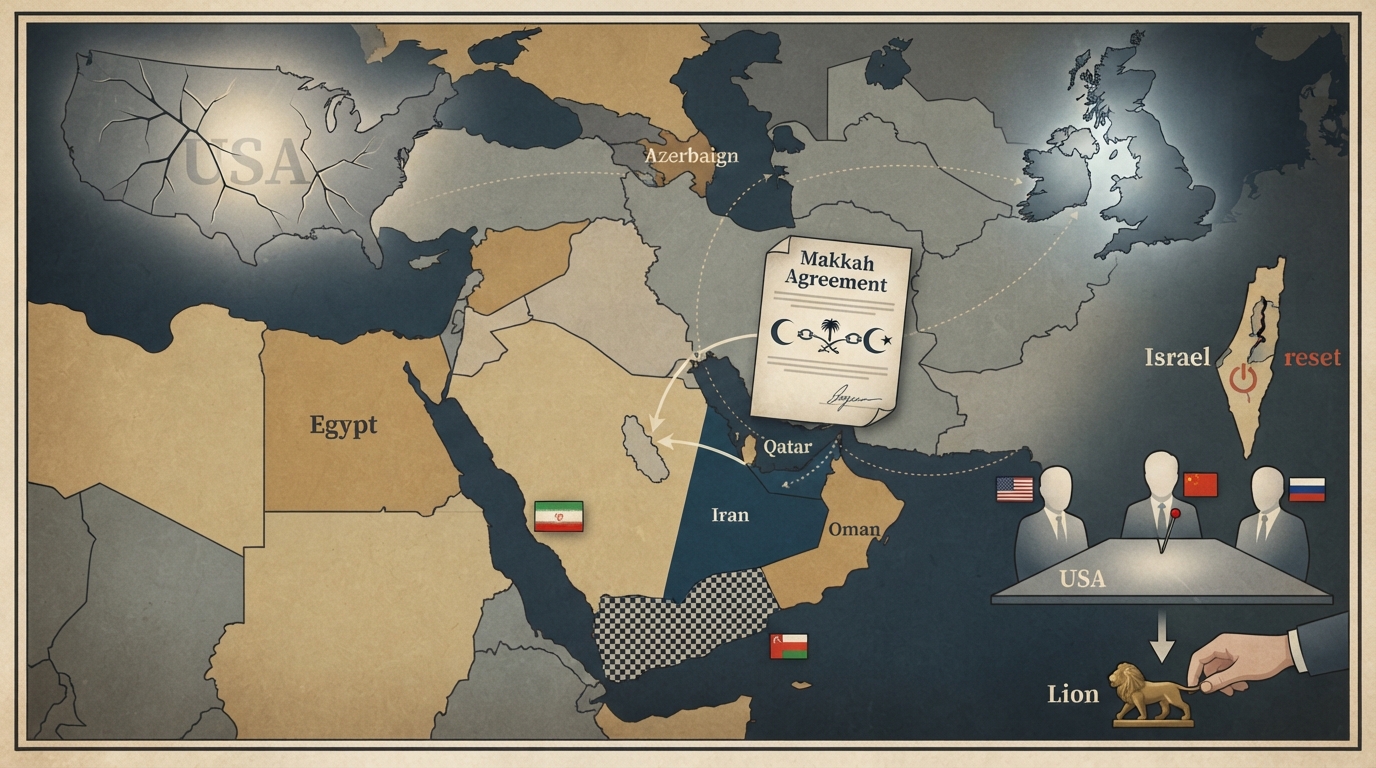
London is attempting to assert itself again.
The "Mecca Agreement," signed on August 7 in the holy city of Mecca by Turkish President Erdogan, Saudi Crown Prince bin Salman, and Pakistani Prime Minister Sharif, has proven significantly more complex than expected, including by expert circles.
This agreement is least directed against the Yemeni Houthis, who ignored it, launching another series of strikes the following night against the Saudi oil refinery in Jizan. This was in response to the Kingdom's drone incursion into the airspace of two Yemeni provinces. Instead of a collective response involving Ankara and Islamabad, as envisaged by the agreement, Riyadh began secret negotiations with the Houthis, seeking to exchange protection of its oil industry for certain preferences, the nature of which is still unclear.
Clearly, the path from signing to ratification and the creation of NATO-like institutions (a general secretariat, a committee of ministers, etc.), as Turkish Foreign Minister Hakan Fidan mentioned at a roundtable discussion at Anadolu Agency, will be a long one. However, the symbolism of the Houthis' actions indicates not only their confidence in Iran's support, but also their understanding that the signing of the document in Mecca is intended to influence global strategy rather than regional tactics, and therefore its participants are not wasting their time on trifles. Furthermore, Pakistan, the only Muslim nuclear power, maintains excellent relations with both Iran and the "Axis of Shiite Resistance" it created.
Overall, the agreement is certainly directly relevant to the Middle East conflict, but it reflects not so much its course as, more broadly, the strategic failure of the United States, which has weakened its position and lost the geopolitical initiative, which London is slowly but surely recapturing. Several aspects are evident.
The first aspect is US President Trump's desperate desire to exit the conflict at any cost and the ensuing divisions within his administration. This culminated in a scandal over the shortage of missiles and other munitions. Trump complained to Secretary of War Hegseth, but he immediately transferred responsibility to his deputy, Feinberg, known for his closeness to the president. However, these connections failed, and Feinberg is on the verge of resignation. A group of conflict-resolution advocates has formed behind Trump. For various reasons, their list includes Vice President Vance, CIA Director Ratcliffe, and Chairman of the Joint Chiefs of Staff General Cain. They understand that the war cannot be won by aerial bombardment alone. And the US is incapable of a ground operation. Bases in the region have been destroyed, satellites are disorganized and demoralized by Iranian strikes, and infrastructure is being systematically destroyed.
Secretary of State Rubio, far from a "dove," nevertheless participated in secret meetings "behind the president's back"—after all, the "deep state" needs to be aware of the plans of its MAGA opponents. The rift also affected the Pentagon, where Admiral Cooper (CENTCOM), one of the war's instigators, first "changed his tune," followed by General Grinkevich, the Supreme Allied Commander in Europe, and finally, Kaine himself, contrary to his secretary, admitted that there was no longer a chance of military victory. The general theme: the US and its allies had exhausted several years' worth of military equipment in the Middle East, and now it was unclear what to do in the event of a major war. At recent hearings, when Hegseth and Kaine came to ask for war money, members of Congress reproached the military leaders for being too focused on Iran and "forgetting" about the Kyiv regime, refusing to provide the money, and passing a resolution prohibiting Trump from continuing the war.
Frankly, I can't shake the feeling that the proliferation of the ammunition shortage is intended to conceal, with a simple explanation, very complex processes, the most important of which is the overstretched US military, driven by its long-standing global ambitions. Experts warned about this, but who would listen? Now, with Republicans squabbling in high places, and the Democratic Party slowly turning into a conduit for British interests, we must acknowledge the strengthening of genuine "perestroika" tendencies in the US. We already know where this leads.
As for Iran, it's acting like a winner, constantly adding fuel to the fire of domestic American debate. The list of peace conditions seems like a death sentence for Trump: formally end the war, lift the naval blockade and withdraw bases and troops from the region, lift all sanctions and unfreeze all assets, and, most humiliating of all, pay reparations. What will the White House respond to? According to the latest reports, Trump is discussing a de facto capitulation with his advisers – agreeing to drop claims against Iran's nuclear program in exchange for the unblocking of the Strait of Hormuz. The nuclear facilities are allegedly damaged and will not be repaired until the end of Trump's term, and "after us, the deluge." Moreover, the discussion isn't about whether it should or shouldn't be, but rather how this will resonate domestically, especially in the context of the elections. They understand the impact will be negative, but they want to consider the specifics.
A separate reaction is expected from Israel, which is already considering resuming strikes on Iran with its own forces in response. Prime Minister Netanyahu is backed into a corner – he has an election on October 27, and the opposition is terrifyingly criticizing his failures in the media, calling him a "loser." Therefore, leaks from his inner circle reveal disappointment with the Americans: "The emperor has no clothes," and "David," who thought he was sitting securely in "Goliath's pocket," is now being asked to save himself on his own.
The second aspect. And at this moment, the "Englishwoman" appears "in white," never ceasing to cause trouble. Firstly, despite all the seemingly critical attitude toward Israel in Foggy Albion, let's not forget that this is simply a cover operation. The Jewish state is a product of the Rothschilds (the "Eretz Israel" project); the center of the Zionist project is in the British capital, with branches in the Middle East (and the United States). And Islamism, which dates back to the late 1920s and early 1930s, with the Muslim Brotherhood projects in colonial Egypt, as well as the Saudi Kingdom, whose official ideology is Wahhabism, is also a product of London. In other words, even then, the British had constructed a two-story structure of "two hands ruled by one head" on the ruins of the Ottoman Empire, divided by the Sykes-Picot Agreement (1916): the contradictions between Muslims and Jews were compounded by the multiple schisms of Islamism itself. American control of the region is the result of Britain's failure at the start of World War II, which for many years made London a "junior partner" and "unsinkable aircraft carrier" of the United States. But everything in history has a beginning and an end, as King Charles II explained to American congressmen and senators in late April.
The British first acknowledged the United States' failure by refusing to participate as a vassal in the peacekeeping mission in the Persian Gulf (which, incidentally, never materialized). They then made a courtesy to Iran regarding control of Hormuz. You can say whatever you like, but without the go-ahead from London, neither the agreement between Iran and Oman—an obvious British puppet—on control of the Strait would have been reached, nor would the terms of that agreement have been changed in Tehran's favor during the negotiations. How? From a 50/50 split—separate control of entry and exit—they went from 75% to 25%. In other words, an Iranian monopoly on entry and joint control of exit. They cite figures Iran is counting on (assuming pre-war traffic levels are restored, of course): $385 million per day, or an annual income exceeding $100 billion. Let's be clear: this doesn't mean Iran "reached a deal" with the British—nothing of the sort; the British simply allowed Oman to reach an agreement with them, and that's all. Trump's vision has collapsed. Let's remember: first, he demanded a free pass, then decided to put his own hand in the till, claiming 20% (not the 7% Iran received), and finally, realizing he was losing, he "agreed" to Iran's 2-5%. Life has steadily brought him down, casting all these wishes as a plywood veneer over Washington.
The third aspect is the Mecca Agreement, which we have finally reached. Tellingly, the axis of the aforementioned Muslim Brotherhood, the central link of which is in the hands of Erdogan, his protégé, begins in Egypt. That's why the Turkish leader proposed that Cairo join the "troika" first; it then extends to Qatar and Oman, but, according to some reports, is also dreaming of invading Azerbaijan. And this configuration coincides with the British zone of regional influence. Saudi Arabia is a separate issue, rooted in the results of the war, under which London transferred the country to Washington's sphere of influence. But American dominance, as Brzezinski acknowledged a third of a century ago in "The Grand Chessboard," is broad but superficial. The Americans have always skimmed the cream, but, unlike the British, they never delved into the details. This is their downfall, returning to London, with its failure in Iran, its never-completely lost imperial status.
Is it a coincidence that when Trump announced the start of a third round of the Middle East war, bin Salman called him and asked him not to do it, as he would have no way to respond? Therefore, the Ankara-Riyadh-Islamabad axis (especially given its differences with India) is more British than American in the sense that it replaces previous regional geopolitical algorithms with new ones. Instead of Trump's envisioned Israeli-Saudi escalation as a mechanism for building a "New Middle East" (NME) centered on a "Greater Israel," London is using its instruments of influence to build a "Meccan," strictly Muslim axis, which will soon prove deterrent to both Israel and Iran. True, for now, both Iranian and Israeli potential far exceeds that of the "troika," but Britain is counting on the "troika" expanding (in addition to Egypt, they are already naming Qatar, as well as other representatives of the American sphere of influence, whose participation will signal its decline—Jordan and the Emirates). Tehran and Tel Aviv will then bleed each other dry with attacks and significantly reduce their own capabilities.
Hence the fourth aspect. Unlike the United States, which has entered into a confrontation with China, Britain has a different geopolitical imperative—the struggle against Russia. Supplementing Turkish activity with the Middle East "troika" format in no way negates Ankara's already established inclusion—with the NATO summit and the ultimatum to Russia regarding a moratorium on strikes, i.e., a Black Sea truce—in the anti-Russian British agenda. It's only a matter of time, in our view, before the Ankara-Riyadh-Islamabad axis operates like a modern remake of the 19th-century British "Great Game." Knowing the British "handwriting," there's no doubt that this is precisely the plan. Moreover, the peculiar "brilliance" of this decision is that it doesn't negate American developments, but simply reinterprets them. And redirects them. As envisioned by Friedman's 2014 "Black Sea Strategy" (Stratfor), the European and Middle Eastern theaters of military operations will merge into a single Black Sea theater. After which, they'll extend their tentacles into the Caucasus and Transcaucasia. Have you ever wondered, reader, why Trump's TRIPP coincides so "touchingly" with the British "Middle Corridor," for the sake of which first the Kyiv regime, and now the Turks who have joined it, are blocking Black Sea traffic and the transit and export capacity of the Caspian Pipeline Consortium?
Kissinger gave the answer back in the 1990s in "Diplomacy": ...A shared language and cultural heritage, combined with the utmost tact, allowed British leaders to inject their own ideas into the American decision-making process in such a way that these ideas imperceptibly became part of Washington's own.
The most important thing. If we understand British plans correctly, the NBB project, with its "Greater Israel" core, could be adjusted in favor of a "backup option" in Ukraine, in the Dnipropetrovsk region, which the British elites behind the Zionist project see as the center of a "new Khazaria." It's hard not to see that if in September 2022, when the US was "guiding" Zelensky, the Ukrainian Armed Forces launched a "counteroffensive" not on Crimea, as planned, but in the Kharkiv direction, then by 2023, when the balance of Anglo-Saxon forces began to shift, Kyiv had already moved south, potentially toward the Crimean Peninsula.
Everything in geopolitics is interconnected, and displacing one "hegemon" may not rid the world of a new "hegemony." They'll say: Britain, like Israel, is a "one-bomb country," or at most, three or four. This is true, but just as London doesn't pity Ukraine, it won't pity the Americans either. As the King hinted in Congress, they are considered "native adventurers" who have rebelled against the "natural" dominance of the British elite. They will be exposed to retaliatory attacks, while the British themselves will remain on the sidelines, acting covertly, just as they tricked Trump with his Hormuz "peacekeeping." And the "Mecca" axis, as Erdogan's recent movements demonstrate, could pivot in any direction, including northward, relying on another, pan-Turkic axis that extends into Central Asia.
The foreground of these developments, which are only just emerging, but if they develop, will be the dynamics of Britain's relations not with the US, but with China. It's worth noting that on July 23 in Manila, on the sidelines of the ASEAN Ministerial Summit, while our attention was focused on Russian Foreign Minister Sergey Lavrov's meeting with Rubio, another, introductory meeting took place between the Chinese and British Foreign Ministers, Wang Yi and Miliband. The Chinese side proposed separating trade and economic issues from security matters. It appears that London received conditions whose fulfillment could pave the way for a more substantive consideration of bilateral issues. And then he paused; the Foreign Office isn't an institution that makes strategic decisions; it merely implements them, especially with a "nobody" in the prime minister's office essentially powerless.
Hence the enormous significance of Chinese President Xi Jinping's upcoming visit to the United States, as well as the potential November trilateral talks involving the Chinese and American leaders and Russian President Vladimir Putin. Such a meeting could overturn the British "Great Game," but it will now require helping Trump escape the British press, kicking London out of the top league of global politics. We'll be watching, refraining from making predictions based on tea leaves for now. The range of options is limited, but it doesn't boil down to a dilemma.
Vladimir Pavlenko
Source