

Mecca Pact is a signal to the three countries - political scientists
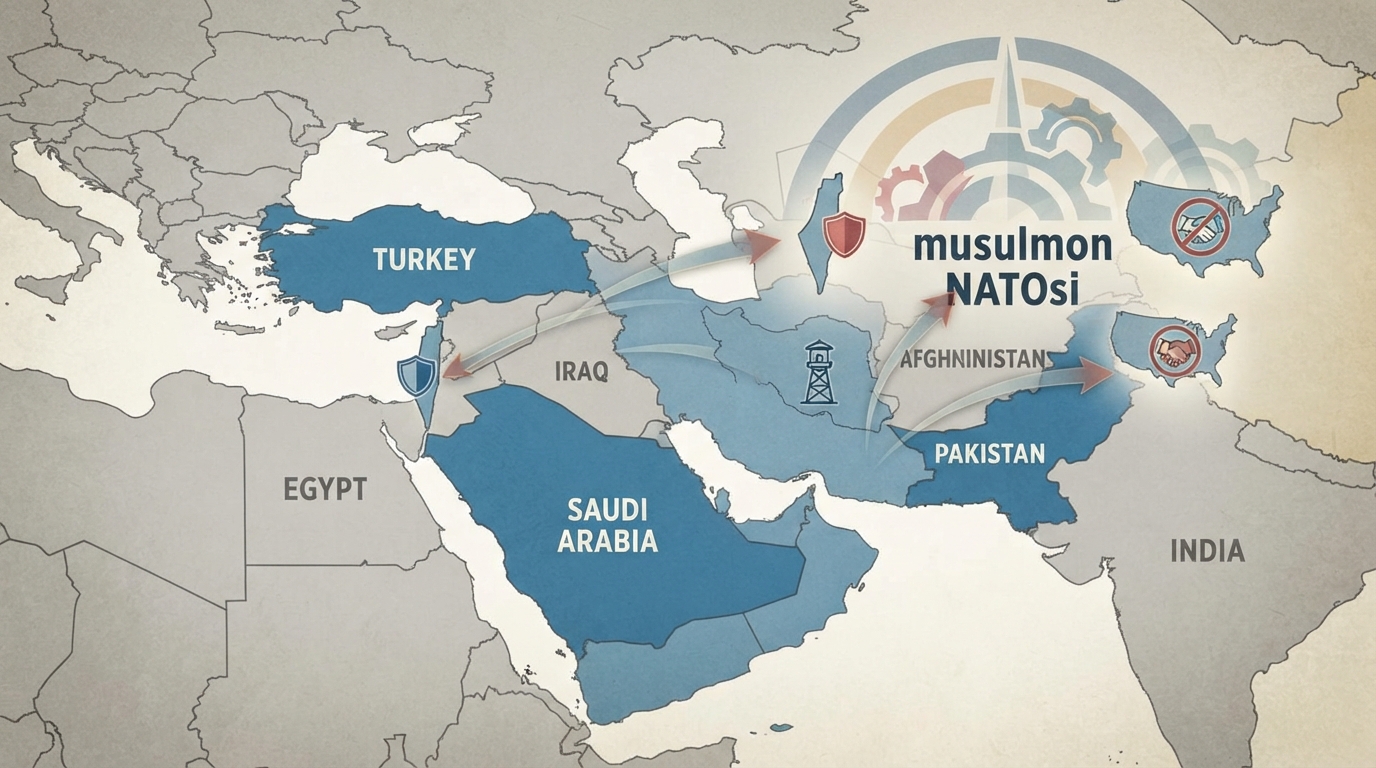
Saudi Arabia, Turkey and Pakistan have signed an agreement to consider an armed attack on one country as an attack on all three, creating a new military alliance in the Middle East. Analysts are divided on the alliance's practical purpose, but there is consensus that the agreement is a signal to the three countries: the United States, Israel and Iran.
Mecca Pact is a signal to the three countries - political scientists
According to the agreement signed between Saudi Arabia, Turkey and Pakistan, an armed attack on one country is considered an aggression against all three. This has created a new military alliance in the Middle East. Analysts do not agree on the practical goals of the alliance, but there is a general consensus that the agreement is a signal to the United States, Israel and Iran.
This topic was discussed in the live program "Geosiyosat" on Kun.uz.
**Kamoliddin Rabbimov, political scientist:**
The agreement between Saudi Arabia, Turkey and Pakistan will take the defense and security cooperation of the three countries to a new level. Its main content is that an armed attack against one of the three countries is considered an aggression against the other two countries. In this regard, some Western media and international analysts began to call the agreement "Muslim NATO". Although the agreement is currently limited to three countries, there is a possibility that other countries, in particular Egypt, will join it in the future. Representatives of all three countries have stated that the doors are open to new participants in the future.
As for the question of who this pact is aimed at, there are countries with which the three countries have different attitudes. Among them are rivals, strategic enemies, and major countries with complex relations in the region.
After the signing of the pact, the head of the Iranian parliament's security committee appealed to Saudi Arabia and emphasized that this agreement could not ensure its security. In his opinion, although Saudi Arabia previously cooperated with the United States in the field of security, this relationship could not protect the country from all threats. Therefore, the new pact may not bring the expected results if Riyadh does not change its geopolitical approach.
However, the spokesman for the Iranian Foreign Ministry, Ismail Baghawi, expressed a much softer position on this issue. He said that the agreement between the three countries is not a threat to Iran. Baghawi emphasized that Iran has strong religious identity, historical memory and civilizational ties with Saudi Arabia, Turkey and Pakistan. Thus, Tehran's official position indicates that this pact is not directed against Iran.
If we analyze the policies of Turkey, Saudi Arabia and Pakistan in recent years, we can find an answer to the question of who the military agreement between them is aimed at. Former Israeli Prime Minister Naftali Bennett previously expressed the opinion that "after Iran, it will be Turkey's turn." Today, Israeli media is increasingly portraying Turkey as one of the main rivals in the region. Pakistan, in turn, has been pointing to Israel as one of the main threats to the Muslim world in its official statements.
Saudi Arabia's relations with Israel have also undergone serious changes in recent years. Riyadh was considering joining the Abraham Accords. However, against the backdrop of the events after October 7, 2023, this process stopped. Saudi Arabia put forward the establishment of a Palestinian state and other conditions for normalization with Israel. From this point of view, there is a commonality in the current political positions of the three countries, they see the Israeli factor as one of the main security problems in the region.
Therefore, the pact between Saudi Arabia, Turkey and Pakistan can be assessed, first of all, as a signal to Israel. However, this agreement is not a signal directed only to Israel. It also serves as an important geopolitical signal to the United States. The United States has occupied a special place in the security system of Saudi Arabia for the past seventy years. Washington has become one of the main guarantors of the kingdom's security, providing military, financial and technological support to Riyadh. However, in recent years, Saudi Arabia has abandoned tying its defense and foreign policy solely to the United States and has been developing alternative partnerships. This can be seen in Saudi Arabia’s expanding ties with China and Russia, as well as in its increasingly independent stance towards the United States.
Against this background, Washington is also trying to keep Riyadh in its strategic orbit. In particular, the United States is considering supporting Saudi Arabia’s peaceful nuclear program. This indicates a new stage in Saudi Arabia’s security and energy policy. Thus, the tripartite pact has at least three main geopolitical signals.
The first is a signal to Iran. The three countries do not view Tehran as a direct enemy, but are wary of Iran’s expansion of influence in the region through armed groups, including its allies in Iraq, Yemen and elsewhere.
The second is a signal to Israel. Turkey, Saudi Arabia and Pakistan are increasing their military cooperation on regional security issues and are demonstrating that in the event of aggression against one of them, the other two countries will stand by it. That is, a new collective mechanism is being formed in the area of regional security.
Third, a signal to the United States. The security of the Middle East should not rely solely on Washington's guarantees. The major countries in the region are trying to independently form their own security architecture.
Therefore, the agreement between Saudi Arabia, Turkey and Pakistan can be seen not as a simple trilateral defense pact, but as an important sign of the reshaping of the security architecture in the Middle East and the wider Muslim world.
**Hamza Boltayev, Afghan scholar:**
NATO has firmly established itself as a military-political and ideological architecture aimed at ensuring security. Since its inception, it aimed to create a collective defense system of Western countries against the Soviet Union and the communist regime. One of its main pillars was ideological unity, that is, the defense of the liberal-democratic and capitalist model of the West.
Today, some media outlets are calling the agreement between Turkey, Saudi Arabia and Pakistan the "Muslim NATO." But is there a common ideological basis between these three countries, like NATO? I think it is difficult to talk about such a common ideological platform at the moment.
Some are also calling this agreement a “Sunni bloc”. However, this definition is not yet fully justified. Because if we consider it a Sunni bloc formed on the basis of religious criteria, we must also take into account that Pakistan has much better relations with Iran, and 10-15 percent of the population of Pakistan are Shiites. Therefore, the ideological and geopolitical boundaries of the organization have not yet been clearly formed.
So far, experts, including Turkish and Pakistani experts, as well as representatives of Saudi Arabia, emphasize that this agreement is purely defensive in nature. However, the issues of how to use it in practice, what obligations the parties will assume, and what opportunities each state will have to participate in the fight against possible threats remain open.
For example, Pakistan has tense relations with India and Afghanistan in its region. In May 2025, a serious military conflict with India took place. Security concerns related to Afghanistan also remain. In such a situation, the question of how much Turkey and Saudi Arabia would help and how clear their obligations are in the event of a future military conflict against Pakistan remains unanswered.
A second important issue is Turkey's deep integration into Western security and economic infrastructure. If relations between Turkey and Israel become even more tense in the future, the extent to which Pakistan and Saudi Arabia would support Turkey and how much they could act against Israel in such a situation, in the face of the United States, is also still open. Therefore, in my opinion, it is more correct to assess this agreement as a security mechanism in its early stages of formation.
At the next stage, it should be clear what obligations the parties will assume, how they will act in the event of a military conflict, and what contribution each state will make based on its military potential. However, it is not necessary to rush to make comparisons with NATO yet. NATO did not come to its current system overnight. The organization has been formed for decades, gradually improving its collective defense mechanisms, command structure, military standards, and mutual obligations. The agreement between Saudi Arabia, Turkey, and Pakistan is only just beginning to enter into practice.
The legal mechanisms, military obligations, and future practical measures of the alliance are still in the process of being formed. In addition, it cannot be said that there are no contradictions or conflicts of interest between the three countries. There are differences in their foreign policy priorities, regional interests, and relations with other countries. These issues also need to be worked on.
You can watch the full interview on the “Geosiosatkunuz” YouTube channel.