

The AI telling farmers when to harvest
Will farmers want AI tools to help judge when to pick fruit, or is their own intuition enough?
**The AI telling farmers when to harvest**
Picking the right time to harvest can be a decision that makes or breaks a crop.
When the first day of the apple harvest arrived in Washington State last year, the fruit was ready and the pickers were prepared — but the weather had other plans.
"It was like 38C… it's not safe for people to work in that heat," recalls Joel Carter at Okanagan Specialty Fruits. "We had to stop at 10 o'clock in the morning."
He says artificial intelligence (AI) models that predict the best harvest dates by factoring in the weather would be valuable. "You need to know more than just when your fruit is going to be ripe. How long do you have to pick it?" he says. "That's where these models are really helpful."
Carter's company has more than 1,250 acres of apple orchards in Washington, and the apples are grown for sliced portions — often sold to hotels and schools, for example. The company is investing in technology in the hope of boosting productivity. Even the apples are genetically engineered so they do not brown easily once cut.
But organising a harvest is difficult. New tools are appearing that count and analyse fruit on the tree or vine, and estimate when crops will ripen. This matters because fruit prices, especially for high-value berries such as strawberries or blueberries, can swing sharply. If the harvest date is wrong, seasonal workers may be booked when they are not needed, and the biggest profits can be missed.
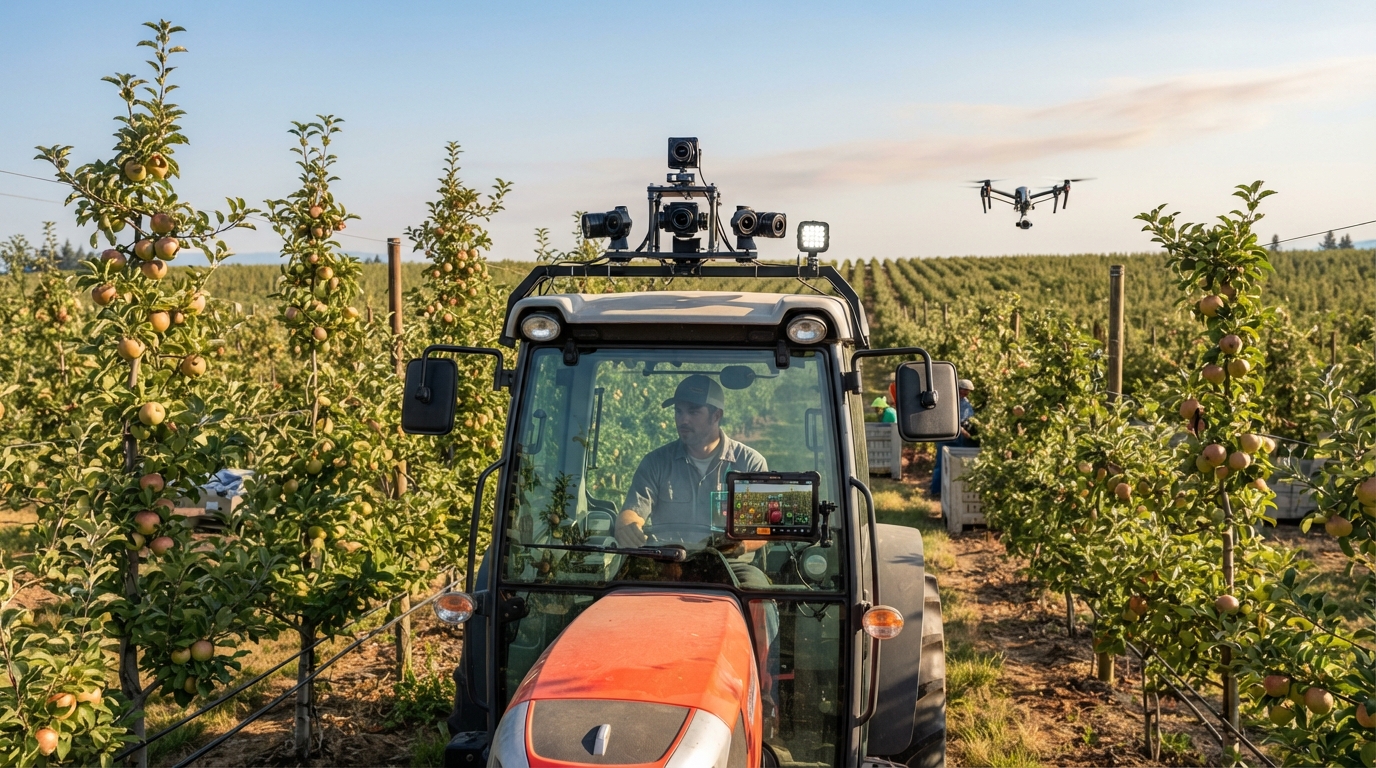
Okanagan Specialty Fruits is already testing cameras from a Canadian company called Vivid Machines. The cameras are fitted on top of tractors and capture images of the apple trees as the tractor moves along. AI then identifies buds, flowers or fruit in the footage.
"Right now, Vivid is telling us crop estimates and harvest dates," says Carter. He says the system is especially good at spotting very small flower buds, which are difficult to see quickly with the naked eye.
But Carter adds that forecast accuracy depends heavily on the quality of historical data entered into the system. "This isn't something where an AI can scrape the internet and figure out what's the average [yield] for Granny Smith," he explains. "It's going to be bespoke to your farm."
Apples are at least somewhat forgiving — the harvest window for Granny Smiths is three weeks long, Carter says. For other fruit, such as berries, there may only be a few days.
"If a strawberry crop is on, you have to harvest it – otherwise your entire crop gets diseased very, very quickly," says Raymond Martin, co-founder and chief operating officer of FruitCast, a UK company that provides harvest forecasts to fruit growers there.
His company offers crop predictions for strawberries, raspberries, blackberries, blueberries and tomatoes. "We're moving on to grapes next year," Martin adds.
Do experienced farmers not already know when their fruit will be ripe, I ask? Martin says they usually do — but not necessarily across their whole farm, which may cover many acres or include both outdoor and indoor growing areas. "We do exactly what the farmers could do but we just do it on a scale that they can't."
The system examines footage of ripening fruit that can be collected by drones, by someone walking through a field with a smartphone, or by a camera mounted on a farm vehicle.
This year has been difficult, Martin notes, with hot weather and severe drought affecting much of the UK.
That has stressed many fruit plants, pushing them into thermal dormancy and slowing fruit production.
There's only a small window for picking berries says Raymond Martin
The FruitCast model takes weather and irrigation conditions into account in its forecasts. The company says, "our forecasts land within 10% of actual picked volume one week out (90% accurate) and within 17% three weeks out (83% accurate). We guarantee less than 20% error…"
Angus Soft Fruits is one company that has worked with FruitCast. AI technology for forecasting fruit ripeness is not yet "a finished solution" says operations director Neill Finlayson: "This journey is still ongoing and, whilst significant progress has been made, the industry remains some way from achieving a fully integrated forecasting ecosystem."
Driscoll's, a California headquartered fruit seller with a large operation in the UK, also confirmed to BBC News that some of its independent fruit growers in the UK have used FruitCast's technology.
Researchers are also investigating new ways to analyse fruit in very fine detail. Many farmers already use handheld brix meters to measure the sugar content of their crop. These devices work by measuring how much light has changed direction, or refracted, after passing through a liquid — showing the amount of solids present.
Some of these meters use infrared light, so there is no need to cut into the fruit to measure it. But Yasaman Ghasempour at Princeton University says millimetre waves, which are high frequency radio waves, can penetrate deeper. "They basically respond very well to humidity, water [and sugar]," she says.
She and her students have developed a millimetre wave-based ripeness detector.
Her students tested it at a local market in New Jersey. "[Staff] there got kind of scared that we were doing something shady," laughs Ghasempour.
Such detailed analysis of fruit, if it is still unripe, could also help predict when it will be ready.
But while some growers, such as Carter, want to try new technology, many will question whether it is really worth the investment. "Adoption is very complicated," says Jing Zhang at North Carolina State University. "The grower has to have confidence in the research and whether or not it works."
Zhang has been working on a system to automatically count the number of blueberries.
The simplest systems do not have to be costly. Kevin Wang at the University of Florida has developed another crop-counting tool that can harvest imagery.
In the future, that information could feed into ripeness predictions. However, he notes that some farmers may be uncomfortable sharing commercially sensitive details about their growing strategies, such as fertiliser and irrigation plans, with third parties and AI models.
Ben Palone is senior director of automation and commercialisation at Western Growers, an association representing farmers in the western US. He says harvest forecasts have some potential as "an optimisation tool".
But farmers will probably still depend on human intelligence. "Growers like to have people in the mix to make some of those very critical decisions – especially when it comes to harvests," he says.