

Testing by ability
Will the maslikhats (local representative bodies of power in Kazakhstan) emerge from the political shadow?
**Testing by Abilities**
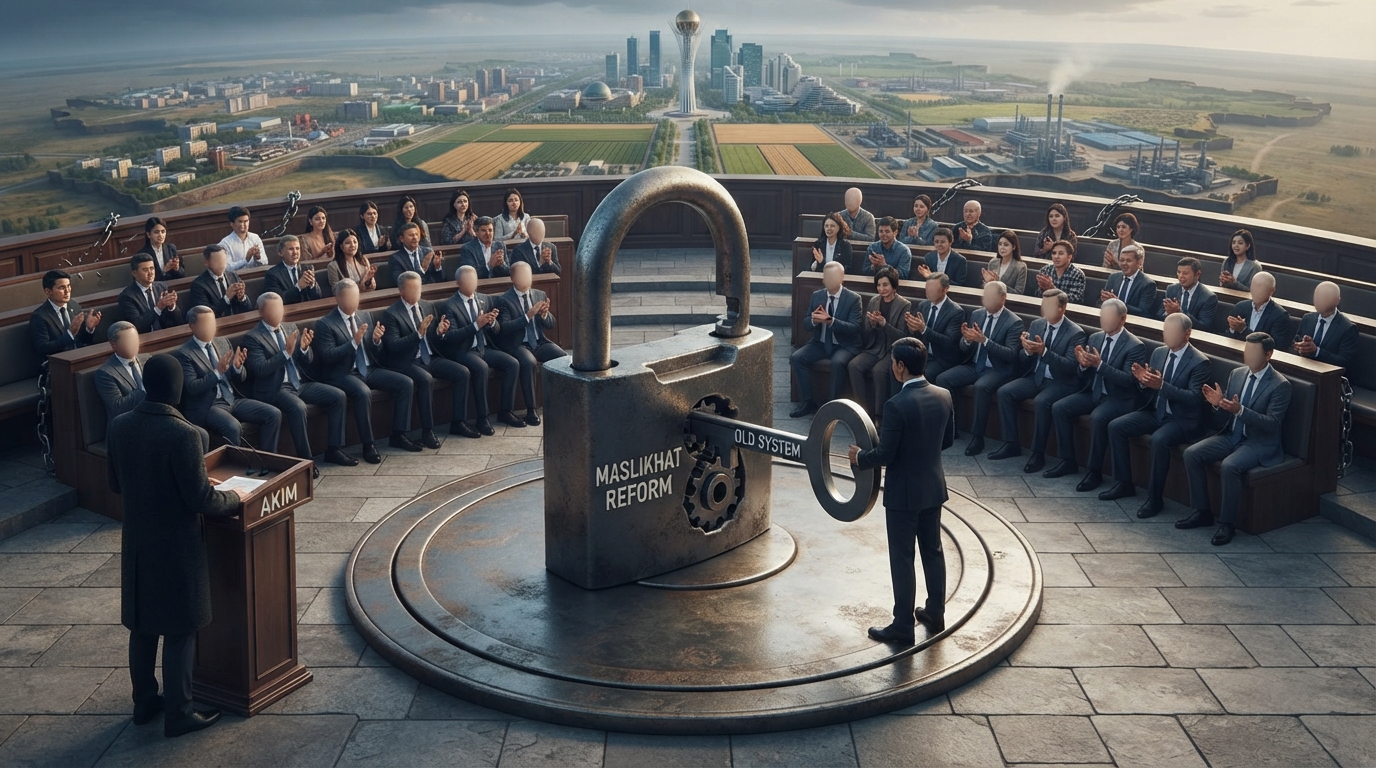
For a long time, maslikhats — local representative bodies of power — in Kazakhstan were a convenient stepping stone for entering big-time politics, but they performed poorly with their main tasks. A series of recent reforms was supposed to change the rules of the game, giving local deputies real power over budgets and akims. However, has anything essentially changed? Are they becoming an influential force or do they still remain followers? On the eve of early elections to maslikhats at all levels, scheduled for November 29, Kazakhstani experts shared their opinions.
**Talgat Ismagambetov, Political Scientist: "No Major Shifts Are Observed"**
— For representatives of the business community and the public sector, maslikhats still remain a career elevator and an instrument for lobbying personal interests and projects. This is clearly confirmed by the first composition of the Kurultai, which included many local deputies from "Amanat". This principle of forming a unicameral parliament shows that the authorities now view maslikhats, among other things, as a platform for selecting and promoting promising representatives of regional elites.
It is noteworthy that for the first time since 1999, we are seeing the dissolution of maslikhats separately from the termination of the parliament's powers. Previously, this happened automatically after the dissolution or self-dissolution of the Mazhilis, and elections at both levels took place synchronously. When the mission of the bicameral parliament was completed and the Kurultai was created, it was clear that a renewal of the maslikhats would soon follow. But now these two electoral campaigns are no longer linked to each other. I think from now on, elections of local deputies will take place independently, rather than in the shadow of parliamentary ones.
It is logical that after the abolition of the Senate, the central authorities should pay more attention to local representative bodies. They will have to work with maslikhats at all levels — from district to regional ones — directly. How effective such interaction will turn out to be is still an open question. The new ruling party "Adilet" is supposed to become the main vector of this policy. As intended, it will fundamentally differ from its predecessors — "Amanat", "Nur Otan", and the People's Unity Party of Kazakhstan from the distant 1990s.
As for strengthening the control of maslikhats over the activities of akims, no major shifts are visible here — except perhaps by a quarter of a step over the past few years. Deputies still have no influence on their appointments, but merely agree with the decisions of the higher-ranking akim or the president, who proposes two candidacies: one formal, the other — the favorite. Not to mention the practice of applying the norm on removing an akim from office by a two-thirds vote of the maslikhat — there have been almost no such cases. At the same time, disputes over budgets do happen, but the final word always remains with the akim.
Further on, everything will depend on how effectively the parties, and above all "Adilet", begin to work. Especially since formally the conditions for this have been created: half of the deputies of regional maslikhats are now elected by party lists, and half — by single-mandate territorial constituencies.
**Rasul Kospanov, Political Scientist: "We Are Unlikely to See a Qualitative Renewal"**
— Unfortunately, to this day, the institution of maslikhats in the country has worked mainly as a tool for imitating a democratic process — that was its main function. No matter how much reforms have been talked about in recent years, no serious changes have occurred in local representative bodies, especially when compared with the transformations of the parliament and other institutions.
In particular, in 2022, the Constitution enshrined that a portion of maslikhat deputies are elected in single-mandate constituencies. In itself, this is not bad. However, in practice, the lion's share of mandates went to nominees from the "Amanat" party, who virtually left no chance for representatives of other political forces. In the same year, maslikhats received the right to choose the akim of a region or a megacity from two candidacies proposed by the president, one of which is already designated as the favorite. But I cannot recall a single case where deputies argued about this, let alone bet on an alternative figure.
It is difficult to call these reforms. It turns out that you can adopt the most wonderful Constitution and write the most correct words in it, but in practice, everything will continue to work according to old schemes.
At the same time, maslikhats remain a good chance for local elites to reach the national level. One only needs to look at the composition of the Kurultai, which included quite a few former maslikhat deputies from the abolished "Amanat" party. The regional level was a kind of school and certification for them before a career jump to the capital.
Of course, there is nothing wrong with maslikhats serving as a social elevator. But let's look at their composition objectively. As a rule, there are only two or three representatives of youth — necessarily Zhas Otan members, other ethnic groups, or people with disabilities. The post of chairman is necessarily held either by a former high-ranking official of the akimat or a functionary of the ruling party. The main backbone, however, is the business elite.
I am not at all against entrepreneur-deputies — often these are competent people with extensive life experience who have achieved serious success in their field. But the fact that they are frequently connected with companies that regularly win tenders for landscaping, greening, road repairs, and so on confirms: serious economic interests are intertwined in maslikhats.
As I noted in my study, among the deputies of Astana, managers predominate — heads of communal enterprises, representatives of the quasi-public sector, former officials, and security forces personnel. In Shymkent, we see a high concentration of representatives from the construction business, trade, medicine, and education. And the Almaty maslikhat demonstrates a more complex and hybrid configuration: along with officials and entrepreneurs, representatives of the financial sector and creative industries sit there.
And one must not forget about the role of the heads of regions, cities, and districts themselves. No matter how much is said in Astana about the need to renew maslikhats with truly bright, independent people capable of working effectively, in the end, it is he who decides who gets a pass there. The system is designed so that no akim will cut off the branch he is sitting on by allowing people into the local parliament who might later interfere with the adoption of the budget or akimat projects.
Perhaps the upcoming elections will surprise us with something. But overall, I think everything will be roughly the same as in previous convocations of maslikhats. We are unlikely to see a serious qualitative renewal.
And one last thing. Observing the information space and reading the posts of the maslikhat deputies themselves on social networks, one comes to the conclusion that only 10–20% of them are truly professionals who are in their right place. A significant portion of their colleagues is more occupied with outright sycophancy and demonstrating complete loyalty to any initiatives from above. Still, one would want people focused on solving the pressing problems of their regions, rather than on personal gain, to predominate there.