

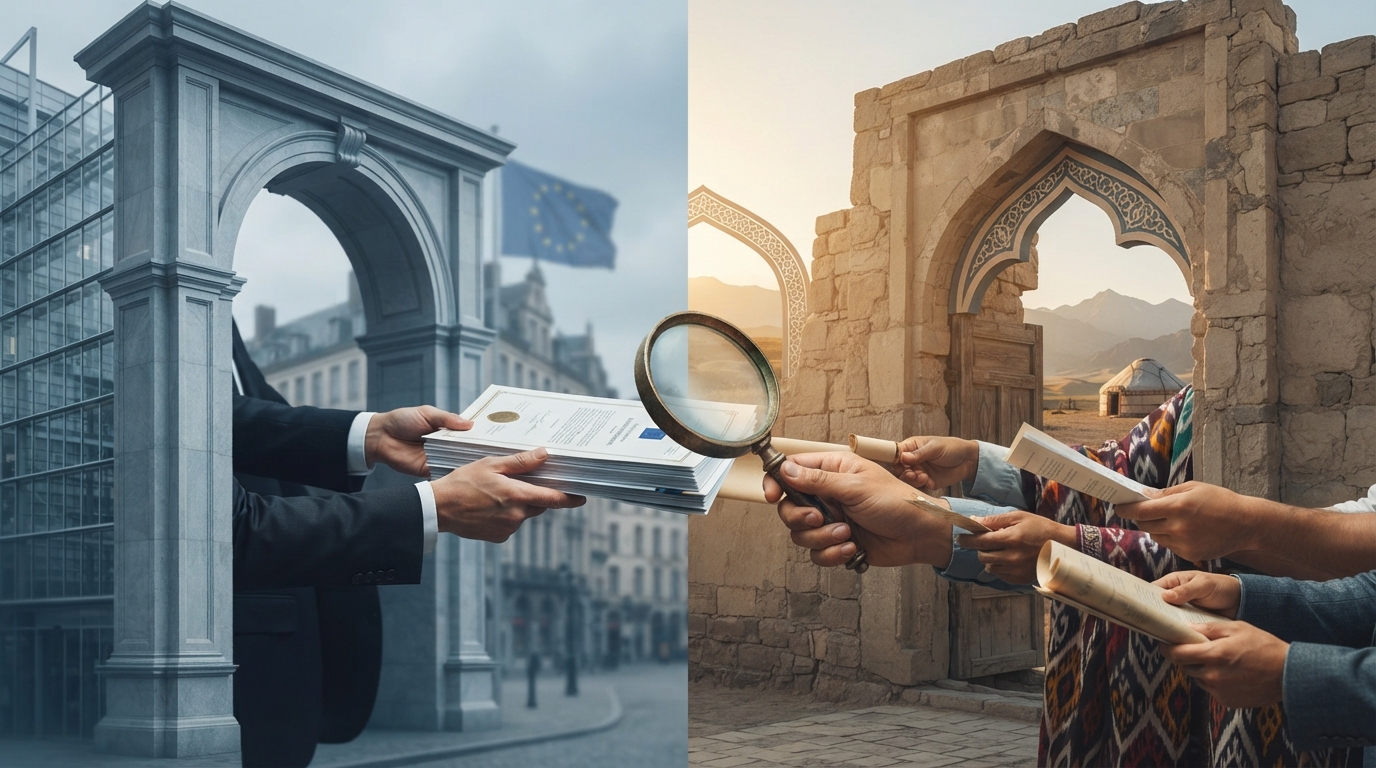
**Feudal Domains or Something Else? The EU Criticizes Central Asia Over Human Rights, Raising Questions of Double Standards**
Central Asian countries have once again found themselves in the spotlight of the European Union, receiving unflattering assessments in the new EU 2025 Report on Human Rights and Democracy in the World. Most of the region's states were criticized for a "deteriorating" situation, curtailing freedoms, and backsliding on democratic principles.
Kazakhstan is accused of shrinking civic space, pressuring journalists, restricting peaceful assembly, and tightening legislation. Kyrgyzstan has faced criticism regarding freedom of speech, NGO work, religious freedom, and the fight against corruption. Tajikistan is accused of persecuting journalists and human rights defenders, restricting access to information, and problems with the judicial system. Turkmenistan once again ranked among the countries with the least freedom. Uzbekistan has been criticized for backsliding on almost every issue.
However, a fundamental question arises: why are such assessments almost always constructed according to the same formula, where Western criteria are declared universal, and any failure to meet them is automatically converted into an indicator of a worsening situation? The problem is not that Central Asian states should be immune from criticism. Of course, issues of freedom of speech, media, justice, corruption, citizen protection, and the activities of civil society organizations deserve attention. And within the countries of the region themselves, there are plenty of problems that need to be addressed. The problem lies elsewhere—the selectivity and political one-sidedness of the Western approach.
The EU lists in detail the grievances against Central Asian governments, but much less frequently explains the regional context in which these states make decisions. These include issues of security, terrorism and extremism, border conflicts, instability around Afghanistan, interethnic tensions, and the need to maintain internal governance.
This creates a strange construct: if a state strengthens control in response to real threats, the West speaks of "authoritarian rollback." If a state attempts to implement reforms gradually, it is called insufficient progress. If laws are adopted that align with national understandings of family, society, or information security, the EU evaluates them through its own value system.
At the same time, the European Union positions its approaches as protecting universal human rights. However, universality presupposes uniform rules for all, not the right of one group of states to judge the rest.
It is particularly telling that the report itself speaks of the world's departure from a "rules-based order." However, a counter-question arises: who, and when, determined that the European model should be the sole criterion for assessing the political development of other states?
The countries of Central Asia are not copies of Europe and are not obligated to replicate its political system. They have their own history, culture, political traditions, economic conditions, and security issues. This does not mean that the region does not need reforms. On the contrary. But reforms must be based primarily on the interests of the societies themselves, and not be reduced to the implementation of external political recommendations. And here, the EU's position is particularly odd: it simultaneously speaks of the need for dialogue and publishes assessments that pre-emptively categorize the region's countries as "improving" or "worsening." Central Asia truly needs dialogue with Europe. But dialogue is when the parties not only evaluate each other but also listen to each other's arguments.
Why should the countries of Central Asia, and all others outside the circle of "civilized states of the collective West," pay attention to assessment reports from the EU, the US, or various Western human rights organizations that carry out political orders to instill in everyone outside the "democratic world" the idea that they have been and will remain "second-class citizens" in this world?
It's high time they wrote their own reports about the US and Europe, pointing out what they themselves are doing. For example, about the treacherous capture of the Venezuelan president in order to take over its oil industry. About direct aggression against Iran, the deliberate assassination of its supreme leader and 168 children during school hours. About plans to attack Cuba and seize Greenland. That's if we're talking about the United States. And that's very little that could be said.
As for Europe, one could describe the fabricated presidential election results in Romania and Moldova. The imprisonment of opposition politicians in Moldova. The persecution of Marine Le Pen in France. The corruption scandals associated with European Commission President Ursula von der Leyen. And who knows what else.
But no. The United States and Europe, for some reason, believe they have the right to assess what's happening in the rest of the world. And the rest of the world, for some reason, feels obligated to listen with trepidation to these assessments, take them into account, and take them into account.
Although it's high time to tell them to go to hell and stop paying attention to all their reports, grades, ratings, and the like. As they say, let them look at themselves.