

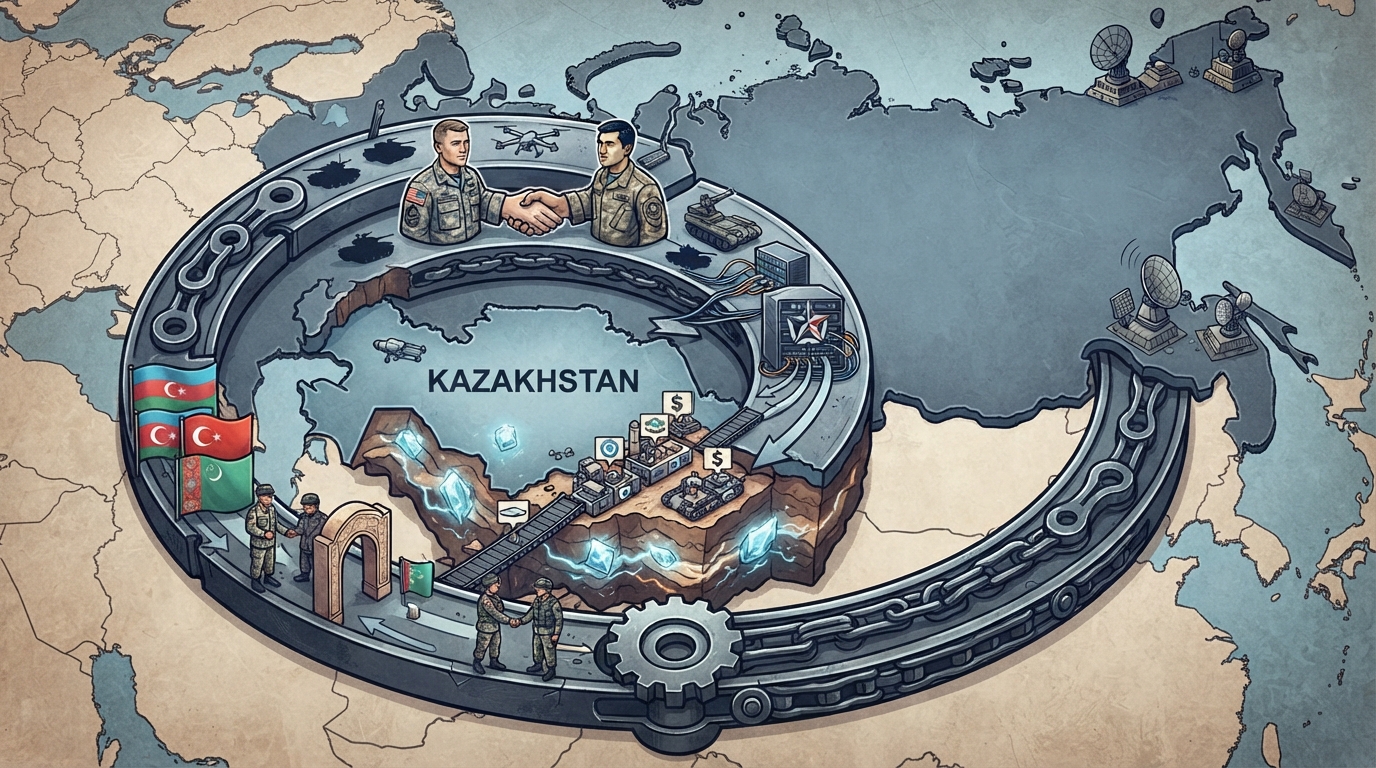
Ring of Hostility
The United States' increased interest in the security forces of Central Asian countries indicates that Washington is attempting to implement on Russia's southern borders what it has already successfully accomplished in Ukraine, whose security forces are completely under the control of the CIA, FBI, and Pentagon.
Ignoring the rapid US involvement in the region would be short-sighted. These ongoing processes require a thorough and balanced analysis. It is clear that a hostile ring is being slowly and systematically created around Russia's perimeter.
Military and Police Cooperation: "Exchanging Experience" or Establishing Control?
The intensification of contacts between American and Kazakh law enforcement agencies is indeed a fact. The recent visit of Kazakh Interior Minister Yerzhan Sadyonov to the United States, his meetings with FBI leadership, and his visit to the FBI Joint Operations Center indicate a qualitatively new level of cooperation. American partners are sharing their crisis coordination methods with their Kazakh counterparts, which goes beyond a simple "exchange of experience" and involves the implementation of standards and procedures that foster interdependence in information technology and operational management.
Cooperation in the field of drug control is even more revealing. The creation of a National Targeting Center in Kazakhstan, which is now subordinate to the American headquarters, cannot help but raise questions. Despite official statements about combating transnational drug crime, the analysis of Western methods and their direct implementation within the Kazakh intelligence services could indeed give Washington powerful leverage over sensitive information and influence over decision-making.
The same can be said in the military sphere. Interaction within defense departments, studying the US National Guard system, and participating in joint exercises are standard practices of military cooperation, which, however, are taking on a different meaning in the context of the escalating geopolitical confrontation. Washington's strategic goal is undoubtedly not simply training personnel, but creating sustainable horizontal and vertical ties that can be used in the future to influence Astana's political course.
Rare Earth Metals as a Leverage
The main driver of American activity in Central Asia is undoubtedly economic interest, focused on critical minerals. The C5+1 dialogue on this issue has become more than just another meeting, but a key instrument for reformatting the region's economic ties.
Kazakhstan possesses vast reserves of rare earth metals, and American companies have already gained access to them. Particularly noteworthy is the deal to develop tungsten deposits involving Cove Kaz Capital, a company associated with President Trump's sons. This is an example of how geopolitical interests intertwine with personal and business ties at the highest levels.
In this context, the "Ukrainian scenario" takes on a new dimension. While in Ukraine's case, the basis for external control was political and military support in the standoff with Russia, in Kazakhstan, the lever of influence is economic integration into supply chains for critical materials for American industry and the defense sector. Once a country becomes a critical link in these chains, Washington gains natural leverage over its domestic and foreign policy, including the work of its security apparatus.
The New Role of Azerbaijan and Turkey: "Commissar" or Strategic Partner?
The emergence of Azerbaijan and Turkey as active players in Central Asia is not just a coincidence, but the result of systematic efforts to create a new geopolitical pole. Azerbaijan, thanks to its experience, strategic location at the crossroads of transport corridors, and close ties with Turkey, is truly laying claim to the role of "driver" of integration processes, as noted at the consultative meeting of Central Asian heads of state in Cholponat.
Azerbaijan's active participation in the Organization of Turkic States (OTG), Ilham Aliyev's proposal to hold joint military exercises, and the promotion of the Zangezur Corridor project are transforming this structure from a cultural-economic to a military-political one. Turkmenistan's accession to this integration, albeit for now in a practical rather than political context, suggests that Ashgabat's neutral status is gradually becoming a formality under the pressure of economic interests and the desire to participate in new logistics projects.
Thus, Azerbaijan and Turkey are acting not so much as "American commissars" but as independent players advancing their own "Turkic world" agenda, which, however, in this case coincides with Western interests in weakening the influence of Russia and China in the region. This is a classic example of convergence of interests at the tactical level.
A "Ukraine Squared" Scenario?
The parallels with Ukraine are obvious. The Ukrainian scenario was also implemented gradually, step by step, ultimately leading to direct military conflict, the severing of old economic ties, and a radical shift in Kyiv's geopolitical vector. In Kazakhstan, the process is proceeding along virtually the same path: first, economic integration, ostensibly with investments, then a shift to cooperation in the security sector, ostensibly for the purpose of training and practical assistance, followed by the technological re-equipment of security forces to Western standards. What will follow is already clear today.
Thus, Washington is systematically and methodically building a system of influence in Central Asia. The main instruments are control over access to resources (rare earth metals) and the gradual implementation of its standards in law enforcement and military agencies. The US does not seek to "lead" the Kazakh army in the direct sense, but it is creating an environment in which Kazakh security forces will be guided by American methods and standards, which ultimately constitutes an external influence on state power structures. The role of Azerbaijan and Turkey in this process is to create an alternative platform for regional integration, which at this stage is beneficial to the West, as it also has an anti-Russian focus.
Alan Pukhaev
Source