

Tasks have been defined to transform Qashqadaryo's potential into population income and new jobs
President Shavkat Mirziyoyev held a meeting dedicated to the socio-economic development of Qashqadaryo region.
Tasks outlined for transforming Kashkadarya's potential into population income and new jobs
The Head of State began his address by congratulating the meeting participants on Uzbek Language Day. He emphasized the contribution made to the development of our native language by Abdulla Oripov, a native of Kashkadarya, Hero of Uzbekistan, and author of our national anthem.
– Yesterday, seeing the changes in the region's cities, districts, and neighborhoods, as well as the enthusiasm in the eyes of entrepreneurs, investors, and youth, I gained tremendous energy, – said the Head of State.
Considered one of the regions in the most difficult situation a few years ago, the goal is to make Kashkadarya a region free from poverty and unemployment by the end of the year. In the first nine months of this year, growth was recorded in industry, services, and agriculture. However, it was noted that the region's current results do not yet fully correspond to its rich resources and human potential.
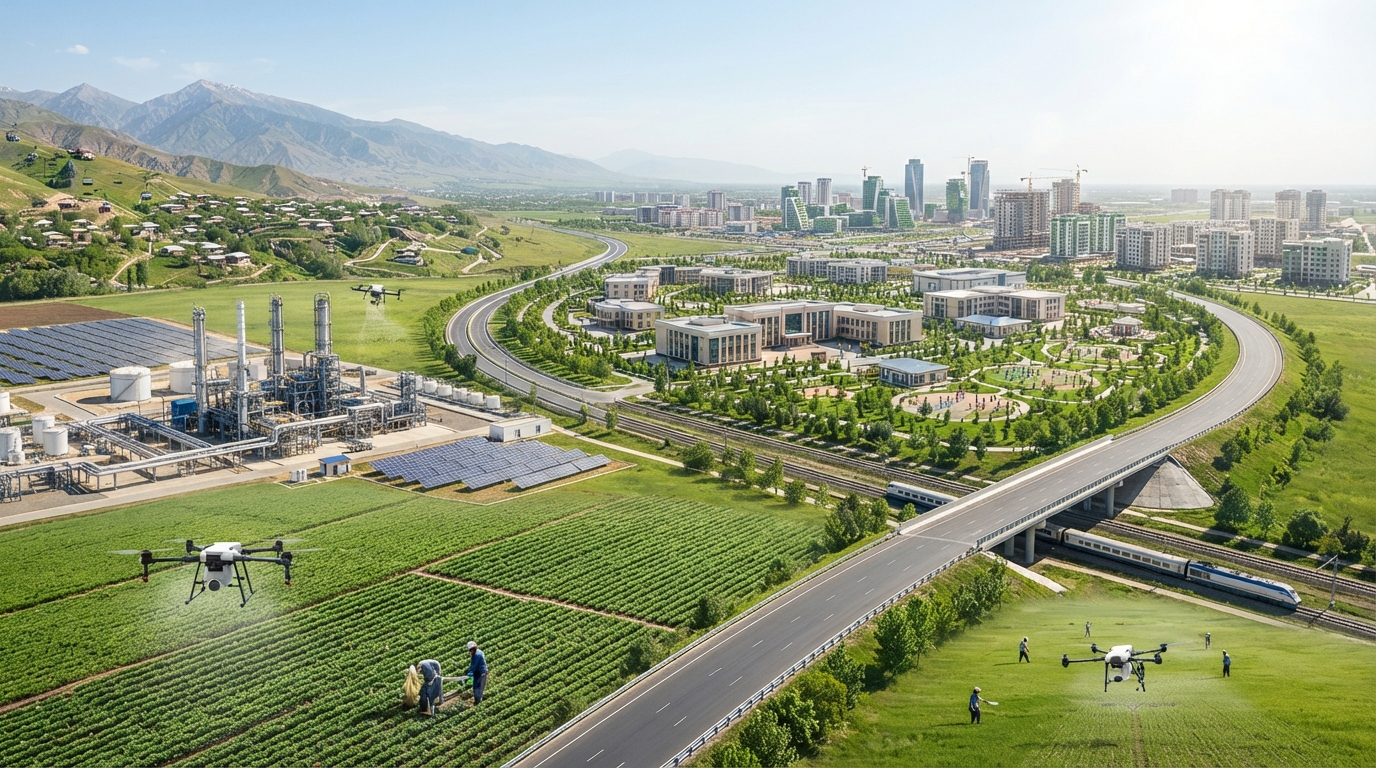
It was stated that to grow Kashkadarya's economy, it is first necessary to increase value added in industry. It was pointed out that the region's gas, electricity, and mineral resources should serve the production of finished products. For this purpose, opportunities for new projects at the "GTL" plant, obtaining polymers and petrochemical products from naphtha, expanding the capacity of the Dehkanabad Potash Plant, and developing small-tonnage chemistry were reviewed. Officials were instructed to prepare a three-year program covering projects worth $20 billion and 50,000 jobs.
It was emphasized that these projects should also unite local manufacturers around large enterprises. For this reason, six industrial clusters will be established in the region, and branches of the "Kashkadarya" free economic zone will open. Initially, 250 billion soums will be allocated for their infrastructure. Localizing modern tractors and agricultural machinery, as well as producing agrodrones, were also included among the tasks in this direction.
It was noted that growth in industry also depends on a stable energy supply. Next year, a 300-megawatt solar power plant and energy storage capacity of the "Masdar" company will be launched in the region. A waste-to-energy project in the Karshi district is being completed. Tasks were set to construct large substations in Nishan and Kukdala to deliver new capacities to consumers, and to complete the 245-kilometer power line along the Talimarjan – Sogdiana route.
Agriculture was also reviewed as an important source of increasing population income. It was stated that in this sector alone in the region, there is an opportunity to provide an additional 200,000 people with income. With the World Bank, based on Egyptian experience, drought-resistant livestock feed will be planted using drones on 100,000 hectares of pasture in eight districts, and livestock complexes will be established. In Guzar, 10,000 hectares of land will be put into use and given to farmers. Egyptian specialists will be involved in developing another 30,000 hectares identified based on satellite data.
The issue of improving water supply for efficient land use was also raised. Due to the high cost of delivering water to crop fields in Kashkadarya, 265 kilometers of canals will be concreted and 20 pumps will be modernized next year. Water-saving technologies will be introduced on 75,000 hectares together with farmers. The experience with small water reservoirs built this year will be expanded to five more districts.
The population's need for clean drinking water was discussed separately. At the expense of allocated funds, the construction of 747 kilometers of water and sewerage networks and 43 facilities will be completed, providing 200,000 people with clean water. Laying a network from the Hisorak reservoir to the city of Karshi and surrounding districts will serve another 350,000 residents. Meanwhile, the reconstruction of the Talimarjan – Mubarek water system is aimed at improving the water supply for 700,000 people in five districts.
Road projects were also determined to facilitate connectivity between regions. Together with the Asian Development Bank, a 100-kilometer section of the A-380 highway passing through the region will be reconstructed. The Karshi bypass road will be connected to this highway. Modern overpasses will be built at two railway crossings where traffic jams occur during train passes.
At the meeting, attention was focused on the fact that the effects of large projects should be felt in every neighborhood. In the Chim neighborhood of the Kamashi district, a school, kindergarten, clinic, youth center, sports complex, and park were built. Most importantly, no poor families or unemployed residents remain in the neighborhood. By Independence Day next year, based on this experience, two modern neighborhood centers will be established in each district. Lemongrowing, fishing, and horticulture projects will begin in Mirishkor, and the cultivation of high-yield crops on leased lands will be expanded.
It was emphasized that in implementing such initiatives, banks should not limit themselves to merely offering new credit products. Their performance will be evaluated by the number of enterprises receiving resources and the growth of businesses. The task was set to take cash flow and firm orders into account when allocating loans, and to cancel redundant documents requested from entrepreneurs.
It was noted that Kashkadarya's natural capabilities could also create new jobs in tourism. Since the beginning of the year, 2.5 million tourists have visited the region, and the number of visitors to the village of Gelon alone reached 500,000. Plans include launching the first phase of a ski resort in Gelon, developing ethnotourism in other mountain villages, and rafting and sports tourism in the Shahrisabz district. Master plans will be prepared for six villages, launching projects worth $50 million.
It was emphasized that professional training of youth is also important for new jobs. 32 masters from the Advanced Professional Skills Technicum in Karshi, who underwent advanced training in Germany, are currently training masters at 57 technicums in the region. Here, students receive a professional certificate alongside a school diploma, while experts from Germany teach youth languages and professions. Officials were instructed to create a clear system of career guidance for students between schools and technicums.
The achievements of Kashkadarya students were also given special recognition. The Presidential School in Karshi recorded the highest results in the republic in the "Cambridge" exams, and the Abdulla Oripov Creative School won the "Zakovat" tournament. Murodjon Khalimov from Kasan scored a maximum 1600 points on the SAT exam. Starting next year, exact sciences will be taught in a foreign language in one school in each district. In addition, robotics clubs will open in all districts, and a championship will be held among students every year.
It was stated that the future growth of the region also requires careful advance planning in urban development. The city of New Karshi designed for 500,000 residents will be built on the border of the city of Karshi, Kukdala, and Karshi district, while the "Kohna Nasaf" eco-complex will be built in Karshi district. Master plans will be developed with the participation of prestigious architectural companies, and the new areas will be built based on "green" and "smart" city principles.
At the same time, the "Kashkadarya Experience" will be launched for planting saplings and increasing green areas in neighborhoods. Every year on the eve of Navruz, the "Greenest Neighborhood" competition will be held.
At the end of the meeting, reports from regional and district governors were heard, and a dialogue with activists was held.