

Tashkent Literature Museum handed over to the Youth Theater. What will be the fate of the exhibits and scientific activities?
The Literature Museum building was transferred to the Youth Theatre for free use by a classified government decision. This sparked objections on social networks. Museum employees are concerned about the fate of the manuscripts and scientific activities, while the Cultural Heritage Agency stated that the murals will remain in place. A Gazeta report.
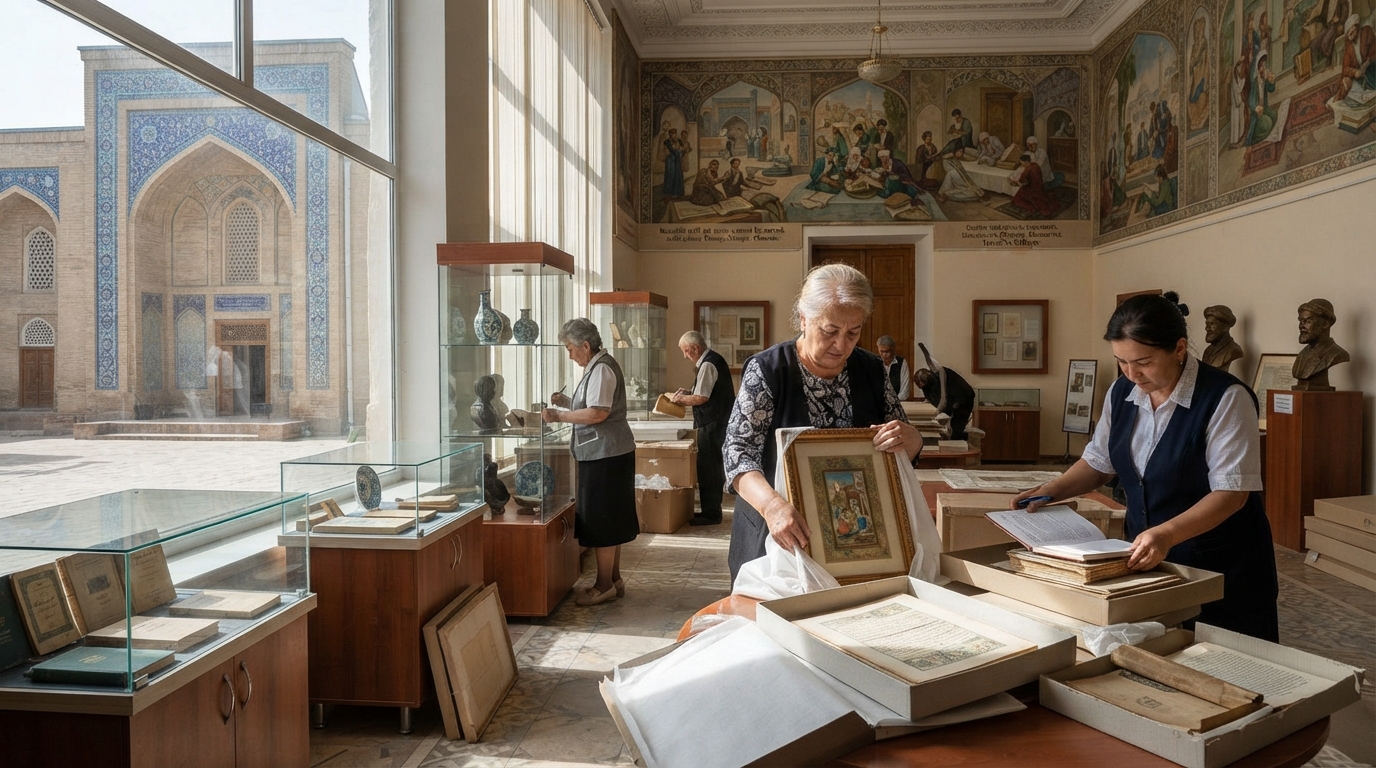
Literature Museum in Tashkent Transferred to the Youth Theatre. What Will Be the Fate of Exhibits and Scientific Research?
The building of the State Museum of Literature named after Alisher Navoi, located in the center of Tashkent, has been transferred free of charge to the adjacent State Youth Theatre of Uzbekistan on the basis of operational management rights.
This measure is provided for in the Cabinet of Ministers' DSP (Designated for Official Use Only) decree signed on September 29, 2026. The document notes that a new building for the museum is planned to be constructed in New Tashkent. However, its construction has not yet been completed, while a portion of the museum's holdings has already been relocated to another institution.
The relocation of the museum and the transfer of its building are being heatedly discussed on social networks.
Scientific staff working at the institution are concerned that moving the museum to another building will affect not only the exihibits, but also scientific work related to manuscripts, lithographs, and the personal archives of writers. According to them, the museum is not merely an exhibition hall, but a scientific institution that studies the history of Uzbek literature based on primary sources. Furthermore, the current building contains murals of historical and artistic significance.
According to Ma'mura Rashidova, the museum was established in 1941 under the Institute of Language and Literature of the Academy of Sciences of Uzbekistan on the occasion of the 550th anniversary of Alisher Navoi's birth. Initially, it operated as a small department dedicated to Navoi, where manuscripts and literary sources related to the poet's life and work began to be collected.
“In 1968, on the occasion of the 525th anniversary of the poet's birth, the museum was moved to its current building. The structure itself holds historical significance and is protected as a cultural heritage site,” she says.
Rashidova has worked here for 51 years. Her career and scientific research are closely tied to the museum. According to Rashidova, the institution's main task is not merely to display literary heritage, but to study it scientifically, research manuscripts, and uncover new information regarding the history of literature.
“The Literature Museum is not an ordinary spectator site. Here, the creative work of writers is studied based on historical sources, manuscripts are researched, and texts of works are verified. Exhibitions are also the result of this scientific labor,” she says.
Scholar Hamid Sulaymonov holds a special place in the museum's history. To enrich the museum's collection, he and his students traveled to foreign countries to study manuscripts, bringing back original copies when possible, and photocopies or transcripts when not. He also made a significant contribution to collecting the personal archives of poets and writers.
In 1978, the Institute of Manuscripts was established based on the manuscripts and literary sources gathered at the museum. It operated six scientific departments engaged in describing, studying, and introducing sources into academic circulation. Following Hamid Sulaymonov's death, Academician Aziz Qayumov continued these efforts. Ma'mura Rashidova notes that she worked alongside him for nearly 40 years. The institute operated for 20 years.
In Rashidova's view, the question of moving the museum to another building is not limited to simply transferring exhibits from one place to another. The institution also encompasses a scientific school, expertise, and traditions formed over many years. Therefore, if the relocation plan is carried out, how the museum's scientific activities will continue must be clearly defined.
According to Abdurasul Eshonboboyev, the institution's exposition contains more than 1,500 exhibits. Among them are oil paintings, ceramic items, editions of Navoi's works published in various periods, photocopies of his divans preserved abroad, and other rare artifacts.
The expositions cover various periods of Uzbek literature. The museum features halls dedicated to the life and work of Alisher Navoi, a "Khamsa" exposition, materials related to Babur and classical literature, as well as exhibitions covering 20th-century and contemporary literary processes.
“In the 'Khamsa' hall, there are murals dedicated to Navoi's five epic poems by Temur Sa'dullayev. The wall paintings dedicated to Navoi's lyrics by the famous artist Chingiz Ahmarov are also part of the museum's artistic heritage. They feature couplets from the poet's ghazals, inscribed by the poet and calligrapher Charxiy domla,” says the museum's chief keeper.
Abdurasul Eshonboboyev emphasizes that the museum also houses murals dedicated to Navoi and Jami, as well as the birth and death of the poet. One of them was later used as a prototype in decorating the Alisher Navoi metro station. The museum's exposition also features busts of Navoi, Babur, Maqsud Shayxzoda, Oybek, and G‘afur G‘ulom, alongside sculptures and artworks dedicated to Ogahiy, Komil Xorazmiy, and other creators.
Eshonboboyev stresses that when discussing the relocation plan for the museum, account must be taken not only of books and portable exhibits, but also the fate of the murals intrinsically tied to the building itself. Moving them elsewhere may prove impossible, while the question of their preservation in their original setting should the building be handed over to another institution remains open.
The museum's primary wealth is not limited to items in the exhibition halls. It houses a collection of rare manuscripts and lithographs, as well as the personal archives of Uzbek poets and writers. Abdurasul Eshonboboyev reported that the collection contains nearly 3,000 manuscripts and lithographed books, the majority of which are lithographed publications.
Shafoat Hasanova has been working here for 22 years. She stresses that the relocation process is already affecting scientific work. According to her, inventorying and preparing the museum collections for relocation have begun. Part of the manuscripts has been transferred to the Center of Islamic Civilization, while the remaining exhibits are planned to be moved to the building of the Institute of Anthropology.
“Our concern is not just about losing the museum building. There is a scientific environment and traditions established here over many years. We are glad that the Navoi Center is being built in New Tashkent, but until the new building is ready, it is unclear how the museum and its scientific work will continue,” she says.
According to Hasanova, due to the inventory and relocation of collections, researchers' access to sources has been restricted. Scientific staff are facing difficulties in conducting their work as before.
She states that the museum staff sent a letter to the President regarding the future of the institution and the uninterrupted continuation of its scientific work. A reply was received stating that the petition had been forwarded to the Academy of Sciences. Subsequently, representatives of the academy visited the museum and spoke with the staff.
“We explained to them our concerns regarding the disruption of our scientific work and the future of the organization. We were told that the museum would not be closed and that we could continue our activities. However, no clear answer was given regarding where and under what conditions we would work. Therefore, we cannot say the problem has been solved. Later, we received a decree designated for official use only. It provided for granting the building to the theatre for free use and renovating it after the museum's relocation,” she says.
Another issue worries the museum staff: construction of the Navoi Center in New Tashkent is still in its initial stages. Hasanova estimates that commissioning the new building will take at least four to five years or longer. How the museum's holdings will be preserved during this period, how researchers will access them, and where scientific work will be conducted remain uncertain.
Chief keeper of the museum Abdurasul Eshonboboyev also considers it appropriate for the museum to function in its current location until the new building is completed. In his opinion, if necessary, renovation work could be carried out in the building while maintaining uninterrupted scientific activities.
The Cabinet of Ministers' closed decree dated September 29, 2026, provides for granting the current museum building free of charge to the State Youth Theatre of Uzbekistan on the basis of operational management rights following the museum's relocation, as well as executing renovation works on the building.
Museum staff, however, believe that the option of preserving its current function through building renovation should also be considered. They point out that besides the historical structure, the site houses adapted expositions, wall paintings, and a museum atmosphere cultivated over many years.
Nurafshon Oripova is also opposed to relocating the institution from its current site before the new building is ready. According to her, the materials in the museum are important sources not only for today's scholars, but also for future generations.
“While studying the archive documents, I once again witnessed the historical significance of the museum. Examining documents related to the 550th anniversary of Alisher Navoi's birth, we saw that nearly 85 years ago, despite difficult times, major efforts were made to name this street after Navoi and erect a statue of the poet. Since such efforts were made at that time to immortalize the memory of the great poet, I believe that today, out of respect for Navoi and esteem for Uzbek literature, the museum must be preserved,” Oripova says.
In her view, approaching the issue of preserving the museum solely from the perspective of which institution uses the building is incorrect. The current museum, Navoi Street, the poet's statue, and the surrounding cultural environment are interconnected. The wall panels and artworks in the exhibition halls are also meaningful in their specific place and setting.
Museum staff are not opposed to the construction of the Navoi Center in New Tashkent. On the contrary, they support creating opportunities to study and promote literary heritage in the new center as well. However, their main demand is that until the new building is constructed and operational, the current museum's activities and scientific work must not come to a halt.
Staff are asking that the possibility of preserving the museum at its current site by performing necessary renovation work on the building be considered. For them, the issue is not merely about their workplace or where expositions will be moved. What is at stake is the fate of manuscripts, lithographs, writers' archives, wall art pieces, and a scientific environment built over decades.
For now, there is no clarity regarding the future of the museum that the staff expect. Questions such as when the new building will be completed, where and under what conditions the holdings will be stored, and when and how researchers will be able to use them remain unanswered. Meanwhile, the staff want the museum's scientific mission preserved and the national literary heritage passed on intact to future generations.
The Cultural Heritage Agency issued a response to social media reports regarding the relocation of the State Literature Museum named after Alisher Navoi to another building.
The Agency reported that the museum building located at 69 Alisher Navoi Street, Shaykhantakhur District, was included in the National List of Immovable Cultural Heritage Objects by Cabinet of Ministers Decree No. 846 of October 4, 2019, and placed under state protection.
The statement noted that the building was historically and architecturally constructed as the Russian Theatre for Young Viewers. The State Youth Theatre has also operated in a portion of this complex's territory for many years.
The Agency explained the transfer of the building to the theatre as an effort to preserve the complex as a unified cultural and theatrical venue and to create conditions for the theatre's expanding needs.
It was noted that although the building is included in the list of cultural heritage sites, it was not on the balance sheet of the Cultural Heritage Agency, but within the system of the Academy of Sciences. Taking into account the proposal of the balance holder, the building was transferred by Government decree to the State Youth Theatre for free use based on operational management rights.
The Agency emphasized that a change in the building's user does not affect its status as a cultural heritage site and does not revoke legal obligations associated with this status. On the contrary, these obligations are assigned to the new user — the theatre.
The response also noted that internal murals and rare artworks in the museum halls cannot be relocated. The Agency stated that they will be preserved in situ in their original state. The interior renovation project for the building will be considered in a second phase, subject to the condition of conserving and restoring the murals.
Other rare exhibits from the museum collection are planned to be temporarily relocated and stored at the Center of Islamic Civilization and the Institute of Anthropology under the Academy of Sciences until the new building under construction in New Tashkent is operational. The Agency also announced that 4.6 billion UZS is envisaged for repairing the building's facade. Renovation work is promised to be conducted in two phases without permitting legal violations.
It should be recalled that in April, Saida Mirziyoyeva, Head of the Communications and Information Policy Branch of the Executive Office of the President of Uzbekistan, visited several cultural sites, including the State Literature Museum named after Alisher Navoi, to discuss the digitization process of rare manuscripts. She subsequently announced that she had taken the situation regarding cultural sites under her supervision.
The project for a new building for the Literature Museum named after Alisher Navoi has been under discussion for several years. In 2021, a proposal to build a museum near the Alley of Writers in the National Park was presented to the President.
Later, the concept changed. In September 2024, a project for a complex in New Tashkent, comprising the International Research Center named after Alisher Navoi, the Literature Museum, and the National Maqom Center, was presented to the head of state. It was designed by the world-famous firm Zaha Hadid Architects.