

Tashkent Khokim: The city needs to allocate about $2 billion annually for development
Tashkent requires about $300 million per year for roads, $400 million for utility infrastructure, and another $300 million for schools, kindergartens, and healthcare, stated the khokim (mayor) of the capital, Shavkat Umurzakov. According to him, another $1 billion needs to be invested in projects that increase the city's value and its revenues.
Tashkent Khokim: City Needs About $2 Billion Annually for Development
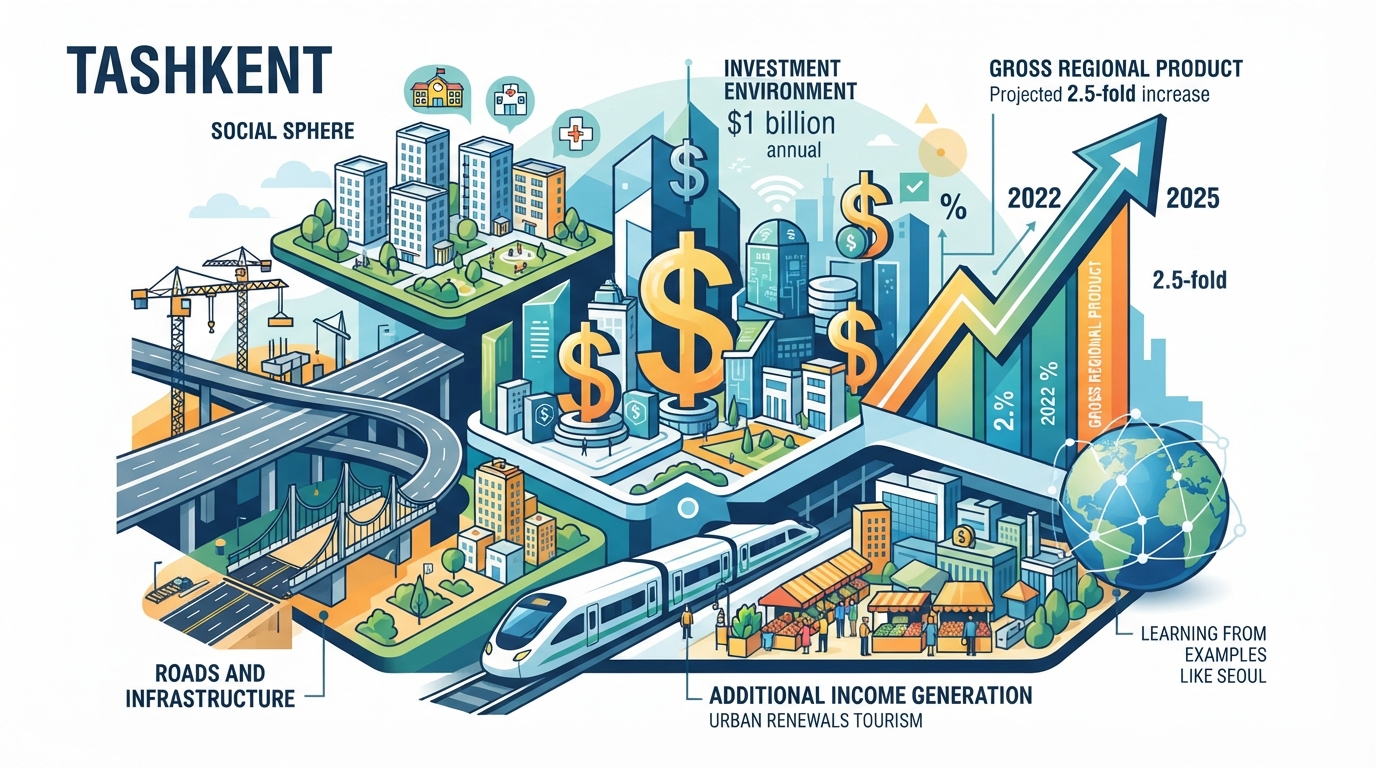
Tashkent needs to allocate approximately $2 billion annually to the development of infrastructure, the social sphere, and projects that can generate additional income for the city.
According to the khokim, about $300 million per year needs to be allocated to roads and road infrastructure.
"According to my calculations, Tashkent today needs to spend about $300 million annually on roads and road infrastructure — to catch up with the pace of development, put in order the existing, largely outdated infrastructure, and keep up with the growing load," he said.
Another approximately $400 million per year, based on the per capita indicator, should be directed to utility infrastructure, according to his estimate.
About $300 million is required for the social sphere — schools, kindergartens, and healthcare. In this amount, Umurzakov includes not only the creation of new capacities, but also expenses for specialists, professional development, salaries, and the implementation of the KPI system.
Separately, the khokim considers it necessary to direct another $1 billion annually to "maintaining the investment environment."
"What does this mean? If we invest $2 billion in the city, they must return at least $3 billion. Renovation, development of tourist streets, festivals, improving ecology — all these are investment projects that increase the value of the city," he stated.
According to Shavkat Umurzakov, Tashkent is capable of independently earning the $2 billion needed for development. He noted that in 2022, the capital's gross regional product was 149 trillion soums, and by the end of 2025, it approached 370 trillion soums — an increase of about 2.5 times.
"We are currently using only 20-30% of the available opportunities. Tashkent is capable of earning those $2 billion I spoke of on its own: directing $1 billion to infrastructure and city problems, and another $1 billion to projects that will then return in taxes and other revenues," the head of the city administration noted.
The khokim admitted that the stated volume might look ambitious, but cited other major cities, including Seoul, as examples.
According to him, the key question lies in creating a mechanism that will allow the city to receive and effectively use these funds.
"I want to say that we are capable of finding even $2 billion. The main thing is to know the mechanism, to understand why to earn this money and what to spend it on. Khokims and all responsible structures of Tashkent must understand that these $2 billion are needed to qualitatively serve the current needs of the population," the head of the capital's khokimiyat stated.
Umurzakov added that the capital's authorities must proceed from this amount when planning the city's development.
At the same time, speaking separately about the city's revenues, the khokim stated that with the implementation of the outlined plans, Tashkent, according to his calculations, will be able to earn $1 billion as early as next year.