

Current agenda (June-July 2026)
At meetings chaired by the President of Uzbekistan, the most pressing issues related to the ongoing reforms are addressed in a working manner. The most important decisions are made during meetings devoted to the development of the socio-economic sphere.
Here's a rewritten version of the text in Russian, preserving all the facts, names, figures, and quotes:
**Current Agenda (June-July 2026)**
**Development of the Namangan Region**
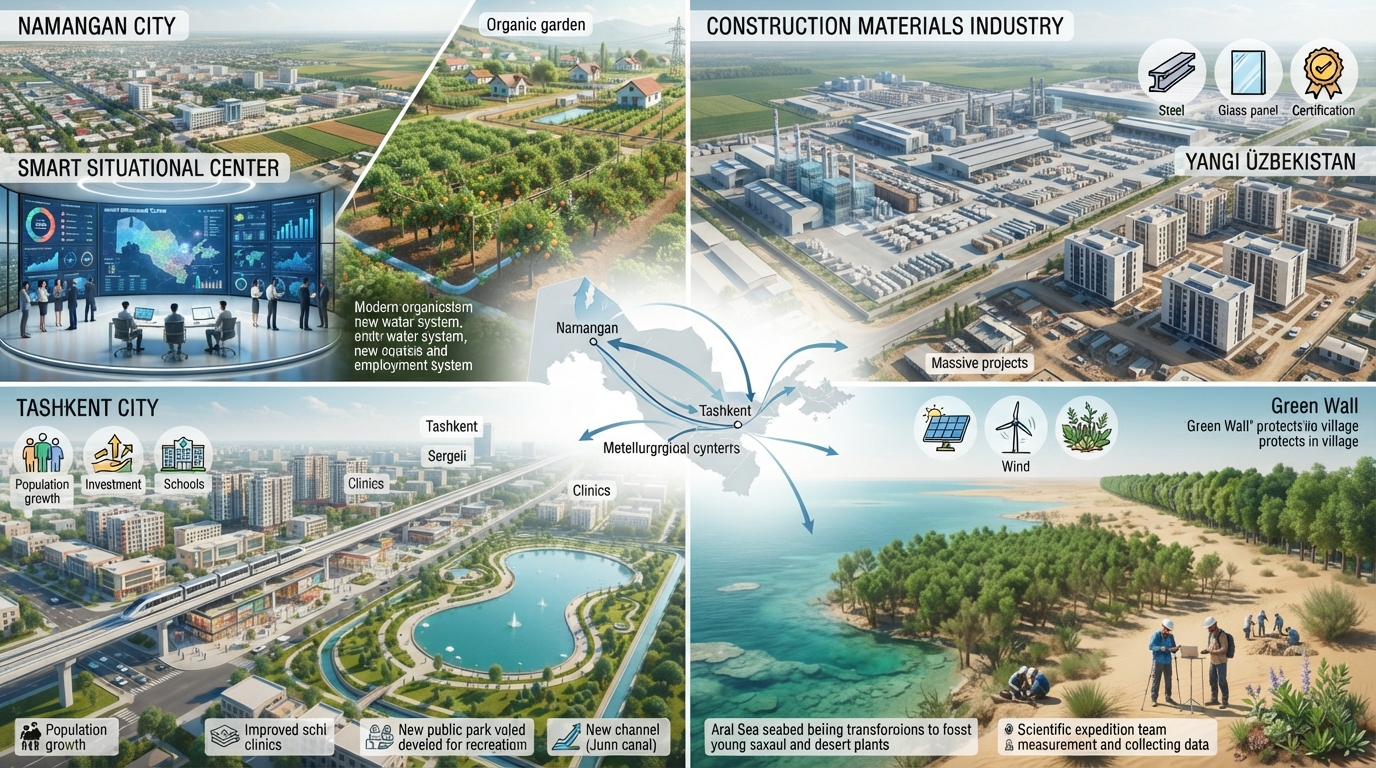
On June 23, President Shavkat Mirziyoyev held a meeting at the Namangan Region Situation Center, where officials presented reports on the region's development. A smart situation center has been established in Namangan, designed to analyze city and district processes through a unified digital system, promptly make management decisions, and create a comfortable and safe environment for the population. This center is planned to provide 980 types of services through a one-stop shop to more than 27,000 residents of eight mahallas directly on-site. The President was also briefed on new priority areas for the socioeconomic development of the Namangan Region.
It was noted that in recent years, industrial production in Namangan has grown from 4.6 trillion soums to 40 trillion soums. Targets for the current year include increasing the gross regional product by 9.2%, industry by 9%, services by 17%, and agriculture by 6.8%. Mechanical engineering, metallurgy, light industry, services, and the "new economy" are identified as the main drivers of the region's development.
This year, 4.5 trillion soums have been allocated from the budget for developing entrepreneurship and improving business infrastructure in the Namangan region. 6.5 trillion soums are being allocated to support small and medium-sized businesses. The region has set a goal of providing permanent employment to 80,000 people, increasing the incomes of 314,000 citizens, and lifting 21,000 families out of poverty by the end of the year.
In the first five months, 23,500 people have found permanent employment, and more than 8,000 families have been lifted out of poverty. However, criticism was expressed regarding high unemployment and poverty rates in a number of districts. Responsible officials were instructed to improve employment, entrepreneurship development, and poverty reduction.
New opportunities in agriculture were also noted. Instructions were given to effectively utilize hilly lands in the Pap district and expand the practice of creating industrialized organic gardens. By the end of the year, gardens are planned to be established on an additional 400 hectares of such land, and within one month, practical work will begin on an additional 2,800 hectares.
Investment and export issues were discussed. This year, the goal is to attract $5 billion in foreign investment to Namangan Region and increase export volumes to $1.2 billion. At the fifth Tashkent International Investment Forum, agreements were reached to implement 43 projects worth $3 billion in the region.
To increase export potential, work has been instructed to be carried out in each district and city, as well as to implement a unified export ecosystem, modeled on Namangan, encompassing all processes—from production to standardization, certification, packaging, logistics, and customs clearance.
This year, 703 billion soums have been allocated for the construction of 130 kilometers of water supply networks, 2.5 kilometers of sewer networks, and nine new water facilities. As a result, 34,000 residents will be provided with centralized water supply for the first time, and 25,000 will be connected to the sewer system.
In healthcare, a new model of primary health care is planned to be implemented in the Kosonsay and Uychi districts. Furthermore, a national program to combat myocardial infarction and stroke will be launched in the Namangan, Andijan, and Fergana regions starting in October of this year.
**Priorities for the Development of the Construction Materials Industry**
On June 25, President Shavkat Mirziyoyev chaired a videoconference to discuss current work in the construction materials industry and future priorities. Over the past ten years, the industry has attracted $12 billion in investment, and over 4,000 modern enterprises have been commissioned. This has created capacity that fully meets domestic demand for more than 20 key products, including cement, glass, basalt materials, ceramics, aerated concrete blocks, and dry construction mixes.
Today, 98% of the materials needed to construct new residential and industrial buildings are produced domestically. As a result, production volume in the industry has increased from 7 trillion soums to 53 trillion soums over the past period, and exports last year amounted to $1.2 billion. Most importantly, the industry has made significant progress in import substitution.
By 2040, it is planned to double the volume of residential construction to 280,000 units per year, and increase the number of Yangi Uzbekistan residential complexes from 61 to 120. Residential and commercial construction alone generates $10 billion in demand for building materials annually. At the Tashkent International Investment Forum, infrastructure projects worth an additional $27 billion were proposed to foreign partners. All of these large-scale projects will primarily require building materials. Naturally, such large-scale projects impose high standards, quality, and certification requirements for the materials used. In this regard, the need to create a new system that will integrate domestic manufacturers into these projects was noted. Responsible officials were instructed to submit a draft resolution to ensure equal conditions for the supply of imported and domestic products to large and megaprojects.
The meeting also focused on the implementation of a two-year program for the development of tourism infrastructure in the regions. The program includes the construction of 34 major tourist facilities and over 1,000 accommodation facilities, including 200 hotels. It was noted that khokims must increase the share of local materials in hotels being built in the regions to at least 95%.
In the Kamashinsky district, the "Yangi Uzbekistan" residential complex, with 4,000 apartments, is being built using a new approach developed by French and British companies. This project utilizes only energy-efficient domestic materials, reducing production costs by 20% and heating and cooling costs by 25-30%. It was noted that this year, in 33 districts and cities that will be reimagined as New Uzbekistan, apartment buildings must be built exclusively using this approach.
Special attention was given to exports. Neighboring countries import $13 billion worth of construction materials annually. It was noted that the Central Asian markets alone have the potential to increase exports by an additional $440 million. Major residential and commercial construction programs are being implemented in Azerbaijan, Georgia, Russia, Kazakhstan, and Kyrgyzstan. If Uzbekistan becomes a reliable partner for these countries in housing construction, this will open up new export opportunities. In this regard, responsible officials have been instructed to build three to four model energy-efficient residential buildings each and conduct roadshows in Baku, Tbilisi, Moscow, Astana, and Bishkek.
Improving energy efficiency within the industry itself was also discussed. Over the past ten years, the volume of fuel equivalent consumed by construction materials manufacturers has been halved. It was noted that this is still insufficient. Regional khokims have been instructed to launch a large-scale program to reduce energy consumption at construction materials companies through technological modernization.
A system has been established to fully reimburse construction materials companies for all costs associated with obtaining certificates. Responsible officials have been instructed to launch an electronic platform for building materials with local and international certifications and, in conjunction with regional khokims, to assist at least 50 companies in the industry in obtaining international quality certificates this year.
**Socio-Economic Development of Tashkent**
On July 4, President Shavkat Mirziyoyev chaired a videoconference on the socio-economic development of Tashkent, particularly the Sergeli District, and the creation of a safe environment in mahallas.
The head of state noted the significant changes that have taken place in the Sergeli District in recent years. Until recently, the Sergeli District was considered the outskirts of the capital, but today, the environment and lifestyle of residents have changed dramatically. Over the past ten years, new residential buildings with 30,000 apartments have been built here, along with industrial, retail, and service facilities totaling 2 million square meters. The number of entrepreneurs has increased from 2,500 to 6,200. Budget revenues generated in the district have increased from 382 billion soums to 2.2 trillion soums, a 5.5-fold increase. Five large recreation areas and parks have been opened for the public.
With the addition of 13 mahallas from the Tashkent region, the territory of the Sergeli district expanded by 1,800 hectares, reaching 5,600 hectares. The number of school places increased from 25,000 to 38,500, and kindergarten places from 7,500 to 15,500. Fifty public and private clinics have been established. While the population of the Sergeli district was previously reported at 181,000, the census revealed that the actual population is approximately 236,000. Sergeli's population is expected to exceed 300,000 in the coming years. In this regard, it was emphasized that leaders must now have a clear plan and program for increasing housing construction, kindergartens, schools, clinics, and jobs in line with population growth.
This year, 173 billion soums have been allocated from the budget for the development of the Sergeli district, with 2.2 trillion soums allocated through banks. This year, the capital's districts are expected to implement investment projects totaling $9 billion. The Sergeli district itself has attracted $236 million in investment over the past five months. By the end of the year, an additional $750 million is planned to be attracted through the launch of 60 projects.
The meeting also discussed the experience of organizing retail and service facilities under elevated metro lines. Under this approach, the state auctions off the land use rights, prepares the design and infrastructure, and then entrepreneurs carry out the subsequent work. Overall, the implementation of such projects on the 23-kilometer section of the elevated metro line running through the Yashnabad, Sergeli, and Yangihayot districts will enable an additional 400 entrepreneurs to start businesses and create 3,000 jobs.
Since the beginning of the year, nearly 3 million foreign tourists have visited Tashkent. However, a shortage of public restrooms for visitors to the capital and residents going for walks was noted. A separate program was instructed to be developed within a month and to auction off land plots for the construction of 15-20 modern restrooms in each district this year.
Some schools in the Sergeli district are operating at 1.5-2 times their capacity. A project for the construction of a new type of school, which would double the number of student places, was proposed at the meeting. According to the new project, the gym, cafeteria, and workshop will be located in the basement, while the upper floors will be used as classrooms. This year, instructions were given to implement this approach in one school and one kindergarten in each district of Tashkent, creating a "metropolitan experience."
Work has begun in the capital to create 12 artificial lakes to create a cool microclimate for residents and tourists. Three of these lakes will be located in the Sergeli district – in the Kushkurgan, Sultonobod, and Farogatli mahallas, covering a total area of 22 hectares. The goal is to transform these lakes into spaces that will contribute to the capital's moderate climate, as well as to recreational opportunities. It was also noted that concrete pouring has begun on a 5-kilometer section of the Zhun Canal, which runs through the Sergeli and Yangikhayot districts. The khokims of these districts have been instructed to establish a walking area and a health trail along the canal by the end of the year.
The meeting also discussed the creation of a capital-wide model for ensuring a safe environment in mahallas. It was noted that assigning republican leaders to the capital's districts is yielding results. Over the past six months, not a single crime was committed in 230 mahallas, and crime has dropped sharply in 332 mahallas. The number of mahallas with alarming crime rates has decreased from 60 to 23. This demonstrates the effectiveness of new approaches to ensuring public safety in the city.
**Development of the Desert Economy**
On July 6, President Shavkat Mirziyoyev reviewed a presentation of proposals to combat desertification and develop the desert economy, as well as implement "green city" principles. Desert and semi-desert zones comprise approximately 80% of our country's territory. Soil salinization, sand drift, dust storms, and dry winds pose a serious threat, particularly to the Republic of Karakalpakstan, the Bukhara, Navoi, and Khorezm regions, as well as certain districts of the Kashkadarya, Surkhandarya, and Jizzakh regions.
The drying up of the Aral Sea has further intensified these processes. Therefore, efforts to create green spaces and plant saxaul and other desert plants in the Aral Sea region are continuing. In recent years, over 2 million hectares of new forests have been established on the dried bed of the Aral Sea. Large-scale work is also being carried out as part of the national "Yashil Makon" project. Over 1 billion tree and shrub saplings have been planted across the country, with the greening rate increasing from 8% in 2020 to 14.3% in 2025.
During the presentation, proposals were discussed for taking desertification control efforts to a new stage in 2026-2030. Plans call for creating and restoring forests on an area of 1.27 million hectares, as well as establishing 16,000 hectares of protective afforestation in desert, mountain, and foothill areas. It was proposed to create green cover over an area of 10,000 hectares in the Surkhandarya region, form an 84-kilometer "green wall" in the border areas of the Syrdarya region, plant trees and shrubs using terraces in mountainous and foothill areas, and test modern agricultural technologies on degraded lands.
The head of state emphasized that desert territories must be viewed not only as an environmental problem but also as a source of new economic opportunities. To this end, he noted the importance of developing a "desert economy" approach, creating sustainable sources of income on undeveloped and saline lands, establishing seed production and nurseries for desert plants, cultivating halophytes, increasing pasture productivity, expanding livestock farming, ecotourism, and scientific research.
In this regard, proposals were made to establish desert plant nurseries in Karakalpakstan, conduct scientific expeditions to the dried-out Aral Seabed, develop pistachio plantations in Babatag using modern methods, and expand the network of halophytic gardens. The creation of a regional drought-resistant plant and seed bank and the attraction of international funds and private investment were also discussed.
The presentation focused on strengthening environmental cooperation with Central Asian countries. Initiatives were put forward to expand the activities of the Central Asian Regional Research Center for Combating Desertification and Developing Desert Economies, increase the number of practical projects within the regional Green Shield program, and develop a strategy to combat desertification through 2040.
Considering Samarkand's historical and cultural heritage, its role on the Great Silk Road, its potential as an international tourism hub, its strategic geographic location, and its existing water and transport infrastructure, it is envisaged that Samarkand will become a model of a sustainable, climate-adapted, and modern "green city" in Central Asia. In this regard, the presentation discussed the "Green Samarkand" model, aimed at ensuring the environmental sustainability of cities.
To implement the project, a project office, "Yashil Samarkand," will be established with the participation of the Samarkand Regional Khokimiyat and the National Committee on Ecology and Climate Change. This office will coordinate activities in urban development, ecology, transport, construction, tourism, industry, and public utilities within a unified system.
In terms of climate policy, carbon emission reduction targets for 2030 and 2035, as well as a "Carbon Neutral Samarkand" roadmap, will be developed for Samarkand. In addition, the Green Samarkand Climate Finance Facility platform for financing green and climate projects and the Green Samarkand Dashboard digital platform for open publication of results and monitoring will be launched.
In the areas of tourism and biodiversity, the Green Samarkand brand, the Green Hotels Samarkand rating system, the Samarkand City Biodiversity Index methodology, the Urban Biodiversity Samarkand pilot project, and the Save Biodiversity volunteer program will be implemented. This will make Samarkand a hub for ecotourism, green investments, and sustainable urban development solutions.
Overall, the project will create the organizational, financial, and practical foundations for developing Samarkand as the "Capital of Green Investments and Innovations of Central Asia."
**Bringing the Ferrous Metallurgy Industry to a New Stage of Development**
On July 13, President Shavkat Mirziyoyev held a meeting at the Uzbek Iron and Steel Works (Uzbek Metallurgical Plant) dedicated to the priority tasks of bringing the ferrous metallurgy industry to a qualitatively new stage of development.
Over the past ten years, our country's demand for metal products has tripled, reaching 5.5 million tons. By 2030, annual demand will increase by another 1.5 times, exceeding 8 million tons.
Currently, the Bekabad Metallurgical Plant produces 40% of its rolled metal products from recycled metal, with the remaining 60% coming from imported raw materials. Although the plant receives 700,000 tons of ferrous scrap metal annually nationwide, approximately 500,000 tons of scrap metal remains in the shadow economy. Therefore, all processes related to the circulation of ferrous metals will be monitored in real time via an electronic platform. The "E-Loam" electronic platform has been instructed to launch on August 1 and establish controls over the circulation of ferrous metals.
It was noted that the country has 1.5 billion tons of iron ore reserves. An agreement was reached with Chinese partners to establish annual production of 650,000 tons of this raw material by enriching ore from the Surun-ota deposit. Furthermore, the need was expressed to create capacity for annual steel production of up to 1 million tons through the Tebinbulak deposit development project, as well as to expedite the finalization of an agreement to supply 700,000 tons of iron ore per year from a Tajik metallurgical plant.
Approximately 150 medium and small private enterprises operate in the metallurgical industry. To ensure a stable supply of raw materials, a separate company will be created to handle the centralized import of raw materials. It will be allocated $200 million, and imported raw materials will be sold exclusively through the exchange.
The meeting focused on expanding the range of metal products and strengthening cooperation between large metallurgical plants and private enterprises. The casting and rolling complex commissioned today creates opportunities for developing products worth a total of $1.5 billion in the automotive, specialty, process equipment, household and agricultural machinery, and construction materials industries.
The "Uzbekistan Industrial Park of Environmental Technologies" with a ready-made infrastructure will be created on 90 hectares of land at the Bekabad Metallurgical Plant. It will house a research and development (R&D) center for ferrous metallurgy and a modern laboratory for issuing international certificates. Furthermore, the goal has been set to develop a program of cooperation projects worth a total of $100 million around major metallurgical enterprises in Samarkand, Jizzakh, Namangan, and Syrdarya. This will expand value chains in these regions and localize new product lines.
The meeting also discussed the digitalization of the metallurgical industry and the implementation of artificial intelligence technologies. The Center for Economic Research and Reforms has been designated as the "think tank" for the metallurgical industry. Additionally, the research centers of the Navoi and Almalyk Mining and Metallurgical Plants, the Uzbek-Korean Scientific and Technological Center of the Technological Metals Plant, Tashkent State Technical University, Navoi State Mining and Technological University, the Almalyk branch of the Tashkent State Technical University, and the Almalyk branch of the National University of Science and Technology "MISiS" will be affiliated with the industry.
These research institutions and higher education institutions will analyze the demand for new materials, identify projects needed to meet this demand across regions, identify optimal technological solutions, and identify training areas for in-demand personnel. One-year, three-year, and five-year programs will be developed for each region.
The Center for Economic Research and Reforms has been tasked with launching a digital platform to consolidate information on issues in the metallurgical industry. A venture fund will also be established to finance and implement scientific research.