

Tashkent. Hold your breath
An uncomfortable conversation about the city of Tashkent by Temur Akhmedov
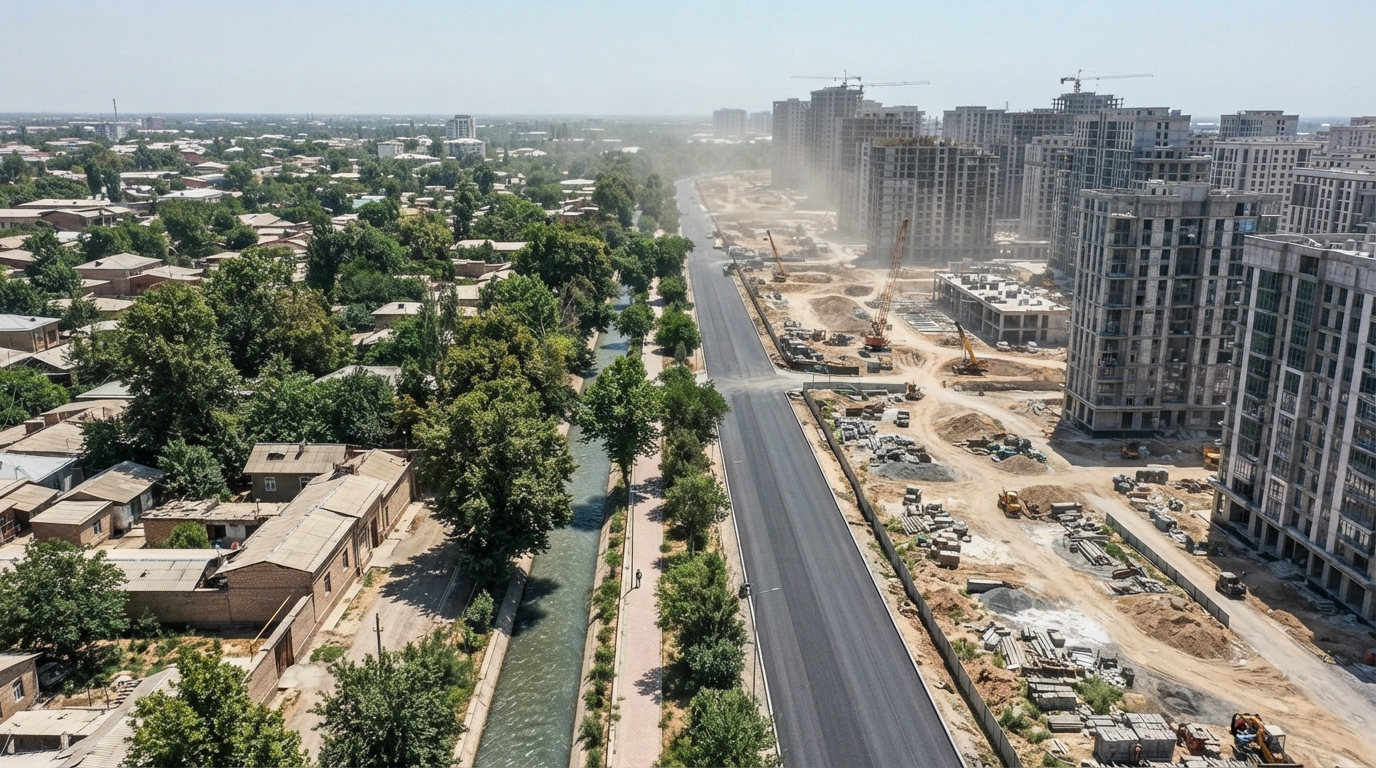
Tashkent. Hold your breath
Tashkent, the capital of Uzbekistan, is getting hotter. But we still behave as if we are just dealing with a hot summer with anomalous temperatures. Last week, I had a conversation that stayed with me for a long time. We were discussing Tashkent — my city. And the question sounded simple, yet uncomfortable: "How is the city coping with the loss of green zones, massive dense construction, and the paving over with concrete of everything that once allowed the streets to breathe?" The short answer: "It isn't."
What we lost and how quickly we lost it
Over the last 8–10 years, Tashkent has lost a significant part of its green canopy. This did not happen by accident — it happened by design, or more precisely, due to the lack thereof. When planners developed the master plan for the city's development after the 1966 earthquake, they deliberately left large green zones between residential quarters. These were not empty plots. They were reserved for future growth — breathing space built into the city's DNA.
I grew up next to one of these places. Near my school in the 1980s, there was a huge grove. It was an area inside the residential block, and in childhood, it seemed endless. The football field where we played after classes was part of that same green fabric. I don't think the planners of the 1960s could have imagined that developers of the 2020s would simply cut down almost the entire grove and erect a residential complex. The football field also disappeared — it was built over. And here is what is especially painful: no one built an additional school or kindergarten for the children of the new residents. The green space was removed. People were added. And that's it.
There is also another, less discussed phenomenon. In the old city — the so-called "private sector" — many residents cut down their fruit trees, replacing them with decorative plants or pouring concrete for parking. The loss of green canopy is not happening only at the hands of developers. It is happening block by block, yard by yard.
The real problem is not just ventilation
When we talk about what disappears along with the trees, natural ventilation is only part of the picture. A more serious problem is the heat island effect, the way the city begins to overheat due to asphalt, concrete, and glass. Tashkent regularly ranks among the top ten major cities in the world with the dirtiest air. This is not an emotional statement. This is a recurring data fact.
And yet, the signals we receive are contradictory. On the one hand, the authorities promise new parks and reservoirs. On the other, residents complain about tree cutting, the reduction of green zones, and new buildings that are simply not designed for such a climate. Both processes are going on simultaneously. And therein lies the problem.
No plan means every decision is contradictory
At the heart of much of this lies the absence of a well-thought-out, calculated master plan of development for the next 25–30 years.
Without such a plan, it is entirely possible that plans to create parks will coexist with the sale of green zones for development — and then, of course, with the cutting down of trees. Somehow, the khokimiyat (mayor's office) of the city of Tashkent manages not to comply with presidential decrees on the moratorium on construction and tree cutting. Even if we set aside corruption and chaotic development, the main question remains: cutting down trees that are 30, 50, and sometimes more than 100 years old causes irreversible changes in the city's ecosystem. New plantings are unable to quickly compensate for this loss. A sapling does not replace a century-old tree — neither in terms of shade, nor carbon capture, nor as a habitat.
The consequences ripple out and manifest in ways we do not always measure. Many native residents of Tashkent note that there are fewer birds and that the species have changed. Accurate data, unfortunately, is lacking. But there are definitely fewer sparrows. Fewer birds means more insects and more tree pests. And Tashkent already has many diseased trees.
Tashkent critically needs a systemic, well-thought-out, calculated plan based on real and objective data — for the next 25–30 years. This is not only a question of ecology or quality of life. It is also a question of the city's investment potential. Investors need certainty. Right now, there is none.
Are we even measuring the problem?
Here is the uncomfortable truth: most of these debates are conducted without objective data. Data may exist in various sources, but no one brings it together and no one publishes the analysis.
When there is no analysis, people rely on sensations and emotions. The phrase "anomalous heat" is heard constantly. But there is no common understanding of how much of the heat is caused by regional and global climate change, and how much by tree cutting, concreting, asphalt paving, and mass construction.
Public awareness is undoubtedly growing. But most people are busy with their lives and with trying to somehow cope with the heat. This is understandable — and that is precisely why the responsibility for action cannot lie solely on individuals.
What is actually being done and what is not
Do state response protocols for extreme heatwaves exist, beyond the standard advice to drink water and stay indoors? I do not know if there are written protocols. But some changes in communication have definitely occurred. The Ministry of Emergency Situations now sends out messages recommending limiting time outdoors during peak heat. Some organizations and construction companies have changed working hours for outdoor workers. These are necessary steps. But they are gradual. There is still no widespread acknowledgment that this is a new reality, not an anomaly. We still call it "anomalous heat" — as if it will pass.
We don't need to borrow. We need to remember
When people ask what Central Asian cities can learn from Europe regarding cooling, it seems to me the very framing of the question is wrong. Central Asian cities already knew how to keep cool. Over thousands of years, the peoples of this region understood what works: green zones, shade, aryks (irrigation canals) with flowing water, reservoirs, ponds — khauzes. This was not decoration. This was infrastructure. And it worked right up until the early 2000s.
Then something changed. As the people who possessed this knowledge passed away, they were replaced by those who — through no fault of their own — did not understand the function of these elements. The aryk system was destroyed. Yet it was precisely this system, along with the green canopy, that created the city's microclimate. We do not need to borrow anything. We need to return to the knowledge that our region developed over millennia.
Four steps that cannot be delayed
If I had to name the absolute priorities for adapting Central Asian cities to extreme heat, they would be the following:
— Acknowledge the problem. The correct formulation of the problem is almost as critically important as understanding it itself. The term "anomalous" is already, one might say, inapplicable.
— Stop making it worse. We must urgently stop paving everything in concrete and asphalt. Cities can and must be built, but with clear requirements and limitations. For example, the state now requires that projects with buildings of 500 square meters or more allocate at least 30% of the plot for a green zone. This is a positive change. But it needs "teeth": a clear, enforceable definition of what counts as a green zone. Potted bushes and palm trees do not count.
— Restore the aryk system wherever possible. This is our native cooling infrastructure. It existed for centuries. It can exist again.
— Protect people indoors. Social facilities — public schools, kindergartens, clinics, hospitals, orphanages, public university dormitories — must be equipped with air conditioners with fresh air intake systems. Private facilities should be obliged to install such systems at their own expense.
Summary: from awareness to action
Here is what this conversation taught me and what I would like you to take away from it: the knowledge exists. Central Asia solved the problem of urban cooling centuries ago with the help of green zones, shade, aryks, and reservoirs. We are not facing an unsolvable problem. We are facing a problem we seem to have forgotten how to solve.
The data gap is real. Without aggregated, published, objective data, we argue at the level of emotions. We cannot manage what we do not measure. Someone — government, academia, civil society, the private sector — must create and publish the analysis.
There is no plan. A master plan of development for 25–30 years based on objective data is not a luxury. It is the foundation of the ecosystem, quality of life, and investor confidence. Without it, contradictory decisions will continue to cancel each other out.
Trees are irreplaceable within our timeframe. A century-old tree cut down today is not compensated for by a sapling planted tomorrow. The losses accumulate. They manifest in the heat, in air quality, in biodiversity, in the number of birds, and in the number of insect pests.
This is a new reality, not a hot summer. The language we use matters. As long as we call it "anomalous heat," we expect it to end. It will not end.
So, here is a request — and it is to everyone, not just officials
If you are a professional — an architect, planner, ecologist, data specialist, developer, investor — bring your expertise to this conversation. Publish. Speak up. Contribute to the data. If you are a business leader — check your own footprint. Are you paving everything in concrete where you could be planting? Are your buildings designed for this climate? Are your outdoor workers protected? If you are a resident — pay attention to what is happening on your street, in your yard, in your mahalla. Ask questions. Record changes. Object when a tree is cut down without explanation. If you are in government — treat the master plan as urgent infrastructure, not as a bureaucratic exercise. Enforce the moratorium. Define "green zone" so that it cannot be bypassed. Fund the restoration of aryks.
Awareness is not the goal. Awareness without action is just anxiety with a richer vocabulary.
The knowledge is ours. The climate is changing. The only question is whether we will act as a region that remembers how to arrange life in Central Asia, or as one that forgets.
Let us remember. And then let us build.