

The cooler, the more economical: Climate change is taken into account in the construction of New Tashkent
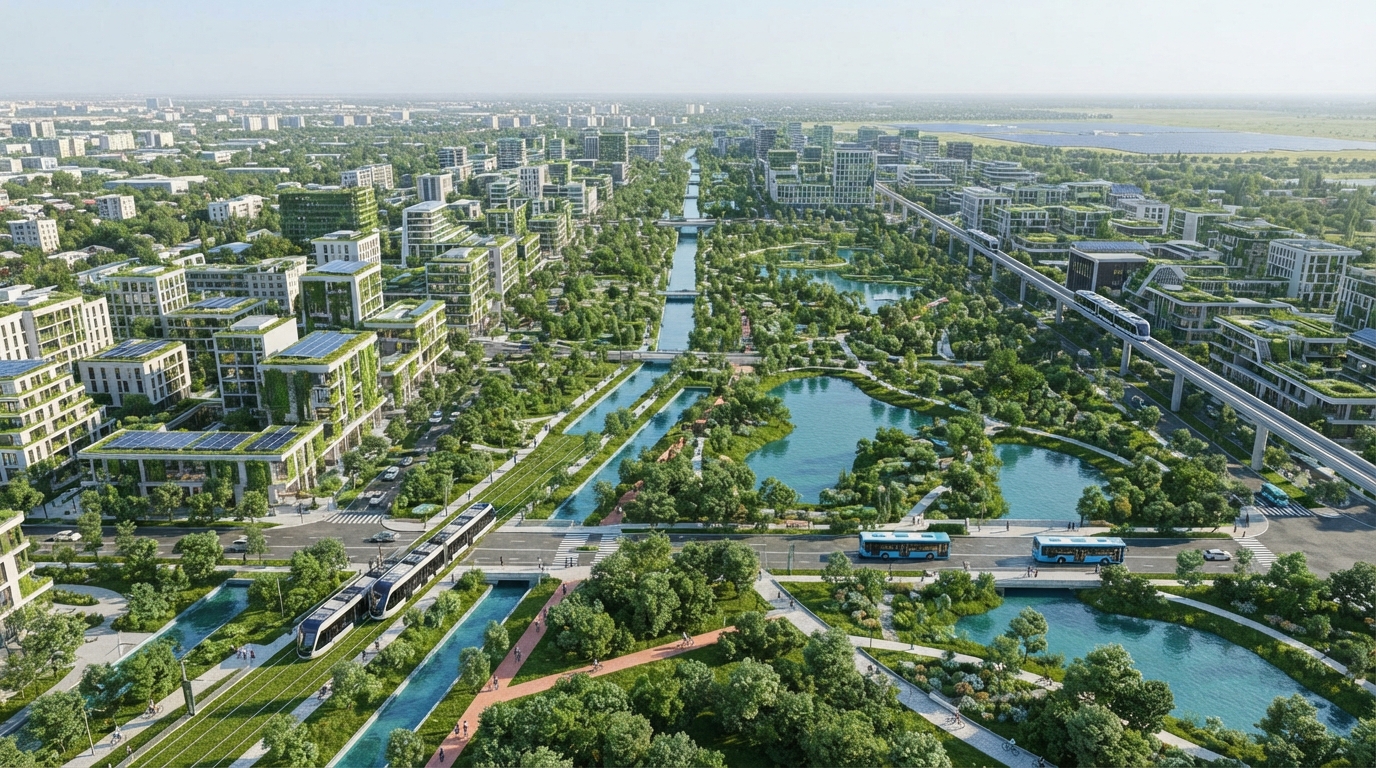
Cooler, More Energy-Efficient: Climate Change Takes into Account in the Construction of New Tashkent
New Tashkent plans to implement solutions aimed at conserving water and energy resources, developing environmentally friendly infrastructure and public transportation. The risks associated with abnormal heat waves are also taken into account in urban planning. This was announced by Temur Akhmedov, a representative of the New Tashkent Directorate, during the High-Level Dialogue on Strengthening Urban Resilience and Disaster Risk Reduction Systems, organized as part of cooperation between Uzbekistan and Japan, Daryo reports.
According to Akhmedov, the total area of New Tashkent exceeds 25,000 hectares. The project envisions the creation of a fully-fledged city, including government and cultural institutions, residential complexes, educational and medical facilities, and, eventually, clean industrial enterprises.
The first phase, covering an area of 6,000 hectares, began in mid-2024 and is expected to be completed by 2035. This phase of the project is designed to accommodate 600,000 people.
"We're not just constructing a single building; we're creating an entire city. Our approach must be oriented toward the next 10, 20, 30, and even 50 years. Providing comfortable spaces while taking regional climate change into account is a serious challenge," Temur Akhmedov emphasized.
Water and Green Spaces
The New Tashkent project places special emphasis on so-called green and blue infrastructure. Blue infrastructure includes water bodies—canals, lakes, ponds, and irrigation ditches. Green infrastructure encompasses parks, green spaces, and other vegetated areas.
Temur Akhmedov emphasized the importance of irrigation ditches. He explained that they are used for irrigation and contribute to a cooler microclimate through water evaporation.
Each plot in New Tashkent is required to be at least 30% green. This requirement is stipulated in contracts with each developer. The possibility of using green roofs, which could be partially factored into this indicator, is also being considered.
"Green space is essential not only for the comfort of residents. Its specific functional purpose is to reduce the heat island effect. If we can reduce the city's temperature by 5 degrees, this will allow us to save over 1 billion kWh per year on cooling in the first stage alone," noted a representative of the Directorate.
Buildings in New Tashkent are expected to comply with the international green building standards LEED, BREEAM, and EDGE. According to Akhmedov, BREEAM was originally developed in the UK, while LEED was developed in the US. Both standards are international. EDGE is a simpler standard, assessing the use of water, energy, and materials. It also establishes additional requirements for the energy efficiency of buildings.
In New Tashkent, water consumption is estimated at approximately 150 liters per person per day. For existing Tashkent, this figure, according to Akhmedov, is approximately 250-300 liters per day.
Another mandatory requirement concerns rainwater. At least 30% of rainwater on each site must be collected and used for irrigation.
Energy from Various Sources
New Tashkent plans to utilize a variety of energy sources. A significant portion will come from renewable energy sources, such as solar and hydropower. Some resources will be provided by the Ministry of Energy, while others will be located directly in Tashkent.
The project also includes public transportation development. Trams, a metro, and electric buses are planned for the city. The "15-minute city" concept is being used in planning New Tashkent: space will be organized so that residents do not have to drive for every trip.
According to a representative of the Directorate, the risks associated with extreme heat and flooding are also being considered in the city's planning. A water management system, not just a flood protection system, is planned for the city.