

"Urban greenery is in poor condition." Why are trees breaking and falling in Tashkent?
According to dendrologist Atirgul Kholmirzayeva, many old trees in the capital have begun to fall because they have become diseased. The expert stated that the city's greenery is in need of preservation. What specific measures are required in this regard? Gazeta discussed the topic.
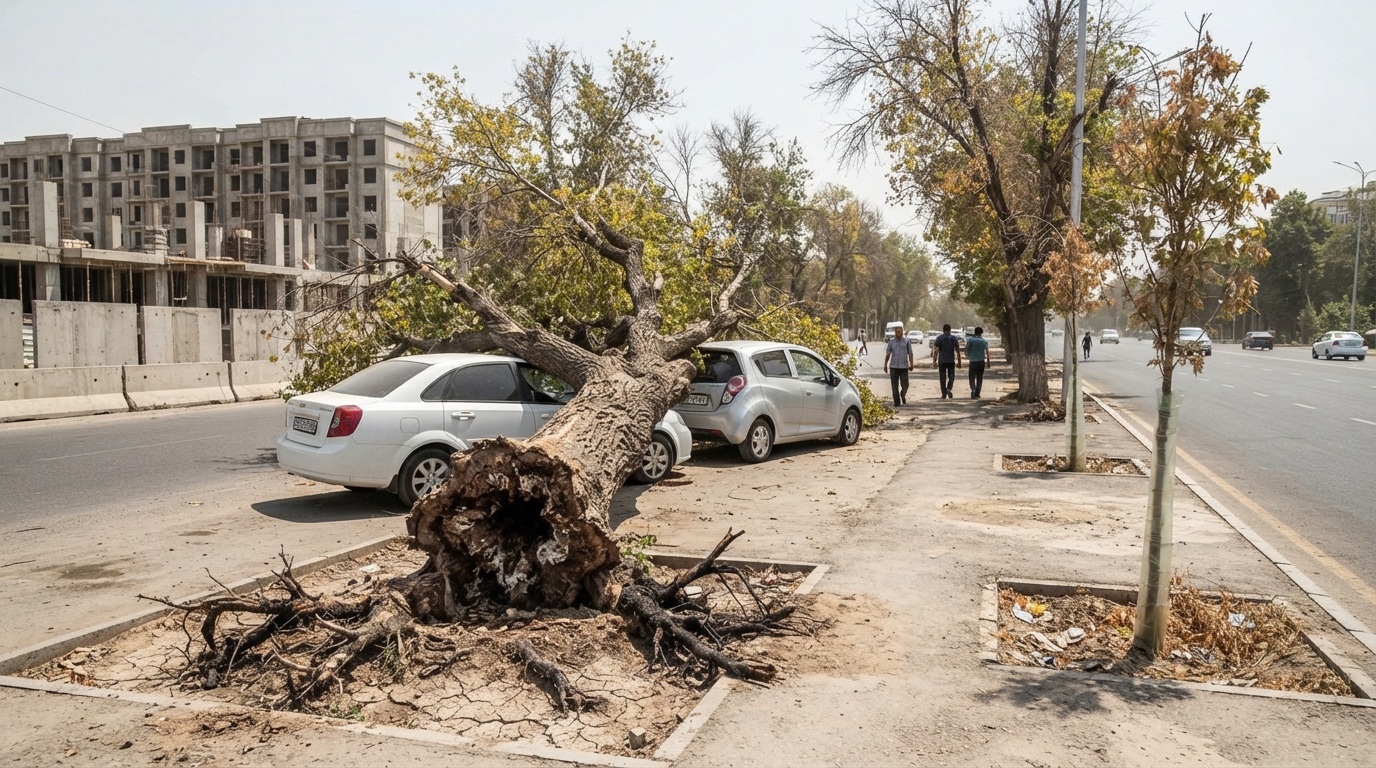
“The city's greenery is in poor condition.” Why are trees breaking and falling in Tashkent?
On September 2, a large tree collapsed onto two cars near the Palace of Forums in Tashkent. Two years ago, a similar incident occurred in the Chilanzar district, resulting in the death of a 1-year-old girl.
At that time, it was determined that the tree's roots had been exposed due to excavation work carried out to repair water pipes, and it fell because it could not support its own weight; a criminal case was also opened.
So, are trees falling frequently in the capital? What is the reason for this? What measures should be taken to improve the greenery of Tashkent? Gazeta discussed the topic with dendrologist Atirgul Kholmirzayeva.
— Atirgul opa, first of all, thank you for agreeing to the interview. If you remember, a young girl died as a result of a tree falling in Chilanzar. At that time, you also gave an interview alongside officials, stating that the tree collapsed because its roots had rotted and it could not support its dry branches. Did a similar situation occur this time at the Palace of Forums? And, in general, why do you think trees are falling?
— Recently, there have indeed been many instances of trees falling in our city. One of the reasons for this is related to the decrease in the groundwater level. Because trees used to feed on these groundwaters. Construction has also increased in cities. Everyone is building high-rise buildings, and making parking lots and shops underneath them.
Because of this, where does the groundwater go? It goes to the deeply excavated areas. The flow of underground water has changed. Consequently, the gradual drying of trees around it is observed due to the lack of water. The plant gets thirsty, it wants to drink water. When there is no water, the color of its leaves fades, and it dries up from the root part. If trees rot at the root part or lack water, they start drying from the top.
Lately, I have never seen ash trees becoming so diseased. In general, a fungal disease has appeared in our trees. The underground water flow has changed and its level has decreased, and on top of that, they are diseased, yet we are not treating them. There is no practice of treating diseases with chemical preparations. All of this combined is causing our trees to collapse.
Recently, an ash tree fell in front of the State Conservatory of Uzbekistan building and crushed two cars. Many specialists looked at it but could not explain why it broke. Then they called me; if you look, the tree fell to the ground and its trunk shattered into pieces. It had dried up from lack of water. Meanwhile, the middle part of its trunk remained wet and white.
Its roots had rotted, and the bark part of its trunk had rotted away. On top of that, the upper part of the tree trunk had become hollow, which indicates that it was pruned incorrectly. Every year, rain and snow water entered that hollow, rotting it from the inside as well. It turned into vermicompost, became damp, and turned into mold. White mold. Not everyone understands this.
Last year in December, a large plane tree fell in the Shaykhontohur district. They called me there too; when I arrived, water had drained from under its roots, and its taproot was completely dried up. If you touched the thick small roots around it with your hand, they would snap with a crackle.
The tree leaned to one side and fell onto a person's car, and that person also died. Even then, I told officials that trees that pose a danger and threat to human lives must be removed. In any case, no one is paying insurance for this.
— How do you assess the health of trees using Tashkent as an example?
— Currently, the condition of the greenery is poor. Previously, there used to be irrigation ditches, but now these ditches have disappeared. When water flowed through these ditches, the trees were irrigated to some extent. On top of that, due to construction in the city, dust accumulation on the leaves has increased.
If you look at the Botanical Garden, it is the same situation. That is why we spray water on them twice a week to wash them. Why? Because as dust settles and its layer thickens, it turns into soil and makes the leaf heavy. This prevents the photosynthesis process from taking place.
Then the leaf turns yellow, and since the trees are not receiving water, they shed their leaves to preserve themselves. If you look at some trees in Tashkent, some have leaves, while others do not.
— How can one identify that trees have reached a dangerous state?
— It can be known when they start leaning to one side. Some year in the Shaykhontohur district, there was a large poplar tree with a single base but two trunks.
A bark beetle called the longhorn beetle settled between its two trunks and ate away the inside. The inside became completely empty, and it leaned over. In such a situation, the tree bark cracks, it sheds its bark, and after that, whether you want it or not, it starts to dry up.
Now, there are many reasons for this. For example, the increased number of harmful insects. Because of them, trees are becoming diseased. If you look, a pitch-black fungal disease is sitting on our mulberry trees as well. They need to be studied, and treatment needs to be established.
The juniper pest, which was never encountered before, has also appeared. The condition of all junipers is bad. No nutrients are being provided either. Lack of water, lack of nutrients, and the increase in diseases are tormenting the poor trees even more. After so many situations are observed, whether you want it or not, the greenery dries up.
On top of that, the anomalous heat is also hard on the trees. There are no dense forests or microclimates like in previous times. Previously, water reservoirs were made in each of our parks, and people swam in them. Now they are gone almost everywhere; they have all been reduced, destroyed, and only small spaces are left. Yet, the city needs a microclimate.
— How effectively do you think the monitoring system is working in this regard? The Ministry of Ecology spoke about conducting an inventory of trees across the entire city.
— At one time, that inventory took place. I know well where and how monitoring was conducted; in those times, our parks were also large. We conducted the inventory of trees together. The level of greenery was high. At that time, ecology officials also worked well.
The best park was the one named after Gafur Gulyam (now Dream Park). If you see it now, its condition is critical. They have cut down all the large trees inside. It used to be a dense forest. Then they did the same with the National Park. That was also a very large place. Now it has become small. The trees we initially inventoried are gone.
— What do you think is the reason for such a negative relationship of officials and people in general with greenery?
— In my opinion, the system needs to be made differently here. During the coronavirus period, everyone was locked up at home. Then, after the illnesses passed, people rushed to greenery. That is, people need oxygen, greenery. People's eyesight has also declined, pregnant women lack oxygen, and children are even being born with disabilities. I believe the decrease in greenery is the cause of this.
— In recent years, the practice of transplanting trees from construction sites to other locations has been applied in Uzbekistan. How correct do you think it is to transplant multi-year valuable trees?
— Under Uzbekistan's conditions, transplanting mature trees leads to their drying up. I also said this in my interview to the media when this practice started, namely in 2023–2024. At that time, 100 trees were transplanted in Tashkent, of which 99 dried up and only one survived. I considered this method incorrect, and I am still of this opinion.
They are unable to perform the transplantation correctly. After transplanting, the soil under the trees must be loosened, and nutrients must be provided on time. On the contrary, they are not cared for properly here. As a result of this, the trees go into stress. They are living organisms just like humans.
In the transplantation practice, certain roots of the trees are cut. If you cut the roots, the tree suffers. Anti-stress agents must also be poured. In addition, transplantation has its own season. In autumn, plants go to sleep, and vegetation ends. If done in this season, most of them will survive.
In summer, during hot days, the probability of drying up is high. Even if you transplant young trees in summer, they may dry up before they recover. You see, the air temperature is rising very high. Under such conditions, evaporation from tree leaves is also greater.
Therefore, if there is no water and care, it is highly likely they will dry up. A wider area around the tree must be excavated, and the root must be taken with its soil. After that, good care is necessary; only then can the greenery survive.
— What percentage of transplanted trees can survive?
— Previously I would say 10 percent, now it is even less. Even young trees are drying up. And there is no need to even speak about large trees. This is a dangerous practice.
— How exactly should they be transplanted, can you explain this in detail?
— In Europe, they do this using a special machine. It transplants it itself, then takes it to the designated place and plants it. They brought such machinery to us as well. The machine lifts the entire tree with its roots and digs it out. The thing is, while lifting, it shakes off the soil from the tree's roots.
A tree with exposed roots catches a cold before reaching its destination. Because of this, it starts to dry up. In my opinion, before planting, the roots should be watered well, and after that, a wider area around it should be targeted and dug out. After going through these processes, it can be planted.
Furthermore, when transporting from one place to another, the root must be wrapped well with its soil. The rest then depends on care. It is enough to pour water on time and provide nutrients on time. Transplanted trees must be monitored for 3 years. Because within these 3 years, there is a possibility of them drying up.
— Currently, the practice of concreting around trees at construction sites in the capital is also observed. What is your attitude towards this?
— This is incorrect. The root of a tree breathes; having concrete around it, or even turf, can interfere with this. In the case of turf, if water is poured, the root will not be able to evaporate part of its moisture. Because ground with turf differs from ordinary loose soil ground; it is compressed. Since it cannot release its moisture, this leads to root rot.
And concrete heats up. Along with it, the root of the tree also heats up, which leads to drying. When they concreted the ground in the Chilanzar district, they put cellophane bags on several trees. What happened then? The trees died. How can they breathe through cellophane?! It also heated up and dried the trees.
The more open ground you leave around the tree, the better. Of course, ammophos and potassium must be sprinkled. When it rains or snows, it reaches the roots as nutrients along with the water. Currently, let alone sprinkling, they are not even leaving space around them. Everywhere is concrete.
— Currently, a policy of urban greening and afforestation is being carried out. But it seems that special attention should be paid to one thing. That is, every region still has its own unique climate. What kind of trees do you think should be chosen for each region?
— Firstly, we indeed need to green the areas. There are many open spaces in Tashkent. Secondly, since there are open spaces, sun-resistant trees must be planted. Anomalous heatwaves have started here. There must be drought-resistant plants. Once they grow, they will start providing shade. A microclimate will appear.
Currently, they have planted chestnuts along the roads. They burn in the sun. They burn bright red and then shed their leaves. Usually, chestnuts are planted in cooler, shady areas between houses. They bloom very beautifully; they are beautiful trees.
In my opinion, oak, plane, ash, maple, and catalpa can be planted in the open spaces of Tashkent. They tolerate the sun. All of these are sun-loving, drought-resistant plants. By planting trees that can withstand the heat first, other beautiful plants can then be placed among them. Then they would not burn and dry up. They will just grow.
They are planting many junipers and shrubs along the roadsides. But I also consider this incorrect. Why? Because they are planting expensive trees. All of these trees are imported from abroad. It is difficult for them to adapt to our climatic conditions.
As a result of this, their decorative qualities deteriorate, and over time they dry up. It is better to plant them not along the roadsides, but in shady, cool, sheltered places. Then they will survive, and people will also enjoy their beauty. Generally speaking, it is correct to plant selectively depending on the regions.
First of all, large trees that provide shade should be planted. Next to them, small shrubs can be planted. I mentioned above that they are planting shrubs along the roadsides. They are burning in the heat. And in winter, the frost hits them. On top of that, when it snows, they sprinkle salt on the road, and then that salt mixes with water and flows towards the trees. The plants are also drying up because they feed on salty water.
As for the regions, in the valley side, all trees will just grow. It may be more difficult mainly in Karakalpakstan, Bukhara, Khorezm, and Navoiy. Because there, along with the heat, it is a salty and sandy region. Plants that can withstand sand, cold, and heat must be planted there. If planted according to the location, it is easy to propagate them.
— What do you think needs to be done to heal and increase greenery in cities?
— First, we must start caring for the existing trees. We cannot do without providing nutrients on time, loosening the soil underneath, and shaping them. They have all grown tall and long. The top branches have dried up. The dry ones must be shortened.
Once shortened, the tree will also thicken. After thickening, its shade will also be greater. Vertically grown trees are breaking because they cannot support their weight. If water has drained from under them, they are falling. If love is given to all of them, it will be good.
— Atirgul opa, thank you once again for agreeing to the interview. We hope our conversation will be useful to many.
— Thank you too.