

Tashkent and Baku: From Closeness of Peoples to Alliance of States
The editors contacted Bakhtiyor Mustafayev, Deputy Director of the Institute for Strategic and Interregional Studies under the President of the Republic of Uzbekistan, for comment on the results of Azerbaijani President Ilham Aliyev's visit to our country. "Leaving aside the formal protocol of the state visit, what was its main political outcome? Can we say that Uzbek-Azerbaijani relations have reached a new level? Absolutely. The formal […]
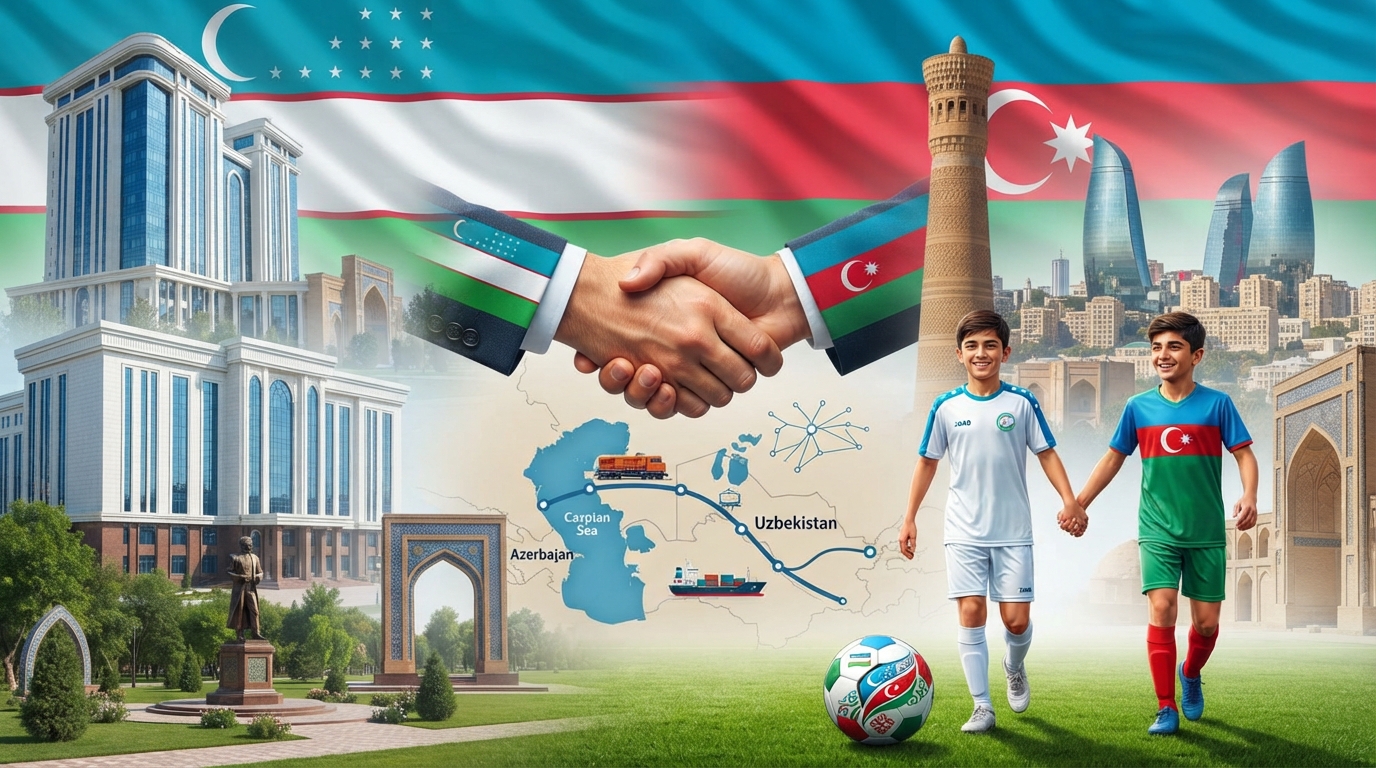
Tashkent and Baku: From Popular Affinity to State Union
The editorial board asked Bakhtiyor Mustafayev, Deputy Director of the Institute for Strategic and Interregional Studies under the President of the Republic of Uzbekistan, to comment on the results of Azerbaijani President Ilham Aliyev's visit to Uzbekistan.
– Putting aside the formal protocol of a state visit, what was its main political outcome? Can we say that Uzbek-Azerbaijani relations have reached a new level?
Absolutely. The ceremonial welcome at the Kuksaroy residence, the guard of honor, and the national anthems of the two countries underscored the exceptional status of the visit. However, its historical significance is determined not by the ceremony, but by its political content. The private talks and the third meeting of the Supreme Interstate Council covered the entire spectrum of strategic partnership and alliance relations. The signing of the Treaty of Eternal Friendship not only expanded the legal framework but also cemented at the highest political level the quality of relations that had already developed in practice. Therefore, President Shavkat Mirziyoyev's remarks about the historic nature of the visit should be perceived not as a mere formality, but as a precise description of the moment.
I would define the essence of the current stage as the materialization of an alliance. Relations are no longer measured solely by the frequency of meetings or the scale of statements. Their true measure is the ability to translate political closeness into concrete decisions and projects. The President of Uzbekistan formulated this principle with utmost clarity. Every aspect of the strategic partnership must be translated into tangible actions. This is precisely the logic demonstrated by the visit.
The package of documents themselves is also indicative. Along with the Treaty of Eternal Friendship and the decision of the third Council meeting, agreements on cooperation in pensions, culture, and tourism were signed. A program to increase trade turnover to one billion dollars by 2030 and a practical action plan in investment and trade were adopted. Cooperation programs between the Ministries of Foreign Affairs and Justice for 2027–2028 were approved. A memorandum on canine cooperation and protocols establishing twinning between Urgench and Khankendi, Bukhara and Lachin, and Urgench and Nakhichevan were also signed.
This is not a collection of disparate documents, but an architecture of cooperation – from high-level politics and macroeconomics to departmental interaction and direct city-to-city ties.
Finally, the visit was based on serious institutional preparation. It was preceded by a meeting of the Intergovernmental Commission, the work of the Business Council, and the Forum of Regions. This month, the khokims of Tashkent, Bukhara, and Namangan regions visited Azerbaijan. This is fundamentally important. The alliance has ceased to be solely a dialogue between leaders and has become a multi-level system of relations. It is precisely this system that is sustainable and does not depend on the circumstances of a single visit.
**– The economic agenda of the visit appears to be quite broad. What distinguishes this from a mere list of intentions, and what place does Azerbaijan occupy in Uzbekistan's foreign economic strategy?**
The main difference is the shift from a general willingness to cooperate to managed economic cooperation. Over the past five years, mutual trade has tripled. However, the parties went beyond simply acknowledging this dynamic and adopted a program of specific measures to increase trade turnover to one billion dollars by 2030. Thus, the target ceased to be a political wish and became a measurable commitment enshrined in an official document.
The structure of cooperation is no less important. The project portfolio covers energy, geology, the chemical industry, construction, finance, and agriculture. During the launch ceremony of joint projects, the leaders launched initiatives in banking, the production of modern building materials, the creation of educational institutions, the construction of gas station infrastructure, large tourist and residential complexes, the processing of mineral resources, and the development of horticulture. This is no longer trade based on the simple formula of "seller-buyer," but the formation of joint production, investment, and infrastructure ties.
The Joint Investment Company, established several years ago, deserves special attention. The mechanism already exists, and the capital has been secured. Now the key question is how intensively it is utilized. The call to more actively utilize the company's capabilities indicates that the parties see it not as an auxiliary tool, but as a growth hub for the new project portfolio.
There is another distinctive feature – the regional dimension. The visits of the khokims of Tashkent, Bukhara, and Namangan regions to Azerbaijan demonstrate a desire to unlock the potential of cooperation not only at the capital but also at the regional level. When economic ties simultaneously encompass energy, finance, agriculture, construction, and the regions, the entire structure gains additional strength. The dynamism of one area can support the partnership while another slows down.
**– For Uzbekistan, the issue of transport connectivity is of strategic importance. What role does Azerbaijan play in this logic, and why does this area extend beyond bilateral trade?**
Azerbaijan possesses a quality of particular strategic value for Uzbekistan. It occupies a key position in the Trans-Caspian Corridor system. For a landlocked country consistently expanding its foreign trade geography, transport connectivity is not a technical issue, but a prerequisite for economic sustainability.
That's why the agreement to jointly develop the Middle Corridor, improve the efficiency of logistics infrastructure, and stimulate transportation should be viewed more broadly than just a transportation agenda. It's about the two countries' ability to connect the spaces of Central Asia and the South Caucasus, transforming their geographic location from a constraint into a development resource.
Here, the specific nature of Uzbek-Azerbaijani relations is particularly noticeable. Political trust makes it possible to discuss not just individual routes, but connectivity as a long-term shared interest. Economic projects imbue this interest with practical content, and coordination on the Middle Corridor elevates the partnership to a level whose significance objectively exceeds the scope of bilateral trade.
**– Economic considerations typically overshadow the humanitarian agenda. However, it was particularly prominently featured in the visit's program. What does this say about the nature of relations between Uzbekistan and Azerbaijan?**
This demonstrates that our relations are built not only on shared interests, but also on the deep affinity between our peoples. Economic agreements create mutual benefit, while humanitarian projects foster mutual recognition, trust, and a sense of belonging. Thanks to this foundation, cooperation becomes a shared heritage.
A striking example is the new campus of the Nizami National Pedagogical University of Uzbekistan in New Tashkent. Built on 40 hectares, it is designed to accommodate 20,000 students and includes dormitories for 5,000 students. A five-story academic building with 12,000 students and a modern laboratory complex have already been erected in the first phase, and a museum exhibition dedicated to the legacy of Nizami Ganjavi has been created on the grounds. Here, the power of vision is particularly evident. The name of the great Azerbaijani poet is entering the educational environment of Uzbekistan not as a mere commemorative inscription, but as part of a vibrant intellectual space.
The establishment of the "Azerbaijan" Park in New Tashkent, covering a 4-hectare site, has a similar significance. This initiative is fundamentally reciprocal. During President Shavkat Mirziyoyev's visit to Baku, a capsule was laid in the foundation of the future "Uzbekistan" Park, covering an area of 4.5 hectares, on the grounds of the "White City," where the architectural forms of our country's historical monuments will be recreated. Such symmetry has become a rare and very precise language of humanitarian diplomacy. Every gesture of friendship receives a fitting response on the partner's soil.
The proposal to produce a joint feature film about the literary legacy of Nizami Ganjavi and Alisher Navoi fits seamlessly into this logic. Here, a shared civilizational code is translated from the realm of formal formulas into a cultural product understandable to a wide audience. This fall, Azerbaijan will host the second Forum of Rectors of Leading Universities, creating a regular platform for student and faculty exchange.
I call all this a long-term infrastructure of trust. Commercial performance depends on the market, while a university campus, a park, a film, and connections between faculty and students become part of people's daily lives and last for decades. This is the depth of the humanitarian agenda and one of the key features of the Uzbek-Azerbaijani alliance.
**– Co-hosting the 2027 FIFA World Youth Championship is a spectacular event, but does it risk remaining merely a sporting event? How can it be transformed into political and social capital?**
FIFA's very decision to host the FIFA World Youth Championship simultaneously in Uzbekistan and Azerbaijan already demonstrates the accumulated level of trust. A tournament of this scale requires the highest level of coordination and the willingness of both countries to shoulder their shared responsibility to the international football community.
But the leaders rightly did not limit the project's scope to stadiums and matches. The agreement to develop a large-scale program, "Two Countries – One Championship," also includes cultural and youth events. This transforms the sporting event into a platform for communication between a new generation – a generation that will shape the nature of future relations in economics, diplomacy, science, and culture.
There is also an international dimension. The joint championship allows Uzbekistan and Azerbaijan to demonstrate the ability of Central Asia and the South Caucasus to act as a unified organizational space and host high-level events.
But the main point lies elsewhere. University exchanges, joint creative projects, and the championship contribute to a unified youth agenda. Alliances have a future only when they are carried forward not only by state institutions but also by new generations of citizens. The horizontal ties that emerge today will prove stronger tomorrow than many declarations.
**– Which episodes of the visit most accurately convey the special nature of the relationship between the leaders and peoples of the two countries – and what is the main conclusion to be drawn from its results?**
First and foremost – the mutual awarding of the highest state awards. President Ilham Aliyev was awarded the highest state award of Uzbekistan, the "Oliy Darajali Dustlik" Order, and President Shavkat Mirziyoyev was awarded the highest award of Azerbaijan, the "Heydar Aliyev" Order. Over the years, this order has been bestowed upon French President Jacques Chirac, Emir of Kuwait Sabah al-Sabah, Turkish President Recep Tayyip Erdogan, and Italian President Sergio Mattarella. The inclusion of the Uzbek leader in this list clearly demonstrates the importance Baku attaches to relations with Tashkent.
This episode was given particular depth by Shavkat Mirziyoyev's words about Heydar Aliyev—a leader who dedicated his life to serving his homeland and laid a solid foundation for the future development of Azerbaijan. It was emphasized that he held Uzbek history and culture in great love and did much to bring the two peoples closer together. This is no longer a matter of obligatory politeness, but an expression of sincere respect for the historical memory of a partner.
It's also symbolic that the visit didn't end in Tashkent. In Bukhara, the heads of state and their spouses toured the ancient city's historical landmarks, as well as the region's potential in digitalization, light industry, and electrical engineering. Thus, the official program acquired a personal and regional dimension. The partner saw the country not only through the negotiating table, but also through its cultural heritage and contemporary creative momentum.
The main conclusion is crystal clear. Uzbek-Azerbaijani relations are strong due to a rare combination of political will, economic complementarity, and human closeness. Their foundation lies not in situational advantage, but in mutual respect, a shared historical and cultural foundation, and a willingness to reciprocate trust with trust. This is precisely why the Treaty of Eternal Friendship is so natural. It doesn't promise to create closeness in the future, but rather gives a name to the closeness that the two countries have already demonstrated through concrete actions.