

Tariff hikes prompted residents of Uzbekistan to save electricity and gas — Ministry of Economy and Finance
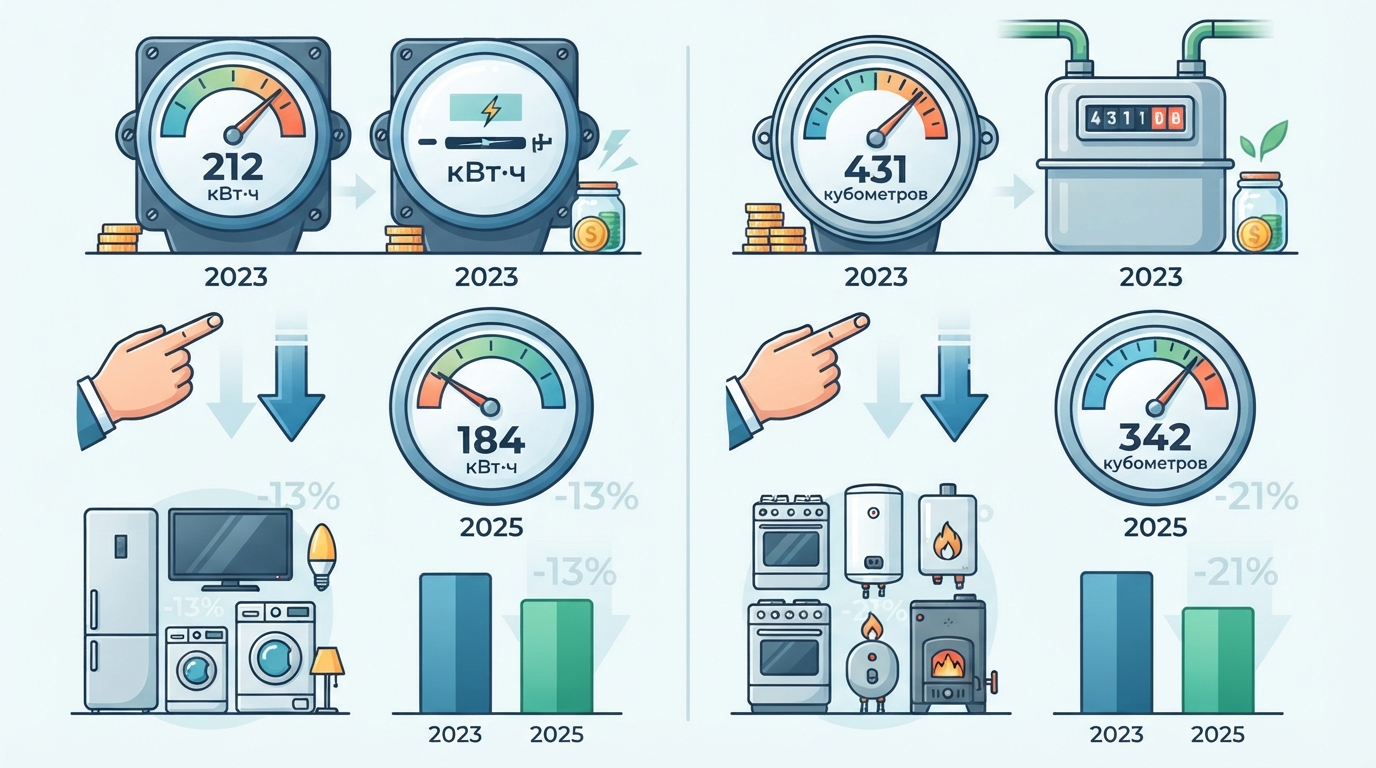
Following the tariff hike, residents of Uzbekistan have begun consuming energy resources more economically, stated Deputy Minister of Economy and Finance Khurshed Mustafayev. According to his data, from 2023 to 2025, average monthly electricity consumption per subscriber decreased by 13%, and gas consumption fell by 21%.
Tariff increases have forced residents of Uzbekistan to save electricity and gas — Ministry of Economy and Finance
Average monthly energy consumption per subscriber in Uzbekistan decreased in 2023–2025 following tariff increases. Deputy Minister of Economy and Finance Khurshed Mustafayev announced this at a press conference on October 14.
According to him, the average monthly electricity consumption per subscriber fell from 212 kWh in 2023 to 184 kWh in 2025. Thus, the reduction amounted to 28 kWh, or approximately 13%.
Over the same period, average monthly natural gas consumption dropped from 431 to 342 cubic meters per subscriber — a decrease of 89 cubic meters, or nearly 21%.
"This means that as a result of timely tariff reforms, the population is gradually beginning to realize this, transitioning toward savings and energy efficiency. A culture of energy consumption is being formed among the public. We consider this a very positive trend," Mustafayev said.
At the press conference, Jamshid Abruev, Deputy Director of the National Social Protection Agency, also explained the reasons for transitioning from the previous system of tariff subsidies to targeted support for the population.
According to him, prior to the start of the reforms, tariffs for the public had not been revised for several years, even though energy prices and energy enterprise expenses were rising. The difference was essentially covered by the state budget and the enterprises themselves.
Abruev noted that during the coronavirus pandemic and the subsequent economic recovery, this approach made it possible to support all consumers regardless of income level. However, it later became clear that households with high energy consumption benefited from it the most.
"During the period of economic stabilization, higher-income families who consume more benefited the most under such a mechanism. Low-income families, on the contrary, derived less benefit from it," the deputy director explained.
As an example, he cited the distribution of electricity consumption among subscribers.
"Subscribers consuming more than 200 kWh of electricity account for 30% of the total. At the same time, they account for 71% of all electricity consumed. It turns out that previously, more subsidies were directed to higher-income populations," Abruev stated.
According to him, this is precisely why the authorities decided to gradually move to differentiated tariffs and targeted compensation for the expenses of needy families.
In particular, low-income households are covered by a mechanism compensating for the difference between the base and increased tariffs for additional volumes of electricity and natural gas.
As the deputy director reported, over 470 thousand families have used this support over the past year and a half. A total of 156 billion soums was allocated for compensation.
As a reminder, starting May 1, 2024, Uzbekistan introduced basic consumption norms for electricity and natural gas, as well as differentiated tariffs depending on the volume of resource usage.
For electricity, the base norm was set at 200 kWh per month. For natural gas, it was set at 500 cubic meters during the heating season and 100 cubic meters during the remaining months.
From June 1, 2026, tariffs were revised again. For most residential consumers, the cost of electricity within the first 200 kWh is 650 soums per 1 kWh. Volumes from 201 to 500 kWh are billed at 900 soums per 1 kWh.
The cost of natural gas within the base norm is 1,100 soums per cubic meter.