

"Tabassum", which is revealing the talent of youth with mental disabilities: what skills are they being taught?
The "Tabassum" inclusive workshop in Tashkent is providing young people with mental disabilities not only with the opportunity to learn a trade, but also to take steps toward an independent life. Pottery, and even candle and soap making, are being taught there. "We need to unlock their hidden talent," says the tutor. Gazeta report.
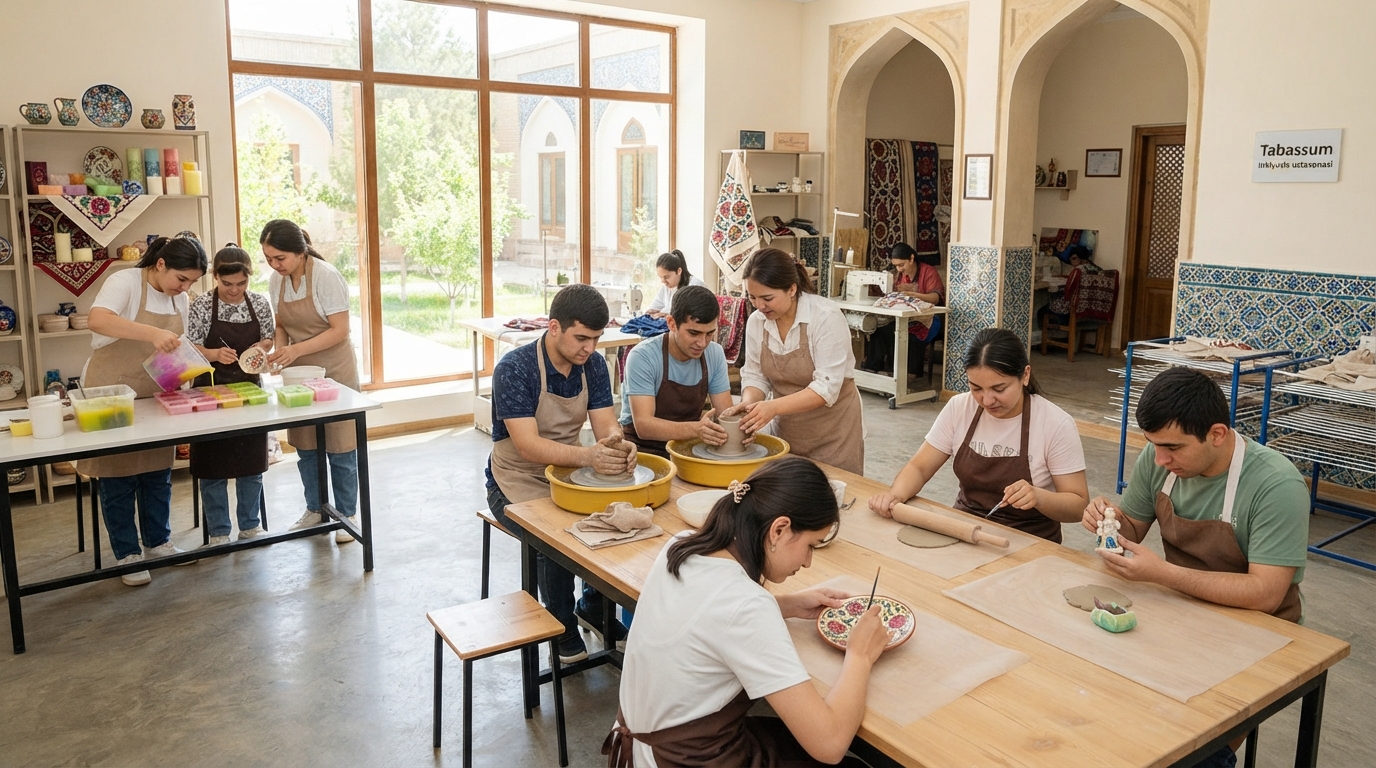
"Tabassum," Revealing the Talents of Youth with Mental Disabilities: What Skills Are They Being Taught?
It has been a year since the "Tabassum" inclusive workshop, designed for youth with mental disabilities, began its operations in Tashkent. In the 20-seat workshop, young people are mastering crafts such as pottery, sewing, candle and soap making, as well as daily life skills. Through this, they are gaining the opportunity to showcase their abilities and actively participate in society.
According to Shahnoza Ikromova, head of the "Tabassum" project and the NGO "Quyoshli Olam" (Sunny World), the main goal is to prepare young people for independent life and create conditions for them to earn an income through their own labor in the future.
The idea for the project stemmed from Ikromova's personal experience. After her son Rustam was born, she had to gradually establish processes related to his development. As the boy neared graduation from school, she began to think about what awaited him next. Traveling to various countries as an international disability expert, Shahnoza Ikromova studied the experience of inclusive cafes and workshops in Turkey, Japan, and Belgium. This prompted her to make plans to create a similar system in Uzbekistan.
According to Ikromova's observations, the daily routine of some young people with disabilities who graduate from school is limited to sitting at home, watching television, or using a phone. This negatively affects their development and independence.
"Every person must live with some purpose in life," she says.
Thus, in 2022, the "Tabassum" center was established. Rehabilitation and multi-functional services are provided there. Sessions are conducted by speech and special educators, as well as on self-care and life skills. In cooperation with the National Agency for Social Protection, day care, rehabilitation, and early intervention services have been launched for children under 18.
After the center moved to a new building, the "Tabassum" inclusive workshop was opened in August 2025 with a UNICEF grant in the 100-year-old building where it had operated for several years. A team was formed, professional masters were recruited, and partnerships were established with the Association of Hotels and the Association of Volunteers.
The workshop employs masters who graduated from the Kamoliddin Behzod National Institute of Fine Arts and Design, along with two tutors. Currently, about 15 young men and women visit regularly. The workshop has the capacity to accommodate 20–25 children at a time.
Cups, brooches, keychains, and interior items are made here. The products are sold in three hotels in Tashkent, as well as through Human House. A QR code is placed on the items, allowing people to see how they were made.
"We want people to buy the things our children make not out of pity, but precisely because they are high-quality products," says Shahnoza Ikromova.
According to Ikromova, the workshop's current main expenses are not fully covered by product sales. At present, the project is also supported by grant funds. The grant is intended to cover raw materials, masters' salaries, and brand development costs. Therefore, the workshop management plans to strengthen cooperation with the tourism sector and organize paid masterclasses for tourists.
Additionally, the "Tabassum" workshop joined the "Yangi Kun" (New Day) project, launched by presidential decree. It is aimed at preventing people over 18 with mental disabilities from being left isolated at home. Functional diagnostics of the participants are conducted here, and state subsidies are expected to be allocated for them.
"We do not want to remain dependent on grants and subsidies. Our ultimate goal is to bring the workshop to a good business level, increase the sales of our products, and pay those children who have reached the level of masters through employment contracts," says Shahnoza Ikromova.
According to her, this goal cannot be achieved overnight. However, in the very first year of the workshop's operation, the building was renovated, and the work process and product sales were established. Now the main task is to turn the workshop into a self-sustaining system and enable young people to become independent through their own labor.
Naima Umarova is responsible for welcoming children at the workshop, working with parents, assisting teachers, and supervising classes. According to her, in the initial period of the workshop's operation, both parents and staff worried about how the children would adapt to the new environment. However, over time, the children's quick integration and their efforts to complete assigned tasks inspired confidence.
"Whatever task you give them, even if they cannot do it, they never say, 'I can't.' They say 'okay' and try. Seeing this makes us happy," she says.
Along with crafts, children at the workshop are taught skills needed in daily life. They participate in cleaning, cooking, and yard work. It is enough to show a newly arrived child the work once—afterward, they join the others and begin participating in the process.
"We thought we would have to take a separate approach based on their diagnosis. In reality, if you show them, they get involved themselves. When they struggle, they call out 'teacher,'" says the tutor.
Children practice here from 10:00 AM to 4:00 PM. Hot meals are prepared daily. At the end of the day, some children leave independently, others are picked up by their parents, or staff members see them off in taxis.
Naima Umarova believes there should be more such workshops in Uzbekistan. This is because it is incorrect to define a child's potential solely by their diagnosis.
"Shahnoza opa always says, 'Do not judge the children on your own, saying this one can do it, and that one cannot. Everyone has a hidden talent; we just need to unlock it.' Based on this principle, we do not tell a child who cannot perform a task 'do not come.' Because their interest might lie in another direction: some like working with clay, some like coloring, and others like yard work," she says.
According to her, children who grasp things well are involved in helping others. This strengthens their sense of self-worth and makes them feel like needed individuals. In nearly a year, along with the children's skills, the quality of the products they prepare has also changed significantly.
"If you saw the first mugs we made, there is a big difference compared to the current ones. Today, our products have improved to a very good level. When we go to exhibitions, looking at how it was before and how it is now, I say, 'We have grown tremendously,'" says Naima Umarova.
For her, these changes mean not only that product quality has improved, but that the children can do something with their own hands, see the results of their labor, and begin to believe in their own potential.
Products made at "Tabassum" are mainly sold through corporate orders and the tourism sector. According to project manager Yelena Turayeva, companies are focusing on local products as their interest in supporting social projects grows.
"Instead of ordering from some Chinese factory, companies are focusing on local projects like ours and supporting us with their orders," she says.
The project cooperates with several hotels in Tashkent, and negotiations are underway with hotels and tourist shops in Bukhara and Samarkand. The next step is to expand to tourist destinations like Khiva.
She notes that payment systems pose a problem when establishing sales in the regions. While payments via QR codes using Uzbek cards are accepted in Tashkent, the ability for tourists to pay on the spot with Visa or Mastercard is not yet fully functional. Employing a separate salesperson in each region would require additional expenses.
According to the manager, there are also plans to establish a tourist spot within the workshop itself. Visitors will be able to familiarize themselves with the product manufacturing process, try making a mug or a plate, and purchase finished products. Additionally, an Uzbek teahouse will be organized, creating an opportunity for the young men and women in the workshop to test their waitstaff skills.
"Waitressing is also one of the directions where they can express themselves," says Turayeva.
She notes that exhibitions are also of great importance in selling and promoting products. The workshop participates in tourism and handicraft exhibitions, involving its own masters in the sales process. Children like Rustam and Bobur are learning to work with customers in addition to making products.
"The volume of production increased after we bought a kiln. After purchasing the kiln with the support of the Sterling Foundation, while previously 10–15 mugs were prepared per week, now the number has reached 50–70. The plan is to bring this figure to 150 per week. Brooch production has also increased from around 150 two to three months ago to up to 800 per week. We have just received the kiln and are in the process of setting up production. This is a good result for us," says Turayeva.
Nilufar Tukhtayeva
My daughter Jannatoy is 20 years old. We have been coming to "Tabassum" since October 2025. It has been three years since she finished school, and she was very bored at home. I searched many places, and also applied to the neighborhood committee and government agencies, to find out where to take my daughter and what kind of clubs to involve her in. Finally, we found "Tabassum" through social networks.
Jannatoy.
After she started attending here, a big change occurred in Jannatoy. Previously, she had fallen into depression regarding life, but now her outlook has changed, and every day she is happy and rushes to come here. She speaks highly of her teachers and, coming home, excitedly tells us what she made during the day. She loves this place so much that she does not want to miss a single day. Even when she does not feel well, she says, "I must go, they are waiting for me."
For me, "Tabassum" is not just a place to pass the time, but a place where children develop and express themselves. My daughter became interested in cooking and pottery here. Previously, she had no interest in such activities. Therefore, I consider "Tabassum" a center of love and miracles. Both my daughter and our family are very grateful to everyone at the workshop.
My son Rustam is 18 years old. We have been coming to "Tabassum" for two years. Previously, he was stuck at home, and then people at school recommended this place. Since he arrived, a big change has occurred in him: now he gets up by himself in the morning, comes happily, and does his work without anyone's help. Our relatives also watch his work and support him. Most importantly, he has begun to feel his responsibility here. Having work to do every day is preparing him for adult life.
If not for "Tabassum," I cannot even imagine where I would take my son. Ordinary workplaces are not suitable for him; he needs special attention. Here, the children are under constant supervision, surrounded by love and attention. We also go about our day with peace of mind.
For me, "Tabassum" is a place that embraces children who have been left without attention. Here, every child has their own responsibility and task. Seeing my son develop as an independent individual over two years makes me very happy.
My son Asliddin is 19 years old. It has been a year since we started coming to "Tabassum." Before that, my child sat at home, was very bored, and did not know what to do. At first, he was not interested in this place, but after two or three months, he adapted and began making various items. Now he comes happily in the morning, and even on Saturdays, he says, "I will go." His mood has also improved significantly, and he has become calm; he does not get as nervous as before.
Currently, he is making small hearts and pomegranates, and he continues what he has learned at home. When his teacher Naima sent a video of him working, I was surprised myself—he was rolling out the clay and cutting it with a mold on his own. We are very happy that our child's time is spent meaningfully.
If not for "Tabassum," I cannot imagine what our life would be like. Previously, I always had to be with him and look after him. Now, I bring him in the morning and go about my own business in peace during the day. For me, "Tabassum" is a place opened with the future of children with special needs in mind, giving them love and opportunities.
I have known Shahnoza opa, the head of the workshop, since my daughter Muazzam was born. For the first time, they gave us her number at the screening center. Later, we worked with specialists at the "Umnichka" center. Currently, Muazzam is receiving inclusive education at School No. 324 in Shaykhontohur, and we have been coming to "Tabassum" since last year.
Significant changes occurred in my daughter here. While initially she completed tasks with the help of her teachers, now she understands what needs to be done herself and works independently. She also learned to roll out clay to the required level and make various shapes using molds. Her teachers are also pleased with her ambition. Most joyfully, Muazzam fell in love with pottery.
Here, she also adapted to the team and is learning to help her peers. She also warmly welcomes newly arrived children and helps them as much as she can. This change in her is very pleasing to me.
Workshops like "Tabassum" are extremely necessary for such children. This is because places where appropriate conditions and attention are shown are still scarce. I brought my daughter here with the intention that she would learn some craft and find her interest. And she fell in love with pottery.
It is difficult to describe "Tabassum" in one word. Here, children are as free as they are at home, surrounded by love and care. The teachers do not differentiate among them; they treat each of them like their own child. Perhaps that is why the children quickly get used to this environment and begin to feel free.