

Switzerland awarded Ig Nobel Prizes for research on kissing, underpants in soil, and silent urinals
Switzerland was awarded Ig Nobel Prizes for research on kissing, underpants in soil, and splash-free urinals
On September 3, the laureates of the 2026 Ig Nobel Prize — an award for research that first makes you laugh, and then makes you think — were announced in Switzerland. Among the honored works were studies on kissing in humans and animals, the behavior of people from upper social classes, the smell of teenagers, and even the creation of a splash-free urinal.
The ceremony took place in Zurich and marked the 36th annual awards ceremony. This year, the prizes were distributed in ten categories.
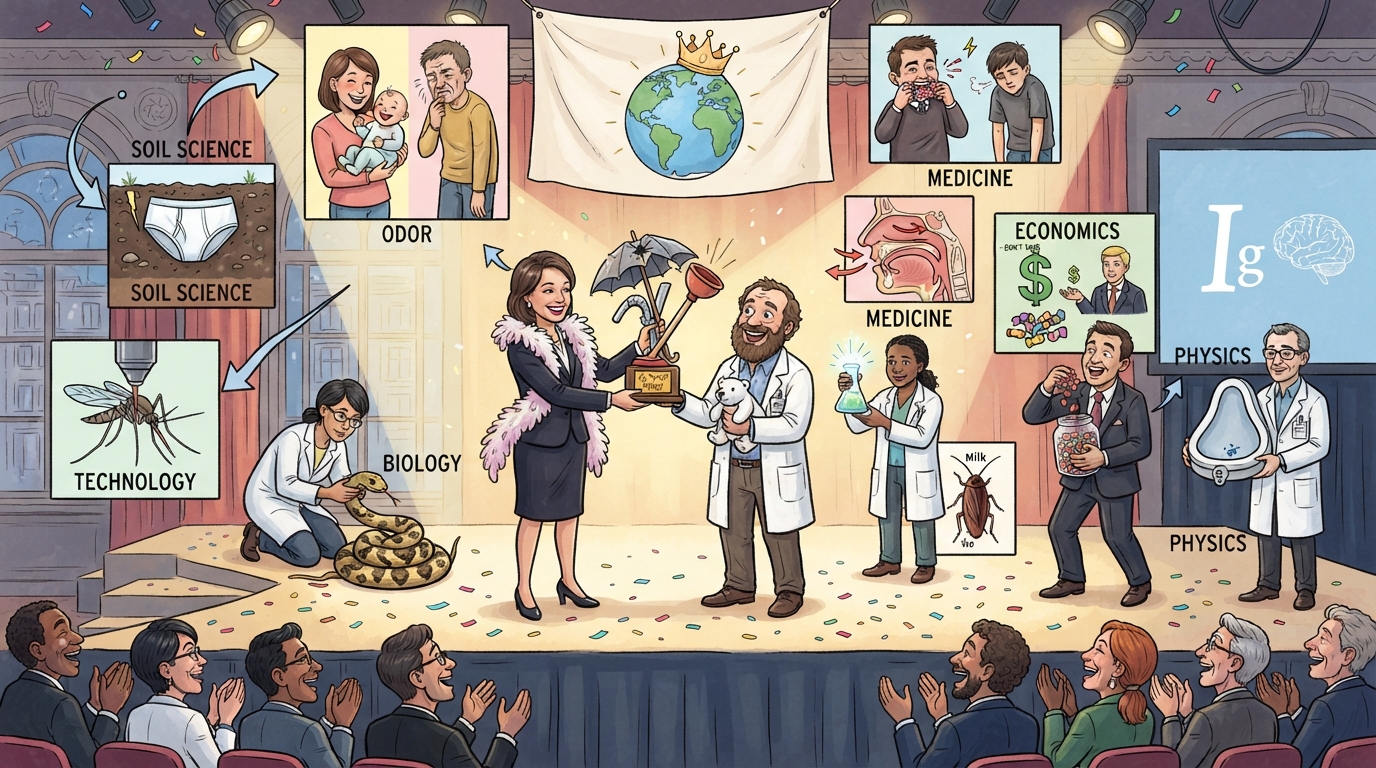
The prize in biomechanics was awarded to Matilda Brindle, Katherine Talbot, and Stuart West for their attempt to formulate a more precise definition of a kiss. They investigated oral contact in ants, birds, polar bears, and humans, and derived criteria to distinguish a kiss from other forms of contact.
The scientists defined a kiss as a "non-aggressive interaction between individuals of the same species, involving directed mouth-to-mouth contact with movement of the lips or mouthparts and without the transfer of food."
In the field of physics, researchers who used theoretical calculations and experiments to try to create a splash-free urinal were recognized. The authors of the work studied fluid dynamics and proposed an approach based on physics and differential equations.
The prize in soil science was awarded to scientists from Switzerland, the Netherlands, and Germany. They buried a thousand identical pairs of underwear in more than 25 countries, and dug them back up two months later. The experiment was used to assess soil health based on the degree of fabric degradation.
Another unusual award went to the authors of a study on odors. Scientists from Poland, Germany, and Sweden collected data showing that parents usually rate the smell of infants as pleasant, whereas the smell of teenagers is perceived significantly worse.
The biology prize was awarded to researchers who studied the defensive behavior of venomous snakes. To do this, they repeatedly and carefully stepped on different parts of the snakes' bodies, conducting experiments at different temperatures and times of day to find out which actions provoke a bite.
In the technology category, the laureates were scientists from China, Canada, the USA, and Egypt. They used mosquito proboscises as high-precision nozzles for three-dimensional printing. The development was named "necroprinting."
The chemistry prize went to an international group of researchers for studying protein crystals formed in the body of a viviparous cockroach. It turned out that the proteins from its "milk" contain about three times more energy than the proteins in cow's milk.
The economics prize was awarded to scientists from the USA, Mexico, and Canada for studying the link between social status and unethical behavior. In one of the experiments, participants were primed to feel a high or low social status, and were then offered to take candy from a jar, after being warned that it was intended for children. Those who were primed with a sense of higher status took, on average, about twice as much candy.
The medicine prize was posthumously awarded to Japanese physician Tokuji Unno for a study on the aerodynamics of nose-blowing, published back in 1977.
The peace prize was awarded to researchers from the USA, Argentina, and Australia for studying why people value friends who can act harshly toward their detractors. The scientists concluded that people may prefer such friends because they perceive their willingness to confront enemies as a demonstration of loyalty and protection of their own interests.
The Ig Nobel Prize is awarded for unusual scientific research that is intended not only to entertain, but also to make people think about familiar phenomena from an unexpected perspective.