

Milk of viviparous cockroaches and how to blow your nose correctly: Winners of the 36th Ig Nobel Prize announced
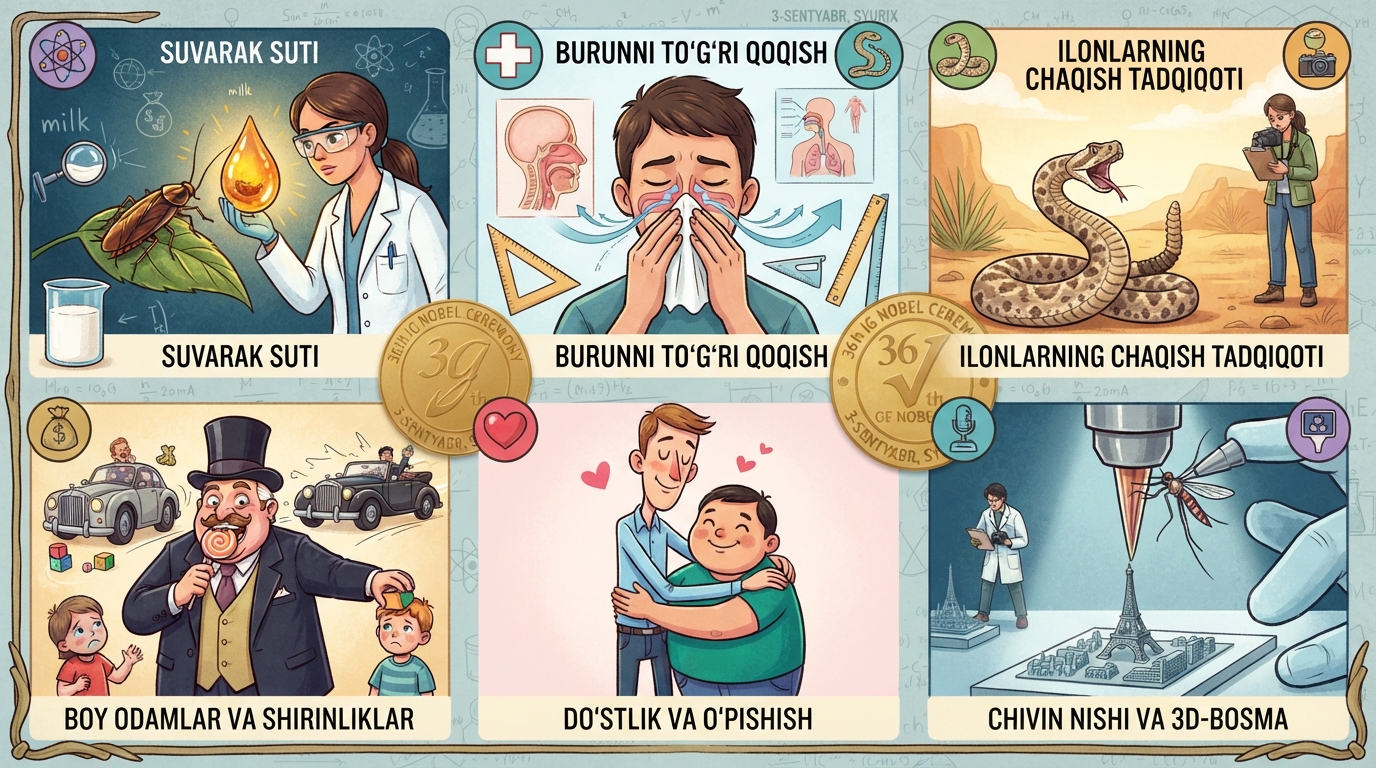
Live-bearing cockroach milk and blowing the nose correctly: Winners of the 36th Ig Nobel Prize announced
The 36th Ig Nobel Prize for unusual research was presented to its recipients on September 3 in Zurich. Among this year's winners are studies on cockroach milk, how to blow the nose correctly, and even the tendency of wealthy people to eat children's sweets.
The prize was established in 1991 by the Annals of Improbable Research magazine and has been awarded in 10 scientific categories since 1999.
The prize in Chemistry was awarded for research dedicated to the milk of live-bearing cockroaches. Scientists found that cockroach milk contains about three times more energy than cow's milk. The study focused on a milk-like substance that some species of cockroaches produce to feed their young.
In the Medicine category, the work of Japanese researchers dedicated to correct and safe methods of blowing the nose was recognized. The authors of the study tried to examine the process of blowing the nose not just as a daily habit, but also from the perspective of aerodynamics and human health.
The awards did not overlook unusual research on animal behavior either. In the Biology category, scientists studied when and under what conditions venomous snakes bite more. According to the results of the study, it was found that snakes bite more during the day and when the weather is hot, and young snakes as well as female snakes have a higher tendency for such behavior.
The prize in Economics was awarded for research dedicated to the behavior of wealthy people. It provides evidence that representatives of the high-income class are more prone to breaking social norms, driving dangerously, not yielding to pedestrians, and even eating sweets intended for children.
In the Biomechanics category, kissing between humans and animals was studied scientifically. The researchers attempted to explain this process not only from a physical but also from an evolutionary perspective.
Additionally, in the Technology category, a group of scientists from four countries who studied the possibilities of using mosquito needles in ultra-precise 3D printing technology was also awarded.
The Peace Prize went to researchers who found that friends who dislike different things and different categories of people may value each other more.