

Studying is more expensive than getting medical treatment: where Uzbeks spend more money
According to the National Committee of the Republic of Uzbekistan on Statistics, during the first seven months of 2026, the volume of services in the field of education amounted to 27.2 trillion soums, increasing by 18.4% compared to the same period last year. For comparison, the volume of services in the healthcare sector reached 13.9 trillion soums, showing a growth of 15.3%. Thus, the volume of educational services turned out to be approximately […]
Studying costs more than medical treatment: where Uzbeks spend more money
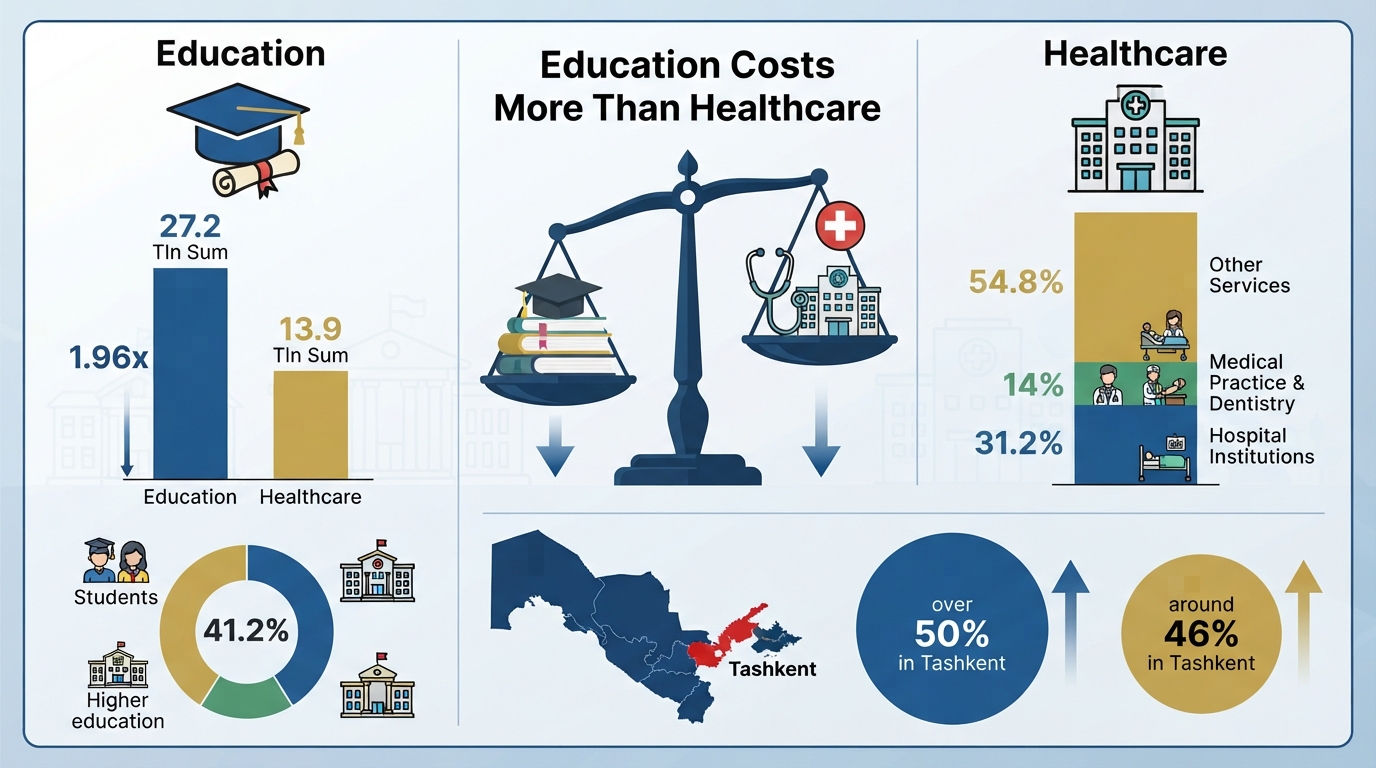
According to the National Statistics Committee of the Republic of Uzbekistan, during the first seven months of 2026, the volume of services in the field of education amounted to 27.2 trillion soums, which is 18.4% more than in the same period last year.
For comparison, the volume of services in the healthcare sector reached 13.9 trillion soums, increasing by 15.3%.
Thus, educational services turned out to be approximately 1.96 times larger in volume than healthcare services. The difference was about 13.3 trillion soums.
The main contribution to the education market is provided by higher education. It accounted for 41.2% of the total volume of educational services.
In other words, out of every 100 soums generated by the educational services market, about 41 soums come specifically from the higher education sector.
In healthcare, the market structure looks different. Services of hospital institutions accounted for 31.2% of the total volume.
Another 14% came from medical and dental practice services, while other healthcare services accounted for 54.8%.
Thus, almost 55% of the medical services market is formed by areas that are not directly related to hospital care, medical practice, and dentistry.
These data show not only the difference in the scale of the two social markets. They also point to a high concentration of educational and medical services in the capital: a significant portion of the corresponding demand and supply is concentrated precisely in Tashkent.
The capital accounted for 14.5 trillion soums of educational services — more than half of the total volume in the country.
In healthcare, Tashkent accounted for another 6.4 trillion soums of services rendered.
In other words, the capital's market generates about 53% of the national volume of educational services and around 46% of healthcare services.